


A dog sits inside An old carriage being pulled by a horse across a field in Wisconsin. The Dalmatian sits next to his owner Susan Keating, who has a firm grip on the brown reins. Keating is a multiple title winner in the world of carriage racing, and God willing, her dog will be too. The Dalmatian has only one job: to sit next to her and behave well. In this competition, the pair is essentially judged on how good the dog is. And if you know dogs, you know that work isn’t always the easiest for them.
The ride goes smoothly until about halfway through the arena. Some ducks, probably spooked by the crowd of people and horses, begin running across the yard within the track. Keating’s Dalmatian shifts in his seat and eyes the ducks. And then the dog suddenly shoots out of the carriage and chases after the ducks. It’s game over for Keating.
Keating and her Dalmatian compete in the carriage dog class of the Villa Louis Carriage Classic in Prairie du Chien, Wisconsin. It is one of the largest carriage driving competitions in the entire classic carriage sector and one of the most coveted titles. More than 125 participants drive through on the Friday after Labor Day, with their horses and carriages in tow, for three days of friendly sports.
Carriage racing is a genteel and well-mannered sport. Villa Louis carriage classic
Although the idea of a carriage driving competition conjures up images of riders whipping horses from a two-wheeled chariot as they fly around a race track at breakneck speeds, the Carriage Classic – and all other driving competitions for pleasure – is nothing of the sort. It is a gentle pace that focuses on horsemanship, carriage qualities and curious moments when dogs ride in horse-drawn carriages.
However, that doesn’t mean there isn’t intense competition in carriage driving. It’s just another branch of the sport called Combined Driving Events (CDE).
“Many CDE people think that traditional carriage driving, where you ride around a ring at the same time as other competitors, is a bit boring,” says Hannah Polson, competitor, groom and organizer of the Lorenzo Driving Competition in New York. “They are used to galloping through a track and negotiating lots of sharp turns and various obstacles. Traditional carriage drivers sometimes think that the CDE people are a little too bold and aggressive. For lack of a better phrase, it’s too much like NASCAR.”
Drivers overcome obstacles that can change from year to year – like stopping at a bartender for a drink.
Both evolved from carriage driving in the Victorian era, when people traveled by horse and carriage dressed in their best clothes. Villa Louis organizer Mike Rider says competitions exist in part because the horse and carriage community feared that the skills needed to drive a carriage would diminish. But it’s also a way to hold on to tradition.
 Participants take on the task of preserving Victorian engineering. Kathleen Haak courtesy of Villa Louis Carriage Classic
“It’s a skill that very few people have,” says Rider. “Horses built this country. The factories that built cars were built by horses. Horses were the reason for the industrial revolution. They were the key to what made us who we are now. So I think it’s important to recognize the connection between good horses and horsemanship.”
The competition at Villa Louis enters its 43rd year in 2024 and continues these traditions with a little more individuality. Over three days, participants attempt to win ribbons (and no cash prize) for both main arena competitions and obstacle events.
The obstacle events are a bit tricky. In the cross country competition, participants drive their carriages through a simulation of a country journey, complete with clotheslines, water crossings, bridges and forest paths. The Timed Obstacle competition requires riders to navigate through cones without knocking off overhead balls. On the Gambler’s Choice course, riders overcome obstacles that can change from year to year – such as stopping to have a drink with a bartender or driving through hanging strips of fabric. There’s also the Reverse Psychology course, where riders overcome all the obstacles, then turn around and reverse through them.
It’s up to Oehlhof to calm him down before the big show – even if she’s just as nervous.
The main events in the arena are more traditional. They include seven classes: Reinsmanship, based on the rider’s performance; turnout based on appearance of driver, horse, carriage and tack; Working based on the horse’s performance; Drive and Ride, where you switch from driving to riding; Companions where the grooms can demonstrate their skills; Concours d’Elegance, where elegance is the focus. Then there is the Carriage Dog Class and another adorable event called the Picnic Class.
 The picnic portion of the event provides an even slower pace to the race. Villa Louis carriage classic
In the picnic class, participants take part in the arena and then have a picnic, judged by theme and food. Costumes are welcome. One year, Polson says, a competitor chose a bee theme. The driver was a beekeeper, the carriage was a beehive and the horse was a bee with wings. Rider says one of the participants this year hosted a German picnic at Villa Louis, complete with matching clothing, schnitzel and potato salad.
Jordan Oehlhof is a 15-year-old coachman who, as a beginner, cannot take part in everything. But on show day, she’ll have to deal with quite a fireball as she prepares for events like Turnouts and Working Class. Her horse, Dallas, is three-quarters harnessed and one-quarter saddled, and today he is anxious. It’s up to Oehlhof to calm him down before the big show – even if she’s just as nervous.
“It can cost you your award or knock you out of a spot in the rankings,” Oehlhof says of Dallas’ pre-show fears. “Working through that is one of the hardest things. It can be frustrating, but I can’t be mad at him because it’s not his fault.”
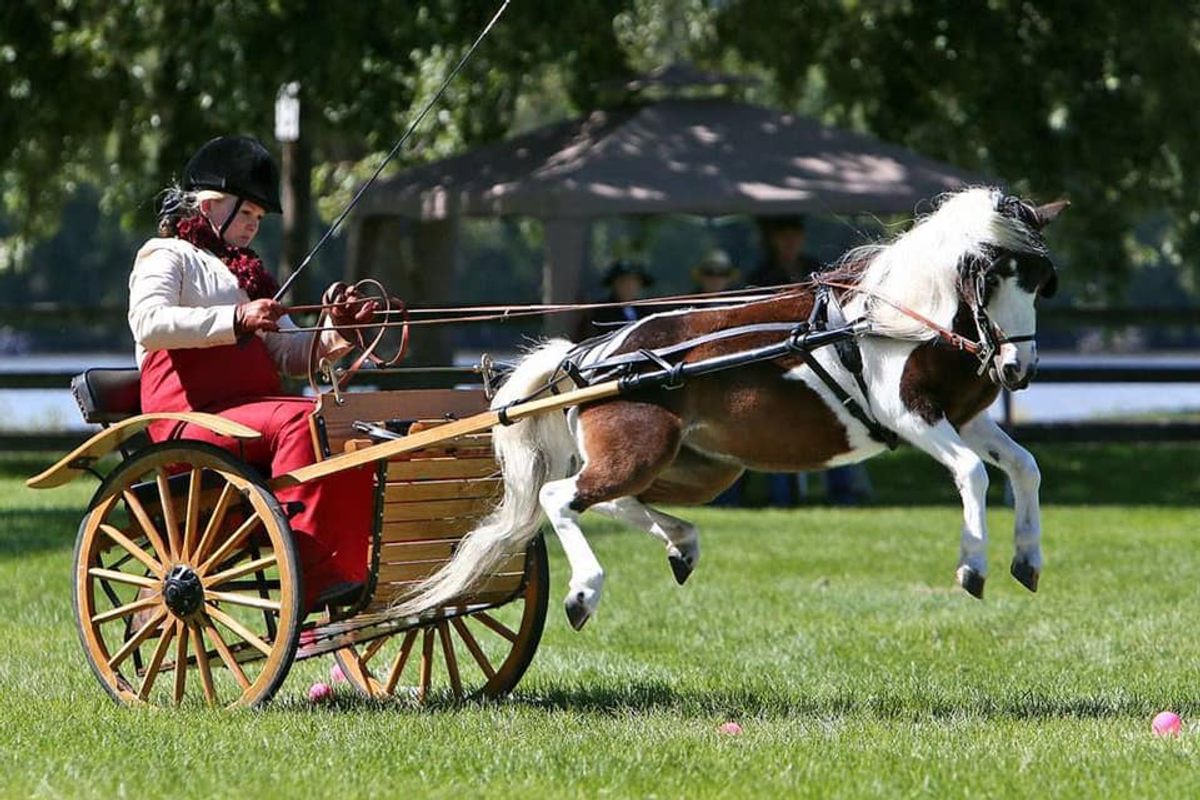 The horse’s personality must also be taken into account. Bob Mischka Photography courtesy of Villa Louis Carriage Classic
Luckily, Oehlhof knows a thing or two about calming horses. She trained for this carriage competition with her grandfather, who has been competing for about 30 years. After a few consoling words, Dallas Oehlhof heads into the ring for the Concours d’Elegance Class, under the watchful eyes of the judges and the rows of spectators scattered along the edges of the track.
As soon as Dallas and Oehlhof enter the arena, all traces of fear disappear. The duo walks around the ring, Oehlhof sitting bolt upright in the carriage and Dallas at a light trot. It’s an emotional moment for her.
“It makes me proud because the daily work pays off,” she says. “It’s cool to see how all this hard work can turn into something beautiful.”
Oehlhof and Dallas hit the jackpot, taking home the first place ribbon at the end of a week full of competitions, elaborate costumes and the occasional carriage driver.
Comments are closed.