


A A remote Bradford field rumbles as a rider, resplendent in a gleaming white shalwar kameez, pistachio waistcoat, turban and fan billowing upward like peacock feathers, gallops his horse toward a stake hammered into the ground. As the rider draws nearer to his target, he lowers a long spear, impaling the stake seconds later with a jubilant roar. “Four points, clap!” one commenter cries in Urdu.
Teams from across the country – all from the Pakistani diaspora – have gathered to compete in a national competition for neza bazi, or tent pegging. It’s a centuries-old cavalry sport known throughout South Asia and growing in popularity in Britain.
“Today you’d think so many British Pakistanis would have horses,” said Sohail Hussain, an enthusiast. “That’s just because we’re all from across the UK and Neza Bazi is slowly becoming popular.”
The majority of British Pakistanis in West Yorkshire are from Mirpur in Pakistan-administered Kashmir. Tent pegging is very popular in this community. “Back at home [in Pakistan], everyone has horses,” said Hussain. “My grandfather, my great-great-grandfather, they all loved horses.”
Some claim the origins of Neza Bazi date back to the times of Alexander the Great or the Persian Empire. But historical records point its practice to the Indian cavalry during the British Raj when it was used as a military tactic to attack tents.
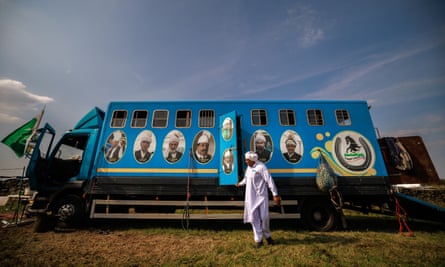 A horse transport decorated with the faces of former Neza Bazi champions. Photo: Joel Goodman/The Guardian
“They sent their first-rate team of tent-pegging cavalry to whip out the pegs, collapse the tents and sow confusion,” said Jem Pearce, a spokesman for the British Tentpegging Association. “They were all asleep and stuck in the tents. Then the infantry would finish them off and they wouldn’t know what hit them.”
Adopted by British cavalry in India, it eventually developed into a competitive sport played in colonial gymkhanas, elite clubs that were once the heart of British social life in South Asia.
Today, tent pegging is an established military sport practiced by the British Army’s Household Cavalry Mounted Regiment. It even has its own World Cup, with October 27th declared International Tent Pegging Day by the Oman-based International Tent Pegging Federation.
The sport requires skill and practice. “You have to improve your hand-eye coordination, your relationship with your horse,” Pearce said.
Hussain, a government fraud investigator, was introduced to the world of equestrian sport by a fraternity of British-Pakistani enthusiasts.
He rents a stable on a Batley farm that has a riding school for children, including those with physical and learning disabilities. There Hussain and his friends found support from the owners and a sanctuary for their horses.
After shoveling the manure out of his stable, Hussain happily tries to hug his horse Faaris (Urdu for ‘night’), a towering Spanish gelding. Summer has bleached Faaris’ normally glossy ebony fur to a deep brown. “I’ve always wanted a Lloyds TSB horse and I got one,” Hussain said, breaking into the opera’s aria from the commercial.
“Animals are beautiful creatures, you get so much peace from them,” he said. “The way the world is today and all the crazy things, you can come here and everything just slows down.”
When he first bought a horse three years ago, Hussain and his friends struggled to find stables on the many white British farms in neighboring Batley, an experience he says was tinged with subtle racism.
Archie Bland and Nimo Omer take you through the top stories and what they mean for free every weekday morning
Data protection: Newsletters may contain information about charities, online advertisements and content sponsored by third parties. You can find more information in our data protection declaration. We use Google reCaptcha to protect our website and the Google Privacy Policy and Terms of Service apply.
He laughs as he remembers a farmer with whom he had a stable who eyed him and his friends with suspicion. “A lot of us are hardworking guys and we have nice cars,” said Hussain. “But they thought we were doing drugs in there or something.”
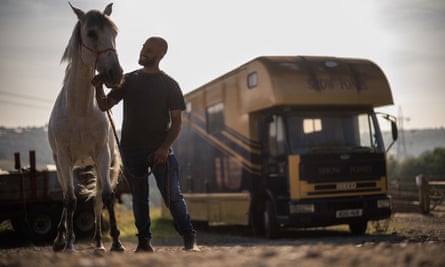 Faisal Qadir says horseback riding has improved his mental health: “It has put my mind in a better place.” Photo: Joel Goodman/The Guardian
For Faisal Qadir, horseback riding became a lifeline for his mental health when he tore his anterior cruciate ligament playing football almost two years ago. “Horseback riding has definitely helped me a lot,” he said. “It put my mind in a better place, and not just my mind. Physically, I’m much fitter.”
As he and a friend led a startled horse back into a trailer, Qadir added, “I’m so much calmer around horses.”
Qadir learned seven months ago from a group of British-Pakistani enthusiasts who were worried about his mental health. It was not only his Pakistani origins, but also the importance of horses in Saudi Arabia 1,400 years ago, when a burgeoning Islam emerged, that also drew him to horses and eventually to tent pegging.
“I didn’t know this sport existed,” he said. “The moment I saw what it was, I decided I had to be there.”
At the Bradford show, the horses, resplendent in gold-embroidered saddles and reins sewn in Pakistan, stamp restlessly on the ground as they prepare to canter. Hooves clatter to the sound of bells as some perform the Spanish trot to the sound of dhol drums and a tutni flute as the Union Jack, Pakistani flag and flag of Pakistan-administered Azad Kashmir flutter above the crowd.
“You could literally die in a split second playing this sport,” says Hussain. But for young British-Pakistani men like him, tent pegging is so much more than a sport. “It’s like I unlocked something in my DNA that I was supposed to do,” he said.
Comments are closed.