


International fears about the impact of the Russia-Ukraine war on an existing global food crisis appear to have abated in the seven months since Russia pulled out of a deal that allowed Ukraine to export grain to world markets.
Such complacency is misplaced and dangerous. The risk of exacerbating food insecurity through the use of grains as a weapon remains. It is worrying that such a risk even exists, given that blocking access to a staple food can have devastating consequences for innocent people and those who have nothing to do with the conflict.
The idea that access to food and other basic goods can be cut off to serve a country’s strategic goals at war is one of the most troubling contradictions of modern capitalist political economy. Yet it is rarely questioned in most political discussions.
Despite the relative stabilization of grain exports and prices, precarious food supplies have not disappeared. As respected Black Sea agricultural expert Andrey Sizov argues: “The calm on the grain export market is deceptive.” The risk comes from many sides.
In July 2023, a grain cargo ship is anchored in the Black Sea near the entrance to the Bosphorus in Istanbul, Turkey.
(Sercan Ozkurnazli/Dia Images via `)
Targets food vessels
On the one hand, Russia has added food ships to and from Ukraine to its list of potential targets, and Ukraine responded by warning of a similar attack on the Crimean Bridge, which connects Russian shipping lanes to key ports.
In addition, there is still a risk that Russia will deliberately slow down controls or restrict exports.
Finally, global grain prices have fallen in recent months, not least due to speculation and hedging on the financial markets.
Short-selling grain hurts farmers in Albania, Poland, Romania, Bulgaria, Hungary and Slovakia and also contributes to price fluctuations that impact countries already struggling with food insecurity.
This illuminates a broader fundamental problem with commodified food systems and with the financialization logic of neoliberal capitalism more broadly.
Read more: What is neoliberalism? A political scientist explains the use and development of the term
Most commentators on food security call for an end to the threat of disruption to grain harvests, a revival of the grain agreement, or a commitment to new agreements.
Others have advocated for a more controlled approach to prudent management of wheat stocks. Similarly, a team of food systems and security researchers worked together to identify recommended research priorities for addressing food security during extreme events.
However, these proposals are governance approaches that remain embedded in existing systems of political economy.
Flawed logic
More lasting solutions may lie in addressing the root causes of our unstable and inequitable commodity systems.
Fundamentally, the promise of our supply-and-demand capitalism is that those who want a good or service are willing to pay more for it. But this is illogical because those who want or need goods the most may not be able to pay the highest price for them.
The result of this flawed logic was that even the threat of disruption to grain supplies drove up prices and put populations in countries in Africa, the Middle East and Asia at risk of famine.
The financialization of everything, including basic needs, is just one mechanism of neoliberal capitalism and highlights the dangers inherent in converting basic needs into commodities.
Since the war in Ukraine, implied wheat price volatility has reached a peak that exceeds what we saw during the 2008 global food price crisis.
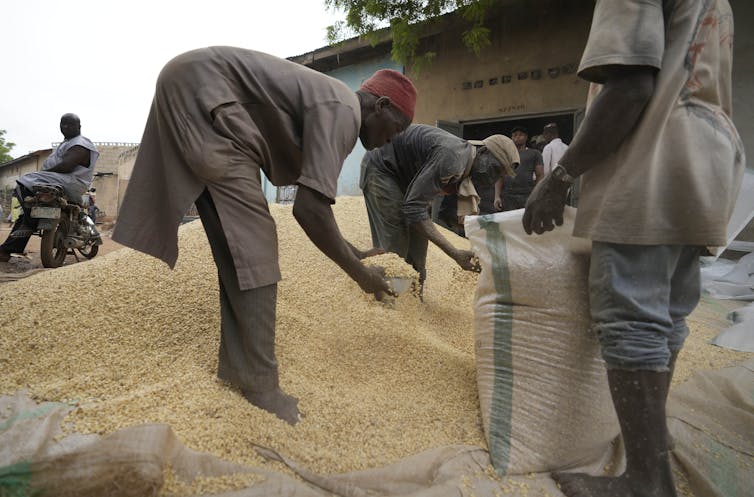
Men pack grains to sell at the Dawanau International Market in Kano, Nigeria in July 2023.
(` Photo/Sunday Alamba)
Financialization leads to speculation and hedging, which leads to price volatility in international grain markets.
Speculation multiplies the risk to food accessibility, as the mere perception of risk in financial centers like New York and London can lead to very real food shortages for millions of people. This, in turn, can trigger other crises, from violent social conflicts to mass displacement.
Throughout the Russia-Ukraine War, wheat provided hedging benefits to investors. The United Nations Conference on Trade and Development (UNCTAD) has recognized that this has exacerbated the current global food crisis.
Speculation underpins food insecurity
During the 2008 crisis, hopeful discussions and research by the G24 group of countries took place, focusing on the role of financial market speculation in causing food insecurity.
These conversations are again urgently needed to further examine the underlying influences of capitalism on food insecurity.
The newly released UNCTAD Trade and Development Report 2023 has again raised concerns about financial speculation and hedging. The report directly links food insecurity to corporate profiteering enabled by financial speculation in commodity markets.
But it failed to challenge the underlying political-economic organization of neoliberal capitalism, which has promoted the use of critical and life-sustaining goods as geopolitical pawns.
A forward-looking and more sustainable solution would be the complete decommodification of basic needs.
Decommodification is an achievable goal, but achieving it requires a critical examination of the entire political economy. Research shows that basic needs such as food can be supplied in a stable and sustainable manner. These discussions about alternatives to neoliberal capitalism are beginning to take place in prominent political areas.
The impact of the war in Ukraine on food insecurity is of course crucial, but there is more to it than that. The main problem is that capitalism allows food and other basic needs to become precarious commodities.
The current global food crisis may be caused by war, but the fuel is neoliberal capitalism.
Comments are closed.