
Could it be that the Fed’s mega-QE has created so much liquidity that tightening won’t work until that excess is burned through?


Financial conditions continue to ease: Credit markets reject Fed to ensure ‘higher for longer’ prevails? That would be funny.
By Wolf Richter for WOLF STREET.
One of the big surprises this year is that the Fed’s 5.5% interest rate and $1.1 trillion QT have not resulted in any meaningful tightening of financial conditions or slowing of the economy.
The Fed has been conducting a “tightening” exercise since early 2022 to “tighten” financial conditions, and these tighter financial conditions are then intended to make borrowing more difficult and expensive, which is intended to slow economic growth and deprive it of the fuel that drives inflation . “Financial conditions,” as measured by various indices, loosened a bit, and then loosened again. It’s almost funny.
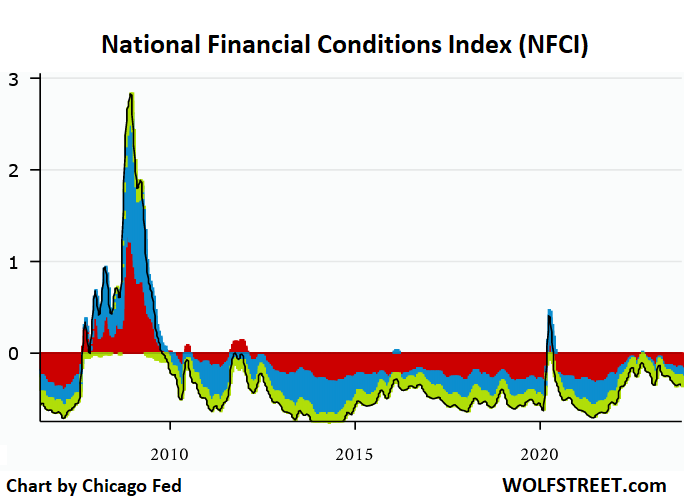
The Chicago Fed’s National Financial Conditions Index (NFCI) continued to ease rates, falling to -0.36 in the last reporting week, the loosest since May 2022, when the Fed was just beginning its tightening cycle. The index is constructed to have an average value of zero since 1971. Negative readings show that financial conditions are looser than average, and they have been easing since April 2023, after a brief period of tightening during the banking panic (chart via Chicago Fed). ):
In the chart above, you can see how financial conditions tightened in March 2020, but not for long – they were already loose again in May 2020, when the Fed showered the country with trillions in QE.
So despite the Fed’s rate hikes and QT, financing conditions are just as loose as they were when the Fed just started tightening in May 2022, and they are far looser than the long-term average, although they have become slightly less-challenging than during the free money era from mid-2020 to early 2022.
The NFCI long-term chart below shows what happens when financial conditions tighten so much that they stall the economy, as happened during the financial crisis. The increase in March 2020 is hardly noticeable in comparison.
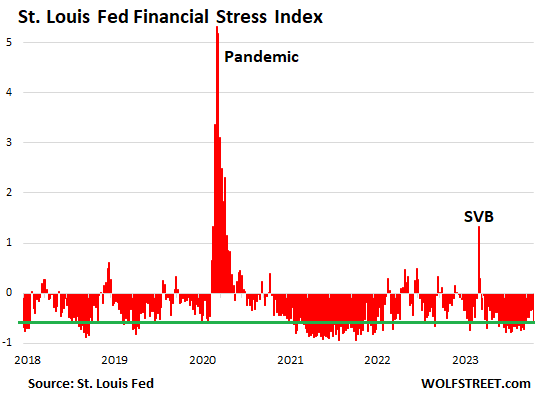
The St. Louis Fed Financial Stress Index takes a similar approach and measures financial stress in credit markets. The zero line indicates the average financial stress. Negative values mean a below-average financial burden. In the current week it fell to -0.56. The green line plots this current value over time, indicating that credit markets are still in la-la land.
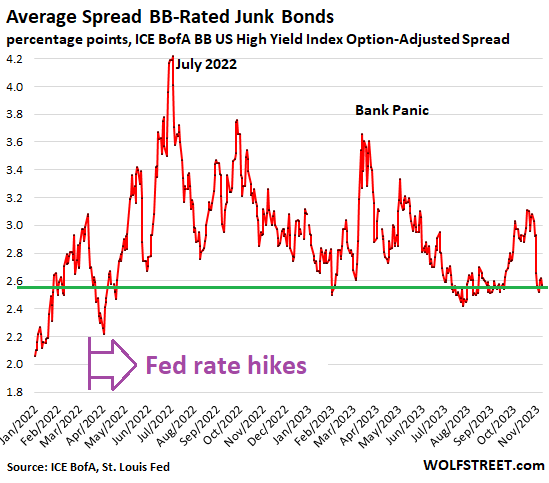
The spreads of BB-rated junk bonds are another measure of financial conditions. Corporate bond yields should rise or fall with government bond yields. However, a wider spread between the yields of these corporate bonds and the yields of government bonds suggests more restrictive financing conditions; A tighter spread indicates looser financial conditions.
The average spread of BB-rated bonds, the less risky end of high-yield bonds (my cheat sheet for corporate bond rating scales), narrowed further yesterday to 2.57 percentage points. So this is in the wrong direction in terms of what the Fed is trying to achieve.
Certainly some sectors are stressed and financial conditions in those sectors are tightened, for example in the office sector of commercial real estate, but the problems in the office sector have structural causes, including working from home and companies realizing that they don’t need all of these vacant ones Office space that they have been occupying for years and that they will never grow into.
And home sales have plummeted because potential sellers don’t want to miss out on the 40% to 60% price increase they enjoyed during the pandemic quantitative easing period; And buyers are simply laughing at these prices and wasting their down payment on all sorts of things and services, including travel and cars – new car sales rose 20% year over year in the third quarter, helping consumer spending.
And of course, major stock indexes have fallen since their peaks a few years ago. Significantly higher yields (lower bond prices) have put pressure on banks’ balance sheets and some have collapsed, led by fools who didn’t manage it properly.
But consumers are working in record numbers and earning record amounts after receiving the biggest wage increases in 40 years that will finally outpace inflation in 2023, and they are spending huge amounts of money and still manage to save some. We’ve affectionately and jokingly called them our drunken sailors here since at least March.
And companies, flush with cash from selling a flood of bonds at low interest rates during the Fed’s zero percent era, are investing, among other things, in a huge factory building boom. And they raised their prices, because that’s inflation, and they got away with it.
And the real drunken sailors, the people in Congress, throw trillions of dollars of easy-to-borrow money into the economy every year to stimulate growth and inflation.
So the Fed’s key interest rates, which rose from 0.25% to 5.5%, and its $1.1 trillion QT to date have failed to tighten financial conditions across the board and slow this trend.
Could it be... that so much central bank liquidity was created during and before the pandemic that, despite Fed tightening, financial conditions cannot be meaningfully tightened until that liquidity is used up?
The Fed alone, not counting other central banks, created, as Musk would say, $4.8 trillion within two years of printing giga-money; It has now removed $1.1 trillion of that via QT.
Given the amount of liquidity still available, could it be that it could take much longer and longer for financial conditions to tighten to the point where there is any chance of defueling inflation?
And that’s kind of funny Because if financial conditions do not tighten sufficiently to slow the economy and remove the fuel for inflation, and if it then turns out that this year-on-year decline in inflation rates was just a “head trick,” then a recovery will occur, Powell said he suspects the Fed will raise interest rates further. Powell made that clear. With credit markets still disappointed by the Fed, are they trying to ensure that the “higher levels for a longer period of time” prevail? That would be funny.
Do you enjoy reading WOLF STREET and would you like to support it? You can donate. I appreciate it very much. Click on the beer and iced tea mug to find out how:

Would you like to be notified by email when WOLF STREET publishes a new article? Login here.

Comments are closed.