


The prospectus presented by Instacart at the end of last week met with great enthusiasm and the hope of boosting the ailing IPO market together with the chip company Arm. The company’s shares are expected to start trading on the Nasdaq later this month.
The prospectus reveals that Instacart is one of the few profitable companies operating in the gig economy, which also includes companies like Uber, Lyft, and DoorDash. For the first half of the year, the company reported net income of $242 million, its fifth consecutive profitable quarter. Instacart ended 2022 with a net income of $428 million, compared to a loss of $73 million in 2021. However, most of the profit in 2022 — a total of $358 million — was at one attributed tax benefit.
2 view gallery
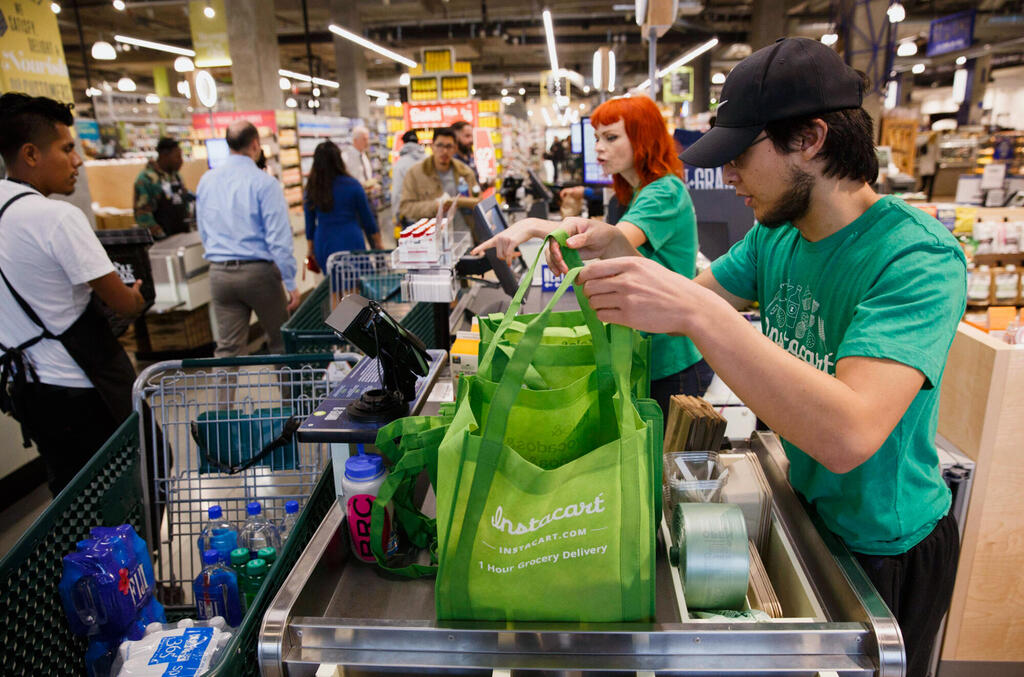
Instacart employees pack products at Whole Foods Los Angeles
(Photo: Patrick T Fallon/Bloomberg)
The past two years have seen a significant slowdown in technology company IPOs. Last year, just 100 companies valued more than $50 million were issued, compared to 397 companies in 2021. Instacart is expected to be one of the largest IPOs of the year in terms of market cap, probably the second largest after Arm, Japan-owned SoftBank also filed a prospectus last month and could reportedly be worth as much as $64 billion.
Approximately 9 million users per month
Instacart is in the grocery delivery business, so it’s mostly grocery. In recent years, however, the company has expanded its operations into pharmacy chains like CVS, convenience stores like 7-Eleven, and makeup and cosmetics chains like Sephora. Overall, the company has partnerships with over 5,500 brands across North America and over 80,000 stores representing 85% of the American market. According to the prospectus, the company has 7.7 million monthly orders averaging $317, over 9 million monthly active users, and about 600,000 couriers.
For the six months ended June 30, the company’s revenue was $1.48 billion, an increase of 31% compared to the corresponding period in 2022. Year-over-year, revenue increased 1.83 $1 billion in 2021 to $2.55 billion in 2022 Orders increased 18% from 223.4 million in 2021 to 262.6 million in 2022. In the first half, orders were to 132.9 million compared to 132.3 million in the same period last year.
According to Crunchbase, Instacart has raised $2.7 billion in 17 funding rounds since its inception in San Francisco in 2012. In March 2021, the company closed its latest funding round of $265 million from investors including Andreessen Horowitz, Sequoia Capital and D1 Capital Partners, for a record $39 billion. In December 2022, the company lowered its internal valuation to $24 billion and then to $13 billion. According to the prospectus, beverage giant PepsiCo is set to become a major investor and has already agreed to buy $175 million worth of shares in a private offering.
The company’s business gained momentum and notoriety especially with the outbreak of the coronavirus pandemic, when population demand for supplies from grocery stores and other small supermarkets surged. At the time, the couriers who worked for them called a multi-day strike and asked customers to delete the app after claiming it didn’t offer them minimal protection from the virus. They said the company does not provide them with disinfectants or masks and does not give those infected paid sick leave. In January 2021, as part of efficiency measures, some of the employees who joined this year were laid off.
Also, in 2022, it emerged that the company doesn’t protect its delivery drivers from customers tipping heavily to trick delivery drivers into speedy delivery, and then canceling the tip. In late 2022, the company also had to pay a $46 million penalty to California delivery drivers it classified as freelancers when they should have been classified as employees. In the first two years of the pandemic, Instacart experienced exceptional growth and hired thousands of employees. The inevitable downturn resulted in the company gradually laying off thousands of workers from the second quarter of 2022 and currently employs 3,486 workers. Accordingly, Prospectus-related administrative and general expenses decreased to $51 million in the most recent quarter, compared to $77 million in the second quarter of 2022 and a record $102 million in the most recent quarter of 2021.
Throughout the prospectus, the company emphasizes the size of the American grocery market, the huge potential for online shopping, and its commitment not to compete with the brands it works with. In fact, the advertising business is a central part of its activity and accounts for about a third of its turnover. Over the 2021-2022 period, advertising revenue grew from $572 million (31% of total revenue) to $740 million (29% of total revenue) in 2022 and from $327 million (29% of total revenue) in the first six months of 2022 to $406 million (28% of total sales) for the first six months of this year.
The person who approved the development of this revenue segment is the company’s CEO, Fidji Simo, formerly head of the Facebook app at Meta, where she worked for about a decade. Simo joined Instacart’s board of directors in January 2021 and was appointed CEO in July, replacing co-founder Apoorva Mehta, who was appointed chairman. Before vacating his seat, Mehta tried to sell the company to Uber and DoorDash amid slowing growth. His efforts met opposition from the board and eventually led to his resignation from the position.
2 view gallery

Instacart CEO Fiji Simon
(Photo: Bloomberg)
In the past two years, Instacart has acquired several artificial intelligence companies to help the company with dynamic pricing, improve the recommendation algorithm and allow brands to pay for product placement within the app. Not only do the acquisitions indicate a focus and desire to boost the ad business, but Instacart also cites this as a risk factor in the prospectus. While it’s almost inevitable for any tech company these days to rely heavily on advertising, this is not good news at a time when high inflation is causing companies to scale back their ad spending.
The timing of the IPO also raises questions. The current valuation of the company is significantly lower than in previous financing rounds. The company itself planned to go public during the tech sector’s heyday in 2020 and had reportedly already recruited Goldman Sachs to underwrite the offering, which was expected to be worth an estimated $30 billion. The offer fell through and instead the company raised private capital. In May 2022, it submitted a confidential prospectus for an offering planned for the final quarter of the year, but it was revealed in October that it was indefinitely postponing the move, apparently due to high volatility in the industry.
Despite the winding road to the IPO, and even though the company’s performance in terms of future profitability paints a complex picture, Instacart has reasons for optimism. Founded a decade ago, competitor DoorDash, which completed its IPO in May 2022, is currently trading at $32 billion despite reporting just one profitable quarter in all its years. Ditto for Uber, which just last quarter posted its first profit in 15 years and is valued at $93 billion.
Comments are closed.