
Vietnam’s youth are joining China’s trend of “lying flat” as wages stagnate amid a booming economy


A young woman wrote on the site: “I’ve only been working at my company for two weeks, but I already know every single drama from the last two years here. Should I quit my job?”
The work demands and cost of living in the city are oppressive, young Vietnamese workers told This Week in Asia.
Singapore director Anthony Chen on Breaking Ice, Lying Flat and Hong Kong
“I just came to town for work. Housing in Ho Chi Minh City is too expensive,” said 22-year-old Giang Phan. She works full-time as a designer – and part-time as an English teacher – and earns 13 million Vietnamese dong ($530) each month.
She limits her income to an unair-conditioned, 30 square meter room that she shares with another person.
“As soon as I open the door to my room, people who live in the same building come in and start talking to me. I don’t have to invite her either. They just go in confident,” Giang said.
Like Giang, many youth in big cities like Hanoi and Ho Chi Minh City opt for cheap accommodation because they want to focus on their careers.
Khanh Do, 22, a research assistant at a top university in Hanoi, rents a cheap apartment on the outskirts of the city for his monthly salary of 10 million dong.
“If you don’t have a lot of money, you shouldn’t want too many things,” Khanh said.
People at Aeon Shopping Mall in Ho Chi Minh City. The cost of living in big cities is crushing young workers. Photo: Shutterstock
Growth, but for whom?
In an economy aiming for 7 percent growth this year, the story for young workers is likely to be different, although economists say that may be falling short.
Hanoi is boasting of its success in attracting foreign direct investment (FDI), which rose 0.5 percent year-on-year in January-June, with tech giants from China moving to Vietnam to escape the impact of the crisis Trade war between the USA and China.
In 2022, more than $22 billion in foreign direct investment entered Vietnam, mainly from Singapore, Japan and China.
 Workers leave their workplace at Taiwan’s Ty Hung factory in Ho Chi Minh City. Photo: AFPIn September, President Joe Biden and Secretary General Nguyen Phu Trong strengthened US-Vietnam relations and promised more economic benefits to Vietnam.
But experts say Vietnam – which hopes to become a high-income developed economy by 2045 – needs to improve its productive capacity to avoid falling into a “middle-income trap” in the next decade.
There are 10.8 million employed Vietnamese aged between 15 and 24, accounting for 21.4 percent of the country’s workforce, local media VnExpress reported in May. According to the U.S.-based Economic Research Institute, factory workers earn an average monthly wage of 5.3 million dong ($220), and by 2028 that amount is only expected to increase by about $50.
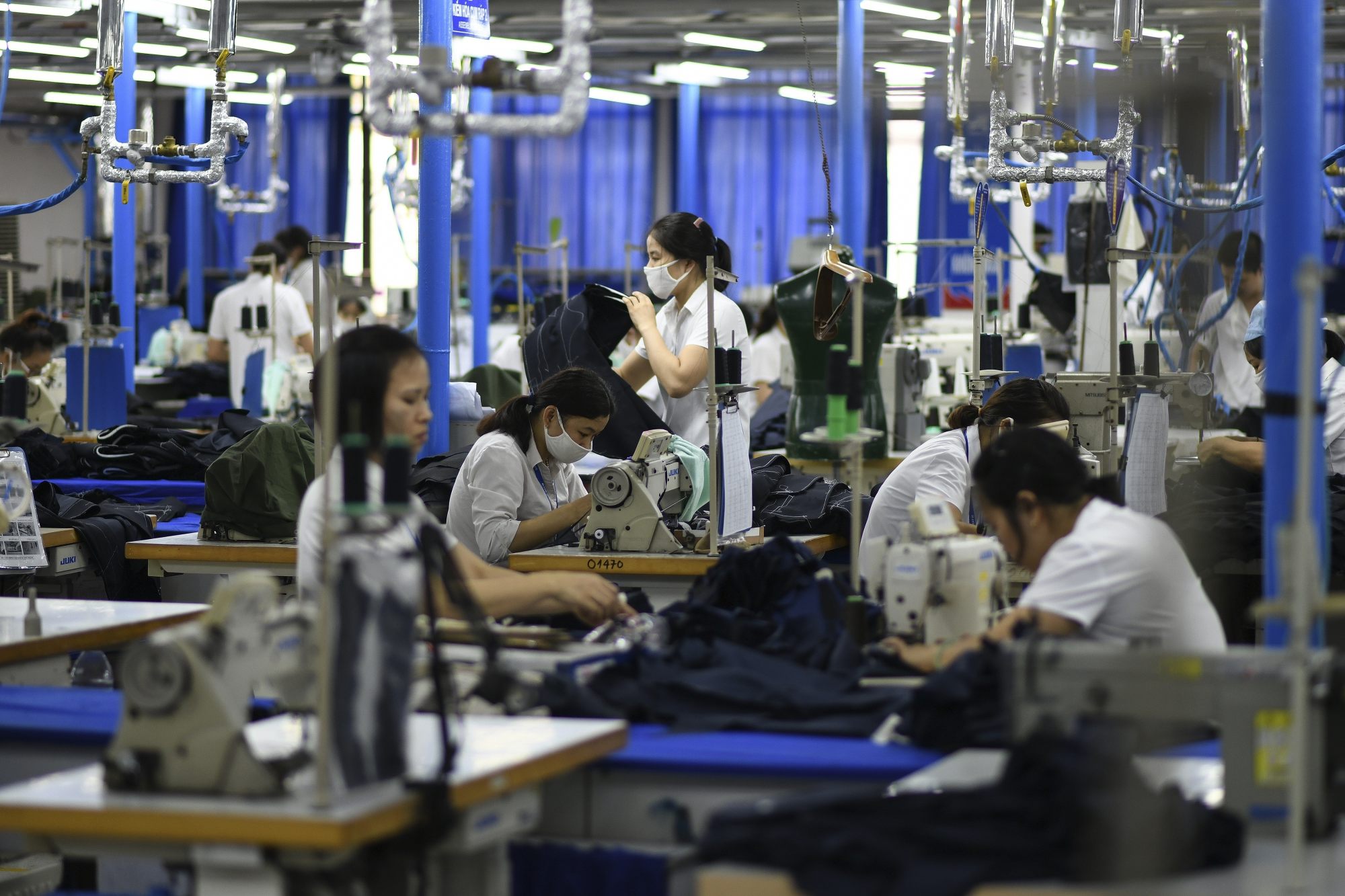 Textile factory workers make men’s suits at a factory in Hanoi. Photo: AFP
“High-income” status is, for now, out of reach for young workers whose primary concern is housing.
“For those working in low-income sectors, it is indeed difficult to afford urban housing even if they are over 30 years old,” said Tran Huong Giang, academic director at Tam Viet Research and Training Institute.
However, young people working in information technology and semiconductor electronics earn higher salaries and “have the potential to buy houses,” Giang added.
“With significant support from banking services, they can buy an apartment and gradually pay it off after five years of work,” she said.
The average household income in Ho Chi Minh City was about 15 million dong per month in the first half of the year, while the average price of an apartment there was 5.5 billion to 6 billion dong, which is 30 times higher than the average annual salary, said global real estate consultancy Savills in July.
Will more houses be built in Singapore in 2023 in a “climate of caution”?
High interest rates and a crackdown on corruption have hit Vietnam’s real estate market, analysts say.
In March, the Vietnamese government sought to address challenges in the real estate market by pressuring state and commercial banks to lower lending rates and inject capital into the economy. However, those efforts were slow to produce results and property prices did not change significantly, rising 0.4 percent between the second and third quarters of the year, according to a report from global real estate services firm JLL.
“The net effect is very weak supply and demand, resulting in one of the weakest markets in recent memory,” said Troy Griffiths, deputy managing director at Savills Vietnam.
However, he remains optimistic about the prospects for young people in a growing economy. “Vietnam is far better positioned for the Gen Z advantage than many other global competitors.”
Vietnam hopes to move up the value chain and create higher quality – and better-paying – jobs in innovation and research and development, Giang said.
Until then, research assistant Khanh remains grateful for any kind of work.
“My life is like a half-eaten cupcake,” he said. “But I’m grateful that I still have enough optimism to keep chewing on it!”
Comments are closed.