


Hong Kong, China – Hong Kong leader John Lee has likened himself to a conductor with the ability to lead a “new symphony” for the global financial hub.
Lee, who is running unopposed as the only “validly nominated candidate” in a tightly controlled May 8 small-constituency election, has his work cut out for him.
Lee will inherit a city debilitated by two years of political crackdowns and strict pandemic policies that have fueled an exodus of highly skilled professionals and turned the once-thriving international business hub into one of the most isolated cities on earth.
Last week, Lee released his 44-page political manifesto and pledged to revitalize the economy, tackle the city’s housing crisis, curb rising unemployment and strengthen governance.
But any hope of restoring the city’s glory must contend with Beijing’s relentless efforts to crush dissent and eliminate COVID-19 under a draconian “Dynamic Zero COVID” strategy.
Beijing’s endorsement of Lee, formerly Hong Kong’s second-highest official, was widely seen as a sign that China is prioritizing security over business. A former security chief and career cop, Lee lacks the business experience of some of his predecessors, including a real estate surveyor and billionaire shipping magnate.
Lee led the response to the 2019 pro-democracy protests in Hong Kong, overseeing the arrests of dozens of people under a controversial national security law that has silenced virtually all critical voices in politics, civil society and the media.
Tara Joseph, former President of the American Chamber of Commerce in Hong Kong, said it was “amazing” that a business hub like Hong Kong would be run by someone with no commercial experience.
“He can be a crucial leader. He can make the city work better. That’s right. But he’s not a businessman. He has no ties to business,” Joseph, who is now a senior director at US firm Strategy Risks, told Al Jazeera. “He has ties to the security apparatus.”
Joseph, who left Hong Kong in part because of the city’s strict pandemic measures, said the “jury is out” on whether Lee or another leader should be allowed to differentiate Hong Kong’s COVID policy from that of the mainland.
“The longer the lack of connectivity in Hong Kong lasts, the more damage it will do. We know how many people are leaving. We know it was very damaging,” she said.
Hong Kong has seen an exodus of professionals after more than two years of political crackdowns and strict pandemic rules [File: Peter Park/AFP]
Pro-Beijing supporters insist Lee’s focus on security will not come at the expense of the economy.
Former Treasury Secretary Frederick Ma said he was confident Lee would surround himself with business-savvy advisors who could help steer the economy.
“If you are a good leader, you rely on people,” Ma told Al Jazeera. “He needs to find capable people to help him. And if he manages to attract capable people to work as a team, I would be optimistic about the future. I certainly have hope.”
Ma said it will be important for the next leader to allay uncertainty about the city’s pandemic strategy, which has prioritized reopening borders with mainland China over the rest of the world but has failed to restore quarantine-free travel with either.
“I think the most important thing is that you have to make a decision, if you want to open the mainland border, do it, but if you want to follow the international path, then do it like this,” he said.
Lee said Hong Kong needs to “develop its international connectivity” and “create a more favorable business environment,” while emphasizing the need to reconnect the city to the mainland.
While Hong Kong recently reduced hotel quarantine from 14 to seven days and lifted a travel ban on non-residents, the moves are widely seen as insufficient to bring international travelers back.
“Without opening the borders, Hong Kong will minimize its opportunities for international business development,” George Cautherley, a Hong Kong-based businessman, told Al Jazeera. “I don’t think there is an alternative.”
“Two Bosses”
Lee has assembled a 148-strong advisory team of powerful businessmen and politicians, including the city’s richest man, Li Ka-shing, and entertainment magnate and real estate developer Allan Zeman.
Zeman said he believes Lee will start negotiations with China to find a way to reopen the border with the mainland.
“Lee is results driven and he’s a go-getter and he knows what needs to be done and I think when he comes out of safety he’s different [kind of] Respect from people, especially from Beijing,” Zeman told Al Jazeera.
“It’s not an easy position for anyone,” Zeman added, explaining the city is caught between the need to reopen to the world and reconnect with the mainland, which is wary of coronavirus cases surpassing its land border come.
“So you have to negotiate with two bosses.”
Ronny Tong, an adviser to current CEO Carrie Lam, said he also believes Lee will tackle Hong Kong’s reopening as a top priority.
“As for the fight against COVID-19 and the reopening of Hong Kong’s border, I’m sure it’s part of the path necessary to revitalize Hong Kong’s economy and I’m sure it would be the first task he did.” would take if elected,” Tong told Al Jazeera.
Lee has previously tried to argue that he is not beholden to any business interest groups and is therefore coming “without baggage”.
“My main concern is the collective interest and not the interest of any particular sector,” he told a news conference last month.
A spokesman for the Hong Kong General Chamber of Commerce said John Lee “brings a new mindset to administration”.
“Lee has pledged to work with the public and business community to address Hong Kong’s long-standing problems such as the housing shortage,” the spokesman said. “With a clear consensus and roadmap, we’re confident the city will get back on its feet.”
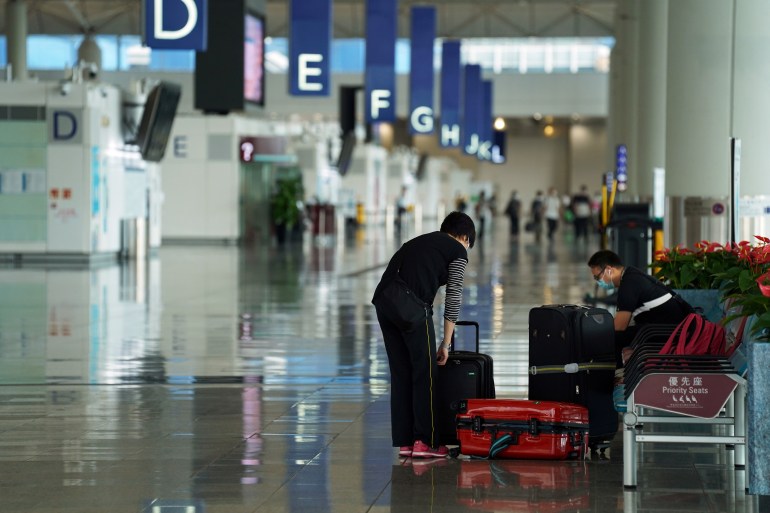 Hong Kong has become one of the most isolated cities in the world as part of China’s “Dynamic Zero COVID” strategy [File: Lam Yik/Reuters]
Jonathan Slone, former Asia chairman of Jefferies Group who is now a private investor, said he sees the economy becoming “an ever-growing focus” under the new administration.
“I think they’re going to be pretty handy,” Slone told Al Jazeera. “Is the business world getting everything it wants? No, but I think these guys know the economy needs to take off.”
Others are more skeptical.
Pro-democracy businessman Herbert Chow said Lee was given an “impossible task” when it came to boosting the economy.
“We’ll see how he can make up for it by breaking the cycle of back-and-forth, putting tap dancing on relaxation and tightening COVID rules again,” Chow told Al Jazeera.
Chow said he believes most companies “don’t care” whether Lee, who has promised to introduce more national security laws, will speed up crackdowns on dissent.
“I think most business people aren’t going to care too much about how the police mend the relationship with citizens or whether Hong Kong will remain a police state,” said Chow, who last year announced his intention to relocate his children’s clothing brand to Chickeeduck Abroad due to pressure from authorities.
Asked if Hong Kong could return to its glory days, Joseph, the former AmCham president, said the city was gazing at a “new normal”.
“And I think people are going to have to adjust to that,” she said. “Hong Kong is no longer globally connected in the same way, so there are risks. It may find a way out of this mess, but much more so than a city in China.”
Comments are closed.