
A jobs report on an economy doing well despite 5.5% interest rates and recession fears. But wage growth is accelerating


The average hourly wage is fueling concerns about inflation.
By Wolf Richter for WOLF STREET.
It was the kind of employment data you would expect from an economy that is doing well. The number of payroll positions created by employers was “better than expected”, the previous two months' figures were revised downwards, and after revisions, companies added 494,000 workers to their payrolls in the last three months, bringing the total number of jobs to a record 157.2 million, according to employer surveys.
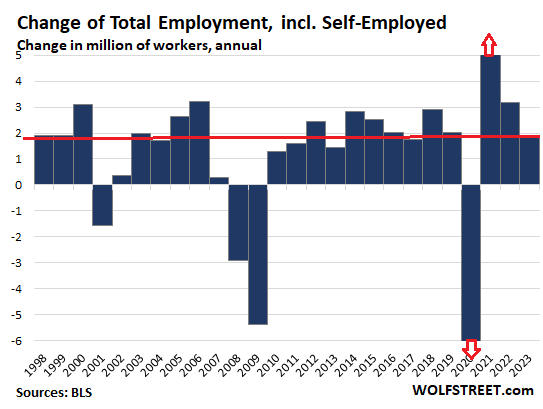
In all of 2023, employers added 2.70 million workers, which was one of the better years in the last 25 years – despite interest rates the Fed raised to 5.5%:
Employment in the vast and diversified U.S. labor market does not suddenly fall from one month to the next, unless there is some kind of shock, like the Lehman bankruptcy or a lockdown. Efforts to measure the details of this vast and complex labor market on a monthly basis through surveys of employers and households result in monthly peaks and troughs that then appear in the headlines even though the trends have not actually changed.
A cottage industry has sprung up predicting what this or that number would be for the month, and then the headlines say “more than expected” or “less than expected” as if it makes any difference which one expects monthly up and down noise.
So people dug into today's labor market data, analyzing the monthly peaks and troughs and discussing the seasonal adjustments, revisions, the structure of the data itself, and so on. But we want to see the trends.
Total employmentthose in paid employment and the self-employed, a broader and more volatile measure based on a survey of households, fell sharply in December, after a big increase in November, after a decrease in October, etc., and this kind of thing happens, I mean, Who wants to answer surveys right before Christmas or Thanksgiving?
This means that the total number of employed people has fallen by 367,000 in the past three months. But in the previous three months they were up 546,000, and that's how it is with this volatile stuff, and a month shows nothing but noise.
For all of 2023, total employment increased by 1.88 million, typical of an economy doing well despite interest rates at 5.5%.
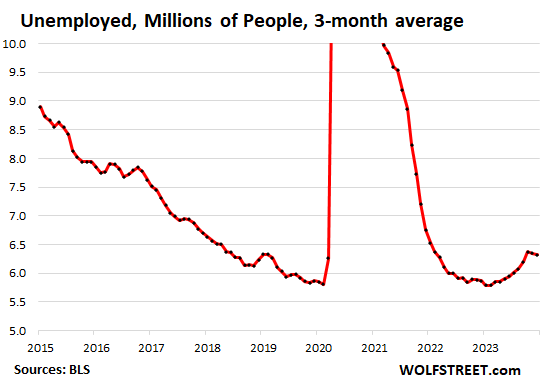
The number of unemployed The number of people actively looking for jobs has suddenly fallen by 446,000 in the past three months, after surging from historic lows at the start of 2023, signaling some cooling in the overheated labor market, the three-month moving average shows . Maybe more noise, maybe the start of a trend:
All year long, people have been hoping that a significant slowdown in the labor market would “force” the Fed to cut interest rates in 2023. But that didn't happen. The job market has performed well throughout the year and the expected decline in jobs associated with a recession – the most expected recession of all time – has not occurred.
We can quibble over some of the details, but overall the employment data has been fine all year, exactly what you would expect from an economy that is currently on the rise.
And there was nothing in these jobs data that would “force” the Fed to cut rates and end this terrible record QT and start QE all over again in their dreams, because QE, or the hopes for QE, that Only thing that happened Works for stocks.
But on the inflation front, some concerns are building in the other direction: Average hourly wages for “production and non-managerial employees” are rising again after a sharp decline.
These “production and non-managerial employees” – which make up the majority of the total workforce, but exclude the management types – include working supervisors and all employees in non-managerial roles, including engineers, designers, doctors and nurses, teachers, office workers, salespeople, bartenders, Technicians, drivers, retail workers, waiters, construction workers, plumbers, etc.
The 3MMA rose to 0.39% in December. Annualized, that's 4.8%, the highest since January 2023. Monthly wage increases fluctuate widely. Maybe just more noise, or maybe the start of a new trend of wage growth in the 4% to 5% range:
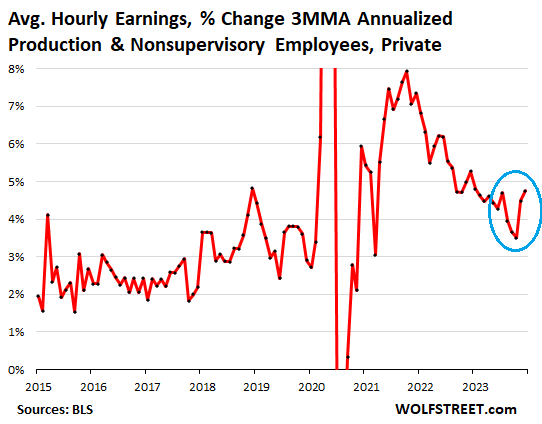
Hot wage increases were a persistent theme at Powell's press conferences in 2022 and earlier in 2023. Then the topic shifted to the slowdown in wage increases, which introduced the hot topic that the rate increases were complete and there might be some cuts in 2024 – According to Wall Street bets, interest rates will be cut by a billion because we don't know why. So can we look forward to the new theme of wage growth accelerating again?
Do you enjoy reading WOLF STREET and would you like to support it? You can donate. I appreciate it very much. Click on the beer and iced tea mug to find out how:

Would you like to be notified by email when WOLF STREET publishes a new article? Login here.

Comments are closed.