


Bitcoin (BTC) has hit another all-time high, its third since March, and the altcoin market is growing alongside it. Why is this happening?
Since the beginning of the cryptocurrency era, Bitcoin has been synonymous with “cryptocurrency” due to the lack of other digital currencies. However, over time, thousands of new blockchain projects have emerged, each with unique applications. Despite this diversity, Bitcoin continues to be the dominant force, influencing market trends across the cryptocurrency spectrum. This article is about why and how altcoins are so closely linked to Bitcoin market movements.
Altcoin season and its market influence
The phenomenon known as “altseason” typically follows a period of significant increase in Bitcoin value. During this phase, investors often shift their profits from BTC to various altcoins to maximize returns. An important indicator of an altseason is the altseason index, which provides an easy way to assess the status of the market.
Source: Blockchaincenter.net
A value of 53 in the index does not mean that 53% of the investment capital is invested in altcoins; This shows that 53% of altcoins have outperformed BTC in the last 90 days. An index value of 75% or higher signals the start of an off-season. In contrast, a decline below 25% suggests a “Bitcoin season” where investment refocuses on Bitcoin, reflecting its market dominance and influence.
How does Bitcoin affect altcoin prices?
Since its launch in 2009, Bitcoin has maintained its status as the leading digital currency. Although several early forks emerged, none reached the popularity of Bitcoin until the debut of Ethereum (ETH) in 2015. Bitcoin's pioneering role and its perception as a reliable store of value catapulted its popularity, driving its value from negligible to over $70,000.
The rise of Bitcoin paved the way for cryptocurrencies to enter the mainstream. Its straightforward concept not only increased its own value but also impacted the broader crypto market. Today, most crypto investors hold some Bitcoin in their portfolios, highlighting their widespread influence. The greater the demand for Bitcoin, the greater its influence on the market dynamics of other cryptocurrencies.
BTC dominance
A key factor in the current market dynamics is that many altcoins, especially those with significant capitalization, are trading in pairs with Bitcoin. Additionally, most coins cannot be purchased directly with fiat currency, meaning traders often have to purchase BTC first.
Therefore, when an altcoin holder decides to exit the crypto market, they typically convert their assets into Bitcoin before exchanging them for regular currency. Because of these frequent transactions, this process closely ties the value of many altcoins to Bitcoin.
However, there are always exceptions. For example, positive developments such as an altcoin's listing on a major exchange or the announcement of an upgrade can drive up its price, even counter to the general market trend. Such increases are often fueled by investors exchanging their BTC for the altcoin in anticipation of a price increase.
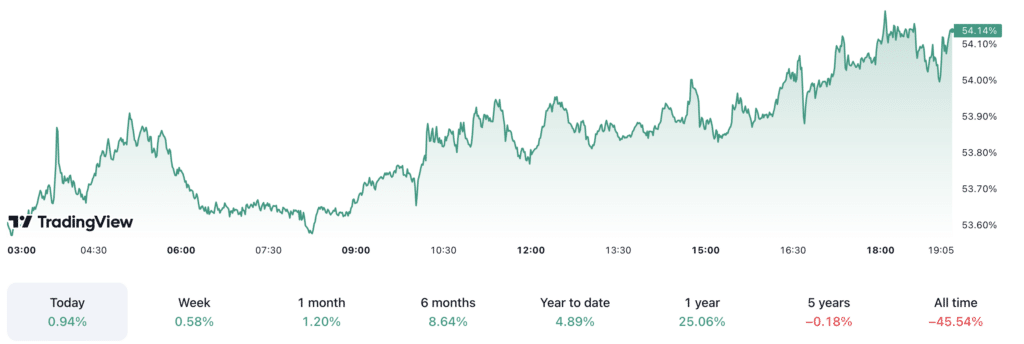 Source: TradingView
The Bitcoin Dominance Index is useful for assessing the health of the altcoin market. This index indicates Bitcoin's share of the total market capitalization. A decline in Bitcoin dominance usually means a relative increase in investment in altcoins. During times of rapid growth in the crypto market, a significant decline in this dominance index is often observed.
Reserve assets
Bitcoin, often called “digital gold,” is considered a stable and trustworthy asset in the world of cryptocurrencies. Investors often compare other cryptocurrencies to Bitcoin's performance. If the value of Bitcoin increases, it may spur interest in various other cryptocurrencies.
Bitcoin's role in the crypto market is increasingly similar to how the US dollar functions in global stock markets – it is like a reserve currency. Due to regulatory requirements in some countries, certain cryptocurrency exchanges do not allow direct trading of cryptocurrencies against regular money (fiat). In such cases, investors usually first buy Bitcoin and then use it to buy other cryptocurrencies. Stablecoins, which are designed to have a stable value, serve a similar purpose. For example, here are the latest reserves from the Binance crypto exchange:
Binance releases its 16th proof of reserve (snapshot: March 1). User BTC was 562,000, a decrease of 31,998 BTC from the previous month; User ETH was 3.98 million, down 180,000 ETH; User USDT was 19.5 billion, up from 1.714 billion USDT.https://t.co/jGCPnwd2PR… pic.twitter.com/4u77grgVTT
— Wu Blockchain (@WuBlockchain) March 8, 2024
The value of cryptocurrencies is usually measured against the US dollar, but it is also common to compare them with Bitcoin, as it is a key component in major market pairs. This explains why the overall market often follows Bitcoin's trends, whether rising or falling.
Predicting the Future of the Altcoin Market
Although altcoins have followed Bitcoin's lead in the past, future trends could be significantly different. Here are some scenarios and factors that could change this dynamic:
- Technological development and innovation: Many altcoins aim to address specific challenges or offer features not found in Bitcoin. If these innovations become the basis for real-world applications, altcoins' dependence on Bitcoin could decrease.
- Mass adoption: As altcoins gain more acceptance among corporations, governments, or large organizations, their connection to Bitcoin could weaken.
- Market diversity and specialization: As the crypto market matures, altcoins may focus on specific niches, making them less affected by general market movements and Bitcoin fluctuations.
While Bitcoin still holds a central position, the future extent of dependence on altcoins is an open question, depending on a number of technology, adoption and market factors.
Learn Crypto Trading, Yield Farms, Income strategies and more at CrytoAnswers
https://nov.link/cryptoanswers
Comments are closed.