


The Venus Protocol is a decentralized money market protocol for lending and borrowing cryptocurrencies. It offers low-cost, fast transactions and allows users to take out loans with fast issuance and no credit checks.
Unlike centralized lenders such as BlockFi and Celsius – which filed for bankruptcy in 2022 and froze user payouts – users don’t have to log in with typical CeFi credentials; Venus Protocol users connect crypto wallets like MetaMask.
The guide below examines the Venus Protocol in depth, but if you are looking for the best alternative centralized crypto lenders, check these out 5 crypto interest accounts that could fill the void left by Celsius.
What is the Venus Protocol?
Venus is the second largest Credit protocol on the BNB chain – only surpassed by accounting for around 30% of the overall market share in terms of Total Value Locked (TVL).
As of December 2022, the protocol has lent over $450 million in assets and its TVL has hovered over $700 million since mid-2022.
Some of the prominent advertised features of Venus Protocol include:
- Lend and borrow in seconds
- Earn staking and rewards in crypto, up to 20%
- Liquidity pools with up to 30% APY
- Synthetic stablecoins coin
- Participate in the DAO community
Disclaimer: Cryptocurrency and especially DeFi protocols like the Venus Protocol are very risky. The following article is not and should not be considered a substitute for investment advice.
How does the Venus Protocol work?
Venus was built exclusively for the BNB chain (formerly known as Binance Smart Chain (BSC)), hence its native currency XVS uses the BEP-20 standard.
Venus supports multiple types of cryptocurrencies and stablecoins that can be used as collateral to borrow from the protocol’s pools or earn rewards by becoming a liquidity provider.
Venus.io dashboard.
How to Borrow the Venus Protocol
Loans are over-collateralised, which means that users wishing to borrow must pledge collateral at a ratio that depends on the current governance proposal, but typically ranges from 50% to 70%. So, hypothetically, to borrow $10,000, you would need to post $15,000 in collateral, for example.
This collateral is then locked into a Venus Protocol smart contract for a specified period of time.
Select an asset in the Market section and you can see the collateral factor (as well as market liquidity, number of suppliers and borrowers, APY and more).
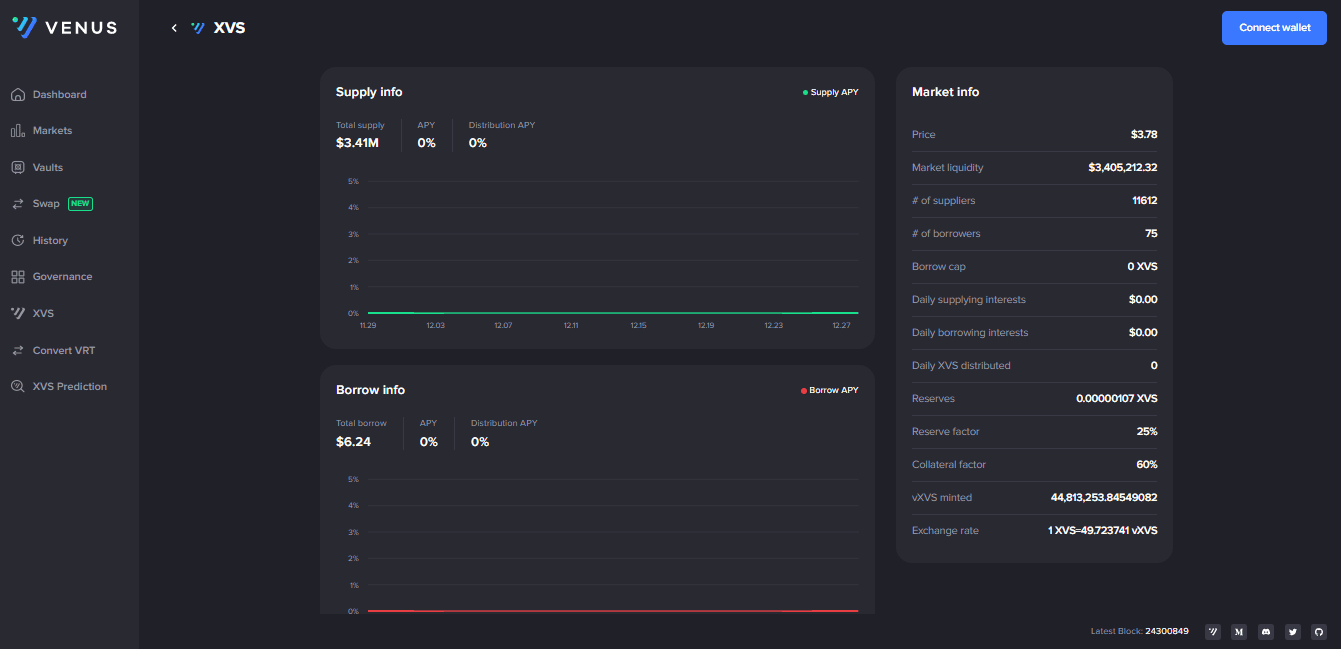
Loan on Venus
Users can lend assets to Venus to earn a return that varies by asset type. When a user lends cryptocurrencies to Venus, the funds are added to the lending pools. In return, depositors receive vTokens (e.g. deposited BUSD becomes vBUSD).
Users can redeem these tokens for the underlying token.
minting stablecoins
Users can mint VAI, a synthetic stablecoin priced at $1 (the price will still fluctuate based on market demand). This asset can be used for yield farming on other DEXs in the BNB ecosystem. Users can mint VAI with up to 50% of the remaining security value from previous vToken deposits.
VAI’s interest rates are yet to be determined (they’re called stability fees in other lending protocols like MakerDAO), so it depends on governance and what the new V4 upgrade will bring.
Venus Protocol: History & Founders
The project was developed by Wipe, a cryptocurrency credit card issuer, officially launched in 2020. The team delegated control to XVS community owners. Since then, several proposals have been submitted and presented to change, update and improve the Venus Protocol.
Venus was born as a fork of Connection (COMP), a popular crypto lender based on the Ethereum network, and also took inspiration from MarkerDAO. The protocol is essentially a hybrid of the two systems and their respective advantages. It was also audited by blockchain security firm CertiK in December 2020.
The team did not run a pre-mine for founders or the community. The only way to earn XVS was through the Binance LaunchPool project or providing liquidity to the protocol in the early days.
Venus V4 release
In November 2022, the Venus DAO unveiled theirs V4 upgrade after months of discussions. The upgrade aims to improve the network in three key areas:
- risk management.
- Isolated Markets: Introduce new tokens of all types, but grouped in their respective, separate credit pools. This has two key benefits: 1) it protects users and the ecosystem from disasters, as they essentially segregate assets at potential risk into isolated pools; 2) It allows users to choose which pools to participate in based on risk tolerance.
-
- Stable Rate Borrowing: A mechanism that sets stable interest rates for borrowing in all markets.
-
- Better Risk Management Mechanisms: will provide a mechanism to provide users with shortfall coverage and a stability fee to keep the VAI pegged to the USD. This is especially important as VAI lost its peg in 2021 due to oversupply and saw a massive market sell-off.
- decentralization
- Improved governance system: New governance roles have been assigned, longer intervals for contract upgrades and role reassignments,
-
- Price Feed Redundancy: Allows Venus to support multiple Blockchain Oracle Avoid single points of failure.
- User experience:
- Partnering with DEXs: Venus has partnered with several DEXs in the BNB ecosystem, including PancakeSwap, to allow users to freely move funds between multiple protocols without leaving Venus. This makes Venus a DEX where borrowing, lending and swapping across multiple DEXs is done in a single interface.
- New Tokenomics:
- Tokenomics 3.0: will introduce new financial mechanisms to incentivize log retention. XVS becomes the core utility token, XVS emissions are reduced, value is reinvested and deficit protection is added.
-
- The protocol will introduce the Venus Prime Soulbound Token (SBT), which users can earn by wagering at least 1,000 tokens in the Venus Vault for 90 days. The advantages of SBT are that it gives users exclusive access to better returns across different markets and dividends can be paid in the currency provided.
Venus Protocol: Tokenomics
XVS is the protocol’s utility token, which is based on the BEP-20 token standard. The main use cases of XVS are:
- Mark out
- Choose
- pay transaction fees
The token has a maximum supply of 29 million tokens and a circulating supply of 12 million (or 41% of the total supply).
XVS and Venus Governance
The Venus community operates a simple system of governance: delegated and direct on-chain voting, where 1 XVS token = 1 vote. Whenever a protocol proposal via a Venus Improvement Proposal (VIP (similar to Ethereum EIP)) Users can vote directly or delegate their voting rights to another user.
Proposals cost 300,000 XVS, which is currently almost $1 million. After the proposal, voting will be active for three days. To pass, the proposal must achieve a quorum of 600,000 XVS. If successful, the proposal will be blocked for two days before implementation.
Final Thoughts: The Future of Venus Protocol)
Venus Protocol has a TVL of $710 million, currently has $1 billion in liquidity according to its website, and has borrowed over $450 million since its relatively short stint in the industry.
Despite these numbers, Venus Protocol doesn’t really garner the same amount of attention as platforms like PancakeSwap. Still, the protocol has managed to thrive alongside the DeFi ecosystem, and the V4 upgrade brings better tokenomics, more risk management tools like isolated pools, and an improved governance system to solidify decentralization.
Learn Crypto Trading, Yield Farms, Income strategies and more at CrytoAnswers
https://nov.link/cryptoanswers
Comments are closed.