


A liquidity pool is a collection or pile of digital currencies, tokens, and other assets locked in a smart contract, allowing users to transact and trade through a decentralized platform. Digital assets can be non-fungible tokens (NFTs), tokens, coins or cryptocurrencies. These are pooled to create liquidity for faster digital transactions.
Decentralized finance platforms (DeFi) use pools of liquidity as a reserve for digital assets to facilitate transactions. A liquidity pool can broadly be compared to traditional bank reserves. Financial institutions must hold a minimum amount of cash.
Read more about a liquidity pool
How does a liquidity pool Work?
In the traditional financial system, people who want to borrow, exchange, or withdraw money have to go to a bank or financial institution. These organizations must have the necessary bank reserves to service their customers, making them liquidity providers of the financial market.
There is no intermediary in DeFi. Liquidity providers can be anyone who deposits tokens into the liquidity pool. If a liquidity pool has Ethereum (ETH) and Bitcoin (BTC), liquidity providers must deposit both tokens, usually in pairs. These investors would receive liquidity pool tokens representing their share of the pool. You also get a share of every transaction fee the pool generates.
People can then trade digital tokens directly via the liquidity pool. Since the system is decentralized, no middleman is required. Instead, liquidity pools use automated market makers (AMMs), which are algorithms that automatically calculate a token’s price based on the ratio of tokens in the pool. If there is more BTC than ETH in a liquidity pool, the price of BTC will increase while ETH will decrease.
What are the advantages of a liquidity pool?
Liquidity pools offer several benefits to both traders and liquidity providers within the DeFi ecosystem, including the following:
- Decentralization and market efficiency: Trading does not rely on a centralized entity, promoting a more open and transparent financial system. Since there is no middleman, trading is faster and prices are fairer.
- Price stability: The larger the pool, the more stable the prices since the token ratio is not affected too much.
- Accessibility: Each token can participate in liquidity pools, allowing for more diverse investment opportunities.
- Passive Income: Liquidity providers generate passive income by depositing tokens into a liquidity pool as they receive a share of trade transaction fees.
What are the risks and challenges associated with liquidity pools?
Like any investment, liquidity pools come with certain risks and challenges. These include the following:
- Ephemeral Loss: This loss occurs when the value of tokens deposited in a liquidity pool falls below their value outside of the pool. Choosing stablecoin pools can help minimize the risk of a temporary loss.
- Smart Contract Vulnerabilities: Liquidity pools are based on smart contracts, which are prone to coding errors and vulnerabilities. To mitigate this risk, use reputable platforms with verified smart contracts.
- Market Volatility: The value of digital assets can fluctuate and affect the overall value of the liquidity pool. Investment diversification can help mitigate the impact of this risk.
- Token risk: Liquidity providers may suffer losses if a token they provide becomes obsolete or delisted. To avoid big losses, it is advisable to diversify your tokens or hold reputable tokens.
What are the best practices for liquidity providers?
While liquidity providers can derive several benefits from a liquidity pool, they can also suffer financial losses due to the risks associated with liquidity pools. Asset diversification and thorough research are some of the precautions liquidity providers can take.
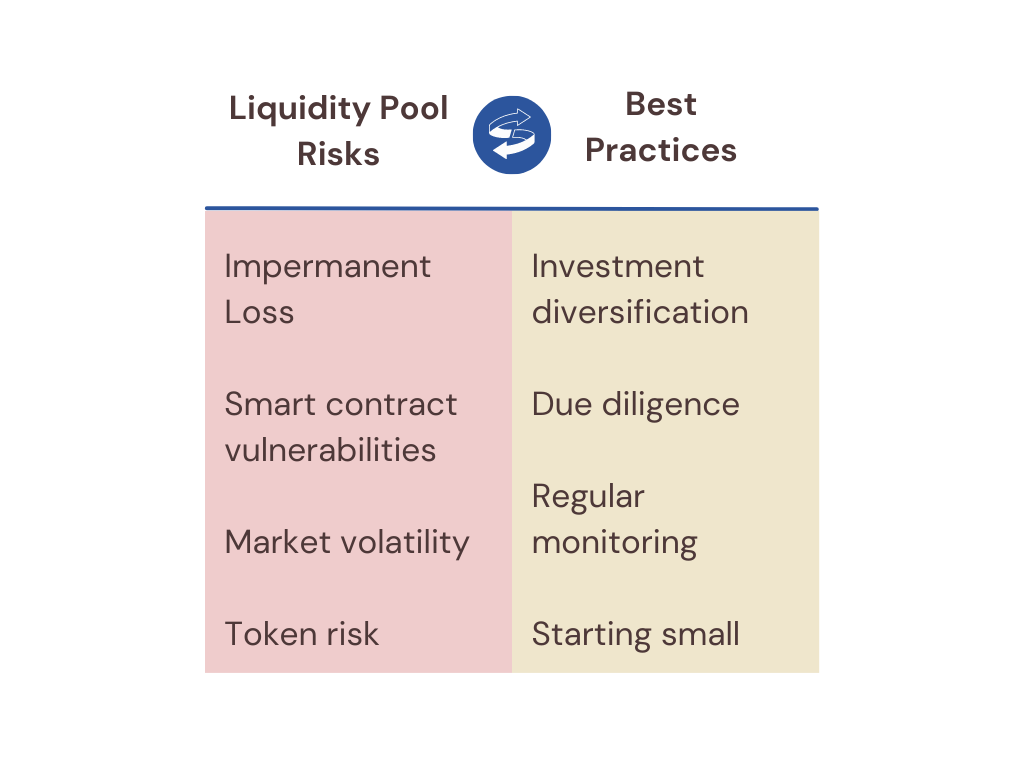
In particular, here are some actionable best practices:
- Spread investments across multiple pools: Even with traditional investments like stocks, it’s best not to put all your eggs in one basket. Diversification can protect against temporary losses, token risk and market volatility, giving you a more stable return on investment (ROI).
- Assess potential risks and rewards: Before participating, weigh potential returns against the risks associated with a particular liquidity pool. While you cannot predict the future, you can look at the past performance of the tokens and the entire pool.
- Regular monitoring: Always keep track of the liquidity pools you participate in so you can react immediately to changes in market conditions.
- Start small: When you start out, invest a small amount first to gain experience. Gradually increase your investment as you understand the market better.
—
Liquidity pools enable decentralized trading. They also offer liquidity providers an additional passive revenue stream. However, there are risks involved and liquidity providers must perform due diligence before participating.
The central theses
- A liquidity pool is a bunch of digital currencies and assets locked in a smart contract, enabling decentralized trading in the DeFi ecosystem.
- Liquidity providers deposit tokens in pools and earn a share of transaction fees as passive income.
- AMMs determine token prices based on the ratio of tokens in the pool, ensuring fair and efficient trading.
- The advantages of liquidity pools include decentralization, price stability, accessibility and passive income opportunities for liquidity providers.
- Risks and challenges include temporary losses, smart contract vulnerabilities, market volatility and token risks.
- Best practices for liquidity providers include diversification, assessing potential risk and reward, regular monitoring, and starting small.
- Liquidity pools are crucial in DeFi, promoting more open and transparent financial systems.
- Investors should understand the risks and conduct due diligence before participating in liquidity pools.
More from tech slang…
Learn Crypto Trading, Yield Farms, Income strategies and more at CrytoAnswers
https://nov.link/cryptoanswers
Comments are closed.