


What are the curve wars?
The Curve Wars concept refers to an ongoing competition between different decentralized finance (DeFi) protocols that provide access to stablecoin trading and liquidity for order execution.
In stablecoin trading, Curve Finance is at the forefront due to its exceptional ability to ensure low slippage and fees. This unique ability has attracted many DeFi investors to the ecosystem.
The Curve Finance protocol includes liquidity pools supporting various stablecoin trading pairs and digital assets. Each liquidity pool can be funded by anyone – so-called Liquidity Providers (LPs) – in exchange for Curve Finance’s CRV network token.
However, liquidity is often tight, resulting in stiff competition for the most LPs for each pool. To ensure sufficient liquidity, many of these protocols use tactics such as bribing veCRV token holders (vote-escrowed CRV) to sway voting decisions in their favor.
veCRV is a non-transferrable variant of the CRV asset. It symbolizes voting power and is only generated when the CRV token is locked or staked. veCRV token holders also receive rewards from the Curve ecosystem; However, these are often spread over four years.
While bribery may seem unconventional, it plays a crucial role in the financial context of the curve finance ecosystem. According to DeFiLlama, the decentralized application (dApp) currently controls well over $2.5 billion in combined Total Value Locked (TVL) spread across 277 liquidity pools.
This portion of liquidity is strategically designed to attract and retain liquidity providers in their respective pools.
The curve wars span multiple fronts, and some of the most popular protocols competing for liquidity include Convex Finance, Yearn, and StakeDAO, among others.
Background on curve finance and the irony of voting power
For a fuller understanding of the struggle in the Curve Finance ecosystem, let’s take a look at the DeFi protocol itself.
Curve Finance is a decentralized exchange (DEX) protocol that allows users to trade crypto assets without permission. Rather than relying on a central order book, Curve Finance employs an Automated Market Maker (AMM) model. Here trading takes place via a peer-to-contract (P2C) approach instead of the traditional peer-to-peer (P2P) format.
While contemporaries like UniSwap allow any cryptocurrency to be exchanged, Curve Finance is focused on stablecoins – making it the DEX platform for buying and selling these digital fiat equivalents.
At Curve Finance, liquidity is provided by the users for both sides of a trade. For example, in a USDC/USDT pool, liquidity providers deposit funds in both underlying assets. Traders on Curve Finance can then use these funds to trade tokens for a fee.
Curve Finance rewards liquidity providers with 50% of trading fees charged at a low rate of 0.04%. These fees are distributed as CRV tokens that are useful in network transactions, stakes, and governance.
Users also have the option to exchange their CRV tokens for CRV tokens in escrow. These tokens play a role in determining which liquidity pools receive CRV incentives every ten days. Users holding a significant amount of these non-transferrable ERC-20 tokens stand a chance to inject a large chunk of liquidity into their respective pools.
However, there is a twist here. Users must lock their veCRV tokens for a maximum of four years in order to receive significant rewards.
According to the Curve Finance protocol, users can only earn a veCRV by locking a CRV for four years. But these tokens cost billions of dollars in total, making them both impractical and costly for investors.
If an individual company can muster the necessary voting power, it can easily determine how and where to channel CRV incentives. In this way, such a protocol can generate the necessary liquidity it needs to buy and sell various digital assets.
Who’s Leading the Corner Wars?
Although the battle has been going on for several years, many DeFi investors have acknowledged that Convex Finance is taking the lead.
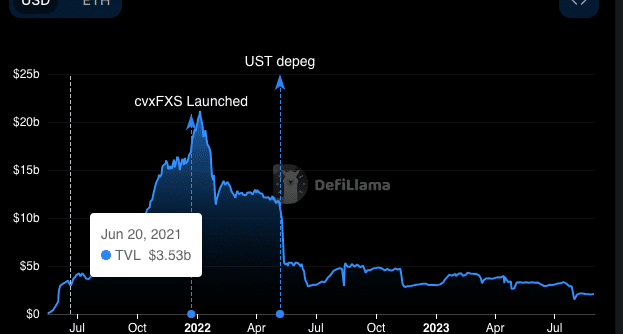
The dApp controls up to 50% of the total CRV supply, which means it has a major impact on how rewards are shared between liquidity pools each week.
 Source: DeFiLlama
For clarity, according to DeFiLlama, Convex Finance controls over 85% of Curve Finance’s TVL, which is more than $2 billion.
What different strategies are used in the corner wars?
Raising liquidity in the highly competitive DeFi and DEX landscape is a tough proposition. As a result, numerous protocols have devised strategies to attract the highest inflow of liquidity by fixing the one crucial flaw of the Curve Finance protocol – staking.
Users must lock their funds for four years to receive the maximum reward for using CRV in veCRV. This is particularly impractical for retail users on a budget.
Below we discuss the different strategies that liquidity pools use to attract users. Due to its outstanding position, our focus is on Convex Finance.
Convex Finance’s formula for success
Convex Finance is the largest holder of veCRV tokens in the Curve Finance ecosystem. By solving the problem of long-term use with Curve Finance, it has risen to the top. Users can stake their CRV on the platform to get cvxCRV tokens that can be withdrawn at any time.
Convex Finance can unlock maximum yield by aggregating each user’s veCRV tokens and keeping them for four years.
Another strategy used in the Curve Wars is the trading fee and staking reward strategy.
For one, Convex Finance charges 17% fees on all revenue generated through the Curve Finance protocol. 10% of this fee is paid out to cvxCRV stakers as CRV, while 4.5% is paid out to CVX stakers.
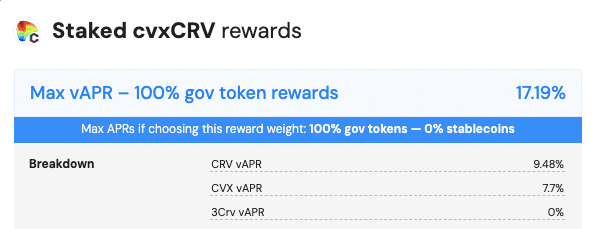
In addition, there is a variable annual percentage (vAPR) that stakers can earn. They are variable as the rate changes frequently.
At the time of writing, this staking reward is split into 100% governance token rewards, with stakers receiving 17.19% vAPR, payable in CRV and CVX tokens.
 Source: Convex Finance
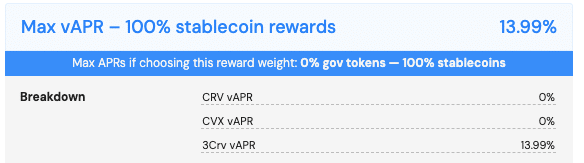
The second is 100% stablecoin reward with a vAPR of 13.99% and investors are paid with USDT, USDC and DAI stablecoins. All of these strategies are a form of bribes (technically cuve bribes) for veCRV token holders to lock in their liquidity using the Convex Finance protocol.
 Source: Convex Finance
These strategies have helped Convex gain a tremendous advantage over other liquidity pools in the Curve Finance ecosystem. Because earning 17.19% in network tokens or 13.99% in stablecoins is quite a respectable return on investment compared to the meager interest rates that banks pay their customers.
What are the risks and rewards of participating in the Curve Wars?
The main advantage of these decentralized application protocols lies in their continuous generation of liquidity. This ability allows them to cater to the needs of any DeFi trader looking to buy and sell digital assets. However, there are major risks before embarking on any of the protocols.
DeFi platforms are still unregulated, meaning investor funds could easily be stolen at any time. Most DEX platforms are not overseen by any global regulator.
Cybercriminals are particularly attracted to this ecosystem, mainly due to the lack of security measures on many platforms. A recent example is the US Department of Justice (DoJ) indictment of an engineer named Damian Williams (Shakeeb Ahmed) for reportedly stealing $9 million from an unnamed decentralized exchange.
If there is a security breach, stakers could lose their funds if hackers attack any of these protocols. Recovering these funds can often be time consuming and in some unfortunate cases, losses can prove irreversible.
Despite these challenges, getting involved as a liquidity provider in the Curve Wars can bring significant benefits. This is primarily due to the sizeable rewards up for grabs. Possession of the CRV token automatically grants access to the veCRV asset.
With veCRV, stakers gain influence over the distribution of funds across the liquidity pools.
-
Earn rewards from liquidity pools
Prominent platforms such as Convex Finance, Yearn, StakeDAO and others actively seek liquidity and regularly offer rewards and incentives to LPs who stake their veCRV tokens with them.
This approach allows these platforms to generate the liquidity needed for their operations. In return, LPs and stakers receive tradable and transferrable cvxCRV tokens (in the case of Convex Finance).
Participation in a liquidity pool typically results in the issuance of the pool’s native token. For example, if you block a veCRV asset at Convex Finance, the user will immediately receive a liquid and tradable cvxCRV asset. This in turn can be withdrawn or redeployed to receive further rewards.
What does the future of curve wars look like?
Liquidity is a precious commodity in the DeFi ecosystem, and Curve Finance is the best place to get it at a fraction of the cost compared to other DEX platforms.
As a result, growing liquidity pools are poised to compete fiercely for CRV incentives with the aim of winning over veCRV token holders in the foreseeable future.
For now, Convex Finance is taking the lead in this liquidity battle, but the tide could turn in the coming years.
bottom line
The Curve Finance ecosystem has been around for over two years since its launch in 2020. It is a seamless and low-cost means of exchanging stablecoins while avoiding slippage (for retail investors) and temporary losses (for well-funded liquidity providers).
With DeFi rapidly gaining acceptance around the world, Curve Finance is likely to play an important role in generating liquidity and making money from such activities. Cryptowhales also use Curve Finance to exchange assets quickly and get the liquidity they need for other trades.
Still, the DeFi landscape is still in its infancy and Curve Finance plays a big role in its continued growth. For example, the DEX platform recently rolled out a Coinbase exchange Layer 1 smart contract protocol on Base.
This will further expand the blockchain ecosystems it runs on. With Curve Finance on the rise, blockchain protocols already running on the Base platform can effortlessly access dollar-pegged stablecoins.
This and many other advantages make Curve Finance a central figure in the quest for a decentralized economy.
Meanwhile, newer blockchain protocols could be included in the development of their liquidity model, leveraging ideas from the Curve Wars.
Learn Crypto Trading, Yield Farms, Income strategies and more at CrytoAnswers
https://nov.link/cryptoanswers
Comments are closed.