


In order for DeFi platforms to trade and conduct economic activities, they must have a stock of assets. If banks and central exchanges are responsible for the accumulation of assets in traditional finance, in DeFi this task is taken over by liquidity pools technology.
What are liquidity pools, how do they work and what is their role in the DeFi system? Continue reading the article to get answers to these questions.
What is a liquidity pool?
A liquidity pool is a collection of digital assets on a DeFi Platform that creates liquidity for trading on crypto exchanges. The assets in the liquidity pool are provided and frozen by platform users (liquidity providers). smart contracts. This allows operations within the pool to be performed automatically and without intermediaries.
The liquidity pools consist of currency pairs. Each currency pair has its own liquidity pool, for example DOT/USDT. The prices of the currencies relative to each other are regulated by the automated market maker (AMM) protocol. This is the part of the code that maintains liquidity balance using mathematical formulas. For example, if a trader buys a DOT token in the DOT/USDT pool, the amount of that token in the pool will decrease and its price will increase.
A trader who trades currencies in a pool does so without the participation of other platform users. It conducts financial transactions via AMM directly with the system where liquidity providers’ assets are frozen. The more user funds put into the pool, the higher its liquidity.
High pool liquidity allows a trader to complete transactions faster as there is enough currency in the pool to meet demand. This means that the currency in such a pool can be bought or sold at any time.
Low pool liquidity increases transaction times and risk of slippage. Slippage occurs when, due to the long duration of the transaction, the total amount of the transaction is not what the merchant expected.
Liquidity pool opportunities for investors
Decentralized platforms with liquidity pools offer an opportunity to make money by sending your own wealth to the pool. This method of investing is called Liquidity Mining.
The essence of liquidity reduction is as follows. The user selects an appropriate currency pair pool and creates a deposit of the amount they are willing to give in support of liquidity.
A deposit is created for a certain period of time, after which the user receives a percentage of the profit for providing funds. The investor’s profit can consist of a percentage of transaction fees and platform tokens. The amount of interest depends on the project that the user has chosen to invest in. For example, on the PancakeSwap platform, you can select a pool with an estimated annual return of 2% to 110%.

Liquidity providers generally receive platform tokens in proportion to their contribution to the pool’s liquidity. If the provider wants to return the assets they added to the pool, their tokens will be burned.
In order to become a liquidity provider, a user must take several steps:
1) Choose a decentralized platform that supports liquidity pools and checks their reliability: view white papers, research social media, assess audience loyalty to the platform.
2) Choose a liquidity pool with the currency pair of interest. Both currencies must be in the user’s crypto wallet. If one of the currencies a stablecoinsthe provider reduces the risk of a partial loss of money in the event of volatility.
3) Add to both currencies into the pool at a 50/50 ratio. That is, if an investor wants to invest $2,000 in the ETH/DOT (Ethereum/Polkadot) pooled currency pair, they must deposit $1,000 in ETH and $1,000 in DOT.
4) After the created deposit expires, receive a reward for replenishing the liquidity pool, the amount of which is provided by the selected platform.
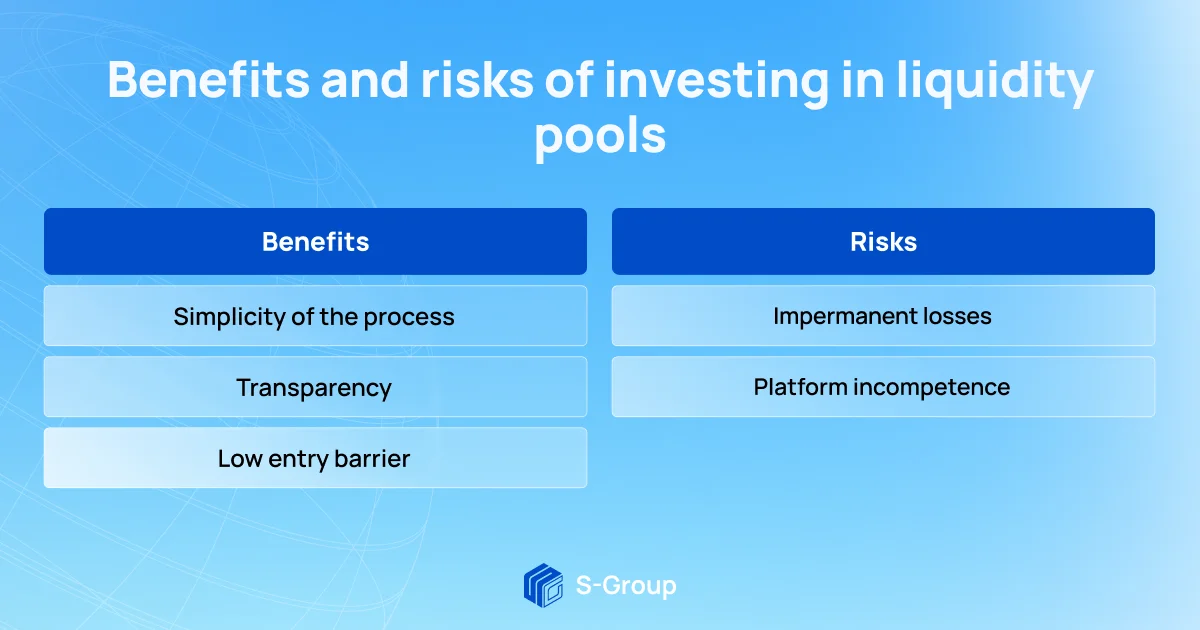
Benefits of investing in liquidity pools
1) Simplicity of the process. Investments in this direction are similar to a deposit in a bank. The investor provides their assets to the platform and receives a percentage of the profit for their use.
2) Transparency. Thanks to smart contracts, the process runs automatically. Therefore, both the platform and the user comply with the conditions set out in the Code.
3) Low barrier to entry. Most platforms allow you to deposit a small amount of assets into the pool. Over time, an investor can use it to increase their return on investment compound interest – Reinvest income from liquidity mining and generate higher returns in the future.
Risks of investing in liquidity pools
1) Temporary losses. The risk of depreciation of an investor’s assets in the liquidity pool due to the volatility of cryptocurrencies.
2) platform incompetence. If the platform hosting the liquidity pool does not have a trading strategy or its smart contracts are vulnerable, the investor may lose his wealth. To avoid this, you should research the platform carefully before investing.
Summary
In the early stages of development, decentralized platforms had problems with liquidity, which liquidity pool technology helped to solve. It is now the base of the DeFi ecosystem, making asset trading easier than in the traditional centralized finance sector.

Liquidity pools have also become an effective passive income tool for crypto investors. Decentralized platforms are developing new reward mechanisms to attract more liquidity providers and create sustainable financial markets. This makes liquidity pools a promising investment area.
Learn Crypto Trading, Yield Farms, Income strategies and more at CrytoAnswers
https://nov.link/cryptoanswers
Comments are closed.