


Unbound is an NFT lending, collateral and borrowing platform that acts as an intermediary between borrowers and lenders. It connects gaming NFTs and offers what the platform describes as “a one-stop solution for gaming NFT lending and borrowing.” The platform allows gaming NFT owners to invest by investing their NFT assets in NFT pools, players wishing to borrow these gaming NFTs could do so for a fee. The fee is based on the rules of the respective NFT pool. The fees generated are collected in these pools and passed on to the owners, with the Unbound platform retaining a share to facilitate rentals.
The platform’s mission is to provide a solution that solves a problem of free lending and borrowing of gaming NFTs. The platform emphasized that gaming NFTs are “intended to be used” and that these NFTs “offer huge potential for lending use cases,” which would include their utilities, calling the Web3 gaming space “still early” in comparison. entire gambling market. Because of this, there is no place where gamers and gaming NFT holders can safely lend and borrow NFTs.
The platform claims to solve this problem by providing a solution for lending and borrowing gaming NFTs that doesn’t require implementation on the part of game developers. The platform allows for lending and lending of all the games listed on the platform.
Unlike other lending protocols that only offer NFTs as collateral to borrow cryptocurrencies, Unbound offers “real rents! where gamers can take advantage of NFTs in their respective gaming dapps.
A unique feature of the Unbound protocol is that the protocol separates utility and ownership of the NFTs listed on its platform. Put simply, in this context, a gamer could use the gaming NFTY he has borrowed from the NFT pool without it being transferred to his wallet address. This will prevent any potential for malicious activities such as transferring or selling them. This feature adds another layer of security to the Unbound Protocol.
The protocol is technically designed to provide a secure and scalable solution to enable utility delegation of a large set of gaming NFTs for gamers. They achieve this through a cross-chain operability approach. The approach bypasses the utilities of smart contracts because while they provide an additional level of security, the smart contract implementation of game developers.
Unbound Protocol mimics the concept of account abstraction, using externally owned accounts. This gives the protocol the ability to regulate the actions of accounts on the platform: what they can and cannot do. This allows Unbound to integrate any game on any blockchain.
What does this mean for gamers?
Using an account abstraction with EOAs simply means that every player user account on the platform comes with an embedded EOA protocol. This EOA gives the player access to the NFT and its utility to play games, but this EOA denies access to the wallets private keys.
A player’s account is programmed to interact with the EOA wallet through the Unbound browser. By logging into the platform with their information (email or Google SSO). This design allows to sign up and play on gaming dapps but not transfer assets within the account.
How to earn with the UnbOund protocol
To earn from the Unbound Protocol, gaming NFT holders must contribute their NFTs to the UNbound Protocol NFT pool. This is similar to what is known Mark out of DeFi liquidity pools. In this case, the lender’s NFT assets are the liquidity deployed on the platform. The lender’s connected wallet serves as account credentials.
This is a security measure as it ensures that only the lender (connected to your individual wallet) can interact with the platform and its NFTs. The lender, by connecting their wallet, becomes the only one able to lend and withdraw NFTs and claim your rewards. For providing this liquidity to the games, lenders are rewarded with rental fees prorated to their total contribution to a pool.
NFT pools
Unbound Platform archives an instant reliable return on their assets by using a peer to pool Method. This method is applied at the moment the NFT owner’s assets are made available on the platform. This means that gaming NFT lending and lending transactions are always routed to or from a specific NFT pool.
Unbound has outlined some benefits that the peer to pool method offers. These benefits are listed below:
First, it allows for instant matching of NFT owners to players. This saves owners the hassle of spending time setting up the right conditions to increase the likelihood of a rental. Once the NFTs are deployed, the platform does the rest.
The method improves the chances and opportunities for scalability by allowing owners with significant assets and significant holdings to collect income at scale rather than finding numerous peer-to-peer matches.
The peer-to-pool method allows owners to earn from their NFT staking with a hands-off approach. This works by pooling the earnings and rewards earned and distributing them proportionately to the contributors to their contribution. As a result, all contributors in a pool earn the same revenue per NFT deployed, regardless of actual usage of the NFT.
Unbound’s token, $una, is still in the vesting phase and has not been released for public transactions. However, it is estimated that there will be around 1,000,000,000 $UNA tokens that will be tentatively allocated to different areas. A breakdown of the allotment gardens and their areas is shown in the following figure: It should be noted that these provisions may be subject to change in the future.
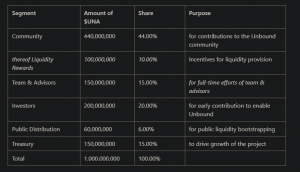
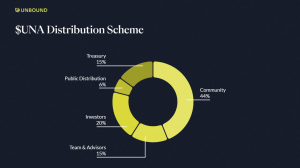
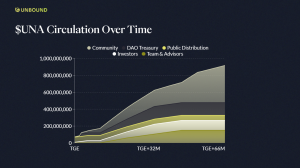
According to Unbound, the circulating supply of $UNA is meant to be an incentive to encourage long-term growth and sustainability. To learn more about the circulation schedule, please see the image below:
See also:
Learn Crypto Trading, Yield Farms, Income strategies and more at CrytoAnswers
https://nov.link/cryptoanswers
Comments are closed.