
If BlackRock continues to buy 6,000 BTC daily, a supply shortage will occur within 18 months. Here's why


Building on CryptoSlate's recent analysis of competing Bitcoin inflows and outflows between BlackRock and Grayscale, I extrapolated the data even further to see how long BlackRock can sustain its current average Bitcoin accumulation.
At a high level, BlackRock's entry via Bitcoin ETFs is a significant moment for Bitcoin's reputation in the United States. Along with the other Newborn Nine ETFs, BlackRock's support will likely result in a reduction in liquid and ultra-liquid holdings as more investors gain access to Bitcoin as a long-term investment. Additionally, it will increase investor confidence among those unfamiliar with blockchain and strengthen Bitcoin's credibility as an asset class, impacting its liquidity and volatility profile.
Before I continue, I would like to add a very clear disclaimer here. The following analysis is a hypothetical look at possible accumulation levels of spot Bitcoin ETFs. I used BlackRock's first inflows as a benchmark. There is no guarantee that these levels will continue, and if they did, it would most likely lead to an increase in the price of Bitcoin. Demand for Bitcoin is unlikely to remain constant at any price, so it is unlikely to see the same BTC inflows over a long period of time.
However, looking at the numbers from a purely theoretical perspective reveals some extremely headline-worthy data points that can then be used alongside other analysis to determine if and when a Bitcoin supply shortage is imminent.
The longer these new ETFs continue to acquire Bitcoin at these elevated levels, the better for long-term HODLers and laser eyes.
In my opinion, HODLing Bitcoin has real purpose now more than ever. The fewer Bitcoins available to purchase in ETFs, the closer we are to a MOASS (Mother Of All Supply Squeeze), where Bitcoin goes down not because shorts need to cover, but because institutions like the rest have to buy Bitcoin on the open market World.
Liquidity in Bitcoin and the Immediate Impact of BlackRock.
Since spot Bitcoin ETFs debuted in the US last week, BlackRock has acquired an average of 6,266 BTC per day, for a total of $1.5 billion 25,067 BTC at the time of printing. The total amount that the Newborn Nine has acquired in just four trading days is now 70,000 BTC ($2.9 billion.) If we include Grayscale, the total Bitcoin under management is 660,540 BTC ($27.6 billion.)
To understand the analysis, I will first outline the buckets used as defined by Glassnode data.
“A company's liquidity is defined as the ratio of cumulative outflows and cumulative inflows over the life of the company. A company is considered illiquid / liquid / highly liquid if its liquidity is L ≲ 0.25 / 0.25 ≲ L ≲ 0.75 / 0.75 ≲ L.”
For more information on how to calculate L, see Glassnode's blog.
- Current supply: The total number of Bitcoins that have been mined and are currently in circulation.
- Illiquid supply: Bitcoins held in wallets without significant movement, suggesting a long-term investment strategy.
- Hydration: Bitcoins that are actively traded or issued, indicating higher market activity.
- Very liquid supply: This category includes Bitcoins that are not only traded but are available for trading on exchanges within a short period of time.
- Exchange offer: Bitcoins held in exchange wallets, ready to be traded or sold.
The chart below shows the different liquidity cohorts for Bitcoin over time. Illiquid supply is by far the largest sector. Interestingly, however, the highly liquid portion is larger than the liquid portion, indicating a dichotomy among investors. Bitcoin holders are either hodlers or traders, and very few are undecided whether to hold or trade Bitcoin.
Bitcoin liquidity supply (Source: Glassnode)
Now that we understand the liquidity situation, let's look at how the different cohorts are performing. The official maximum supply of Bitcoin is 21,000,000 coins. The current circulating supply is 19,600,000. According to Glassnode, the total amount of coins lost is approximately 1,400,000; These include, among other things, Satoshi's coins. There are other higher estimates of lost coins; However, given that this number has remained relatively constant since 2012, I consider it to be the most reliable number.
Interestingly, this means that we Remove the lost coins From the maximum offer we get in the end the same number as the current circulating offer. While this is purely coincidental for this exact point in time, at least in terms of market liquidity, it gives an idea of what it will feel like once all the coins have been mined. Of course, after all coins are mined, the lack of block rewards for miners will add another aspect to the mix that I won't go into in detail now. I would like to say that given Bitcoin's current performance, I believe that the fees will be more than enough to continue securing the network.
| Metric | Value |
|---|---|
| Maximum offer | 21,000,000 |
| Current supply | 19,600,000 |
| Adj. Maximum offer | 19,600,000 |
| Adj. Current supply | 18,200,000 |
| Illiquid supply | 15,402,422 |
| Hydration | 1,306,262 |
| Very fluid supply | 2,892,486 |
| Bill of exchange balance | 2,360,087 |
The current supply can also be adjusted to remove lost coins. The three main cohorts to analyze are liquidity levels, as explained below, and the Bitcoin balance on crypto exchanges. The sum Amount of liquid and very liquid coins to just 4,198,748 BTC ($175 billion), which is about 21% of the $815 billion Bitcoin market cap.
What if BlackRock continued to buy up all Bitcoins?
Now for the fun part you all read: What if BlackRock's inflows continued at debut levels? While some have lamented the launch of spot Bitcoin ETFs as a failure, and the Bitcoin price has even fallen to $0.0413 million from its recent high of nearly $49,000, I think they will certainly end up will have “egg on their face”, as we say in the UK. Here's why!
Currently, 900 new Bitcoins are mined every day, and this value will drop to 450 BTC around April 18, 2024. Additionally, as I said, BlackRock is acquiring around 6,266 BTC every day. If BlackRock attempted to purchase directly from miners, this would result in a net deficit of 5,266 BTC.
So it has to source Bitcoin from somewhere else. So far, Coinbase’s OTC desks have enough liquidity to meet demand. However, this cannot last forever; There is no endless liquidity. The table below shows what would happen if BlackRock purchased from each cohort with miner ownership.
 BlackRock Bitcoin inflow rate
At its current rate, BlackRock would reach around 81,481 BTC in the next 10 days without having a significant impact on any cohort. So the launch failed?
I do not believe that.
If we extend this to September 6, 2024 and BlackRock only purchases from the liquid supply while miners expand this cohort and reduce the impact, the entire cohort would be absorbed.
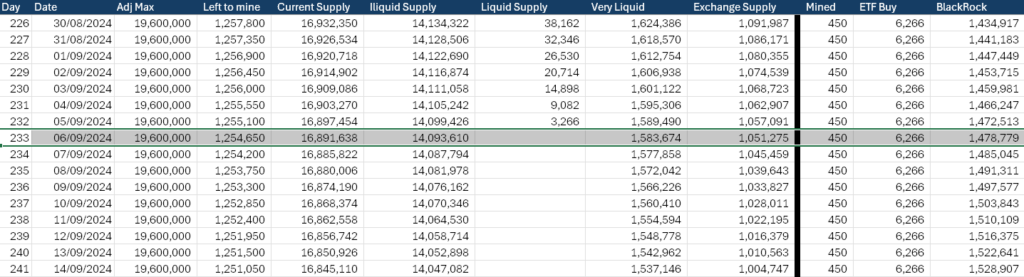 BlackRock Acquisition Day 233
Let's move on.
To keep it clear, every table going forward will be subject to the following hypothetical scenario.
What if BlackRock bought exclusively from this cohort at the rate it was in the first four days and also included newly mined Bitcoins, thereby reducing the impact of BlackRock's purchases?
By March 3, 2025, the Bitcoins held on exchanges would have disappeared and BlackRock would have 2.6 million BTC.
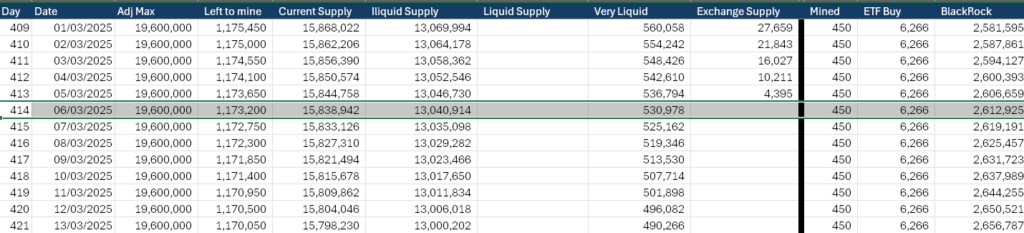 Foreign exchange balance absorbed.
The “very liquid” cohort would be absorbed by June 6, 2025. This group is probably the most accessible group for BlackRock to find liquidity and is only 18 months away.
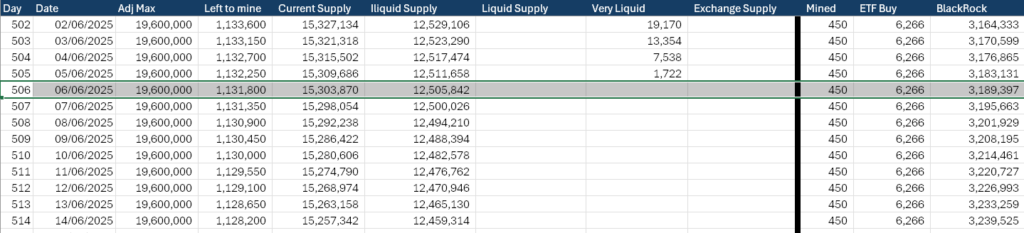 Very hydrated.
In just eight years, by 2032, BlackRock's Bitcoin holdings would be worth $686 billion by today's standards and consist of 16,404,391 BTC. This assumes that the company has found a way to buy up all the Bitcoins from the “illiquid” supply and manage about 79% of all Bitcoins in circulation.
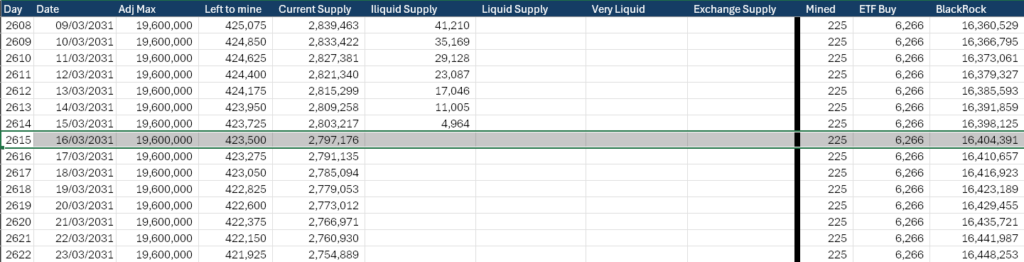 Illiquid supply absorbed
Finally, in just 3,073 short days, on June 16, 2032, BlackRock would have purchased all of the Bitcoins in circulation and eventually had to stop its purchase of 6,266 BTC per day. In the future, only 113 BTC from newly mined Bitcoins would be available every day, of which 327,538 BTC would then still have to be mined.
 BlackRock owns Bitcoin
Of course, few of the above scenarios will occur. It is unlikely that BlackRock will be able to sustain these Bitcoin-based inflows without the Bitcoin price falling significantly or demand increasing with the price.
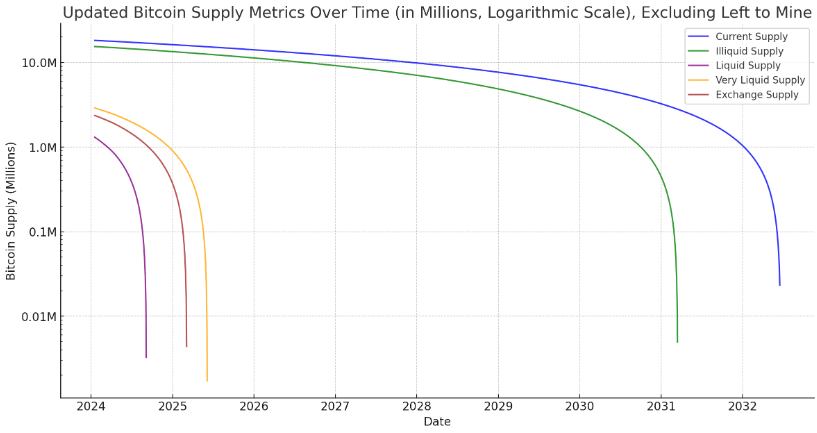 Hypothetical Bitcoin offering acquired by BlackRock
For example, 6,266 BTC is worth $262 million, at $0.04184 million per Bitcoin. At $0.2 million per Bitcoin, this amounts to $1.25 billion daily. Conversely, at $0.01 it is only $62.6 million.
So if Bitcoin doesn't stay around $0.04 million over the next eight years, BlackRock can convince investors to buy its ETF at the same pace and find HODLers willing to sell. We will not see BlackRock take over all the assets of Bitcoin.
However, we can now see what impact consistent Bitcoin ETF inflows can have on different parts of the supply. Personally, my Bitcoin is illiquid and remains so. I see the benefits of spot Bitcoin ETFs and also see the supply shortage that is coming in some form. Definitely not today, probably not this quarter, but after that…
CryptoSlate will continue to crunch the numbers and track down the chain for you. If you enjoyed this exploration of the Bitcoin offering, please let us know on our X account @cryptoslate or contact me directly @akibablade. Thanks also to Samson Mow for the “M” notation for Bitcoin!
Learn Crypto Trading, Yield Farms, Income strategies and more at CrytoAnswers
https://nov.link/cryptoanswers
Comments are closed.