


home” be » How to provide liquidity on Pancakeswap?
What is liquidity?
Liquidity in capital markets refers to the speed with which an asset can be exchanged without adversely affecting its valuation. Liquid assets are sold quickly at fair market value or the current market price. Therefore, assets with higher liquidity are sold at a premium. However, in cryptocurrencies, the term liquidity is defined as an asset’s ability to be easily converted into cash or coins. Liquidity is crucial for all tradable properties, including cryptocurrencies.
Low levels of liquidity indicate that market volatility is present, causing cryptocurrency price fluctuations. On the other hand, high liquidity indicates stable demand with low price fluctuations. In addition, high liquidity is an optimal situation as it leads to improved pricing for all parties involved. A thriving economy with a high degree of trade provides a desirable market price for all. Also, high liquidity facilitates technical analysis by providing accurate chart and price information.
In a crypto market, several factors affect liquidity. One of the essential factors is the trading volume. A larger number of cryptocurrency exchanges are allowing more users to sell their coins, and the number of exchanges has increased in recent years. The increased frequency and trading volume contribute to increased liquidity.
A common term that is used a lot in crypto is “liquidity pool”. It is a fully automated pool and differs from the regular exchange where a price is determined by a change in demand and the recording of transactions in an order book.
When a liquidity pool is created, the liquidity provider sets an initial price. Also, a liquidity pool always trades pairs of tokens that have the same value.
Kryptonomics: what is impermanent loss?
A temporary loss occurs when an investor provides liquidity to a liquidity pool. The asset’s price varies from the time he deposited it – the greater the difference, the greater the temporary loss.
Loss means the difference in dollar value between the time of deposit and withdrawal. It is usually observed in standard liquidity pools where the liquidity provider (LP) is required to have all the assets in the right proportion. One of the assets is volatile compared to the other. For example, the price of ETH is increasing. The sudden price swing creates an irresistible opportunity for arbitrage as the cost of ETH in the liquidity pool now no longer reflects what is going on in the real world.
👉 To ensure that the pool reflects real prices and maintains equilibrium, the pool must rely on arbitrageurs. Traders will buy ETH at a discounted rate until balance is restored. The temporary loss can be turned into a permanent loss if the liquidity provider decides to permanently withdraw its liquidity. However, if the liquidity provider decides to stay in the ecosystem, there is a chance that the assets will revert to their original price.
The question to be asked here is: how to mitigate the risk of temporary loss? Providing liquidity to pairs where the relative price of each commodity matches that of the other in the pair is an easy way to minimize temporary losses.
On the other hand, the downside is that the supply of liquidity with stablecoins is limited in terms of potential price increases and the number of pools available is much smaller.
Other ways liquidity providers can mitigate fickle losses are Balancers and Hummingbot. Liquidity providers use balancers to create custom ratios for assets within a pool, allowing users to gamble on which asset is performing best. LPs will then offset their risks if the economy moves in the direction they predict.
The Hummingbot Miner is a specialized liquidity mining bot that allows users to automate liquidity mining on multiple Binance markets.
Liquidity provision on PancakeSwap – step by step
After PancakeSwap opened its door, a total value of over $1 billion (TVL) has been moved to this platform. It was launched on September 20th, 2020 and uses an Automated Market Maker (AMM). This implies that liquidity pools are permissionless, fully automated and run entirely on algorithms. Similar to the Uniswap DeFi AMM protocol running on Ethereum, Pancake Swap is a decentralized exchange built on top of Binance SmartChain for exchanging BEP-20 tokens.
It allows users to switch between cryptocurrency assets by drawing on user-generated pools of liquidity. These pools are filled with other users’ funds. You put them in the pool and get liquidity provider tokens in return. These tokens are used to reclaim their share, plus a portion of the trading fees. In short, a user can trade BEP-20 tokens or add liquidity and earn rewards.
Unlike Ethereum or Bitcoin, PancakeSwap is a blockchain with lower transaction costs.
- PancakeSwap charges a modest trading rate of 0.2 percent, with 0.17 percent going to liquidity providers and the remaining 0.03 percent going to the PancakeSwap Treasury, which is burned to keep supply down.
- Before proceeding, it is important to understand the difference between yield farming and adding liquidity. Providing liquidity means that users’ initial wealth amounts increase as the pool they are in is used for barter transactions. Yield farming implies that users deposit one set of tokens to mint another token altogether.
- The next question that arises is how to add liquidity to PancakeSwap.
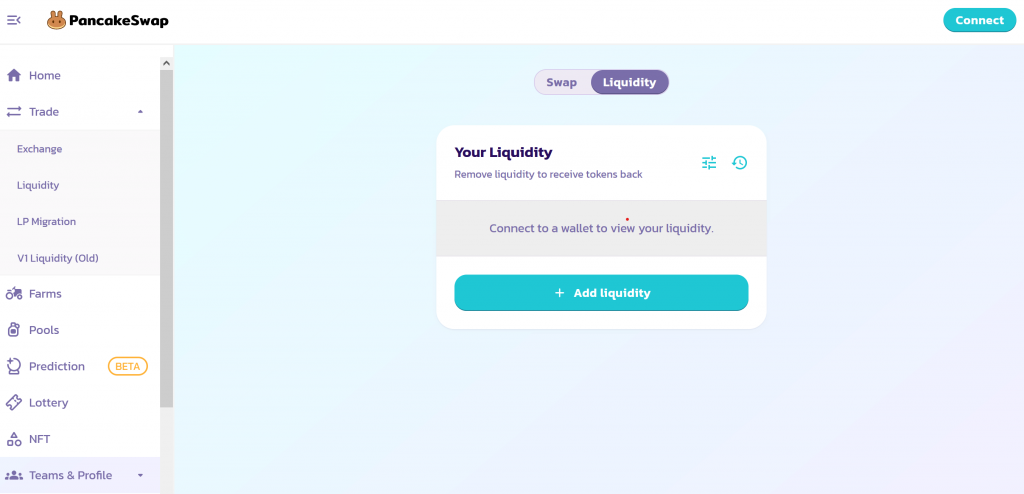
- The first step is to unlock and connect to the wallet.
- Then go to the Liquidity tab and click on the Add Liquidity option.
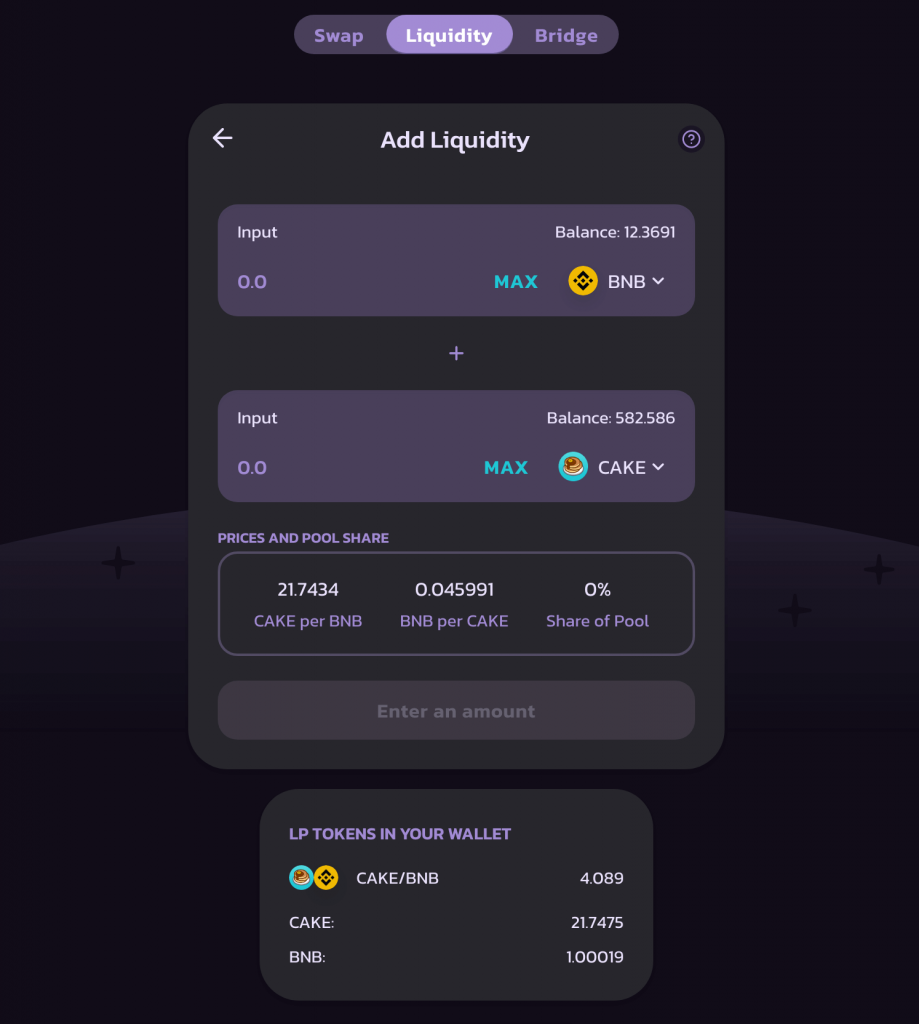
- The third step is to select your tokens (e.g. USDT and BNB) and enter the amount you want to add to the liquidity pool. However, it must be ensured that the token pair is in the same proportion to the value. This means if a user selects Token 1 for $10, Token 2 should also be worth $10.
- Note that a user can provide liquidity in an existing pool or create a new pool. Creating a new pool is an option mostly chosen by new projects looking for a debut in cryptocurrency tokens. However, regular users usually opt to deposit into existing liquidity pools.
- Once the user has selected a specific pair of tokens, deposit the amount and confirm the transaction.
- Upon completion of the transaction, the user receives a FLIP; An LP token represents a user’s share of the pool. In addition, the user can see their liquidity at the bottom of the page.
- The benefit of holding the FLIP LP token is that you receive a portion of the rewards each time an exchange occurs that taps into your pool’s liquidity. To claim these rewards, simply redeem your FLIP tokens to unlock the underlying assets, which have since appreciated in value.
- Once the liquidity has been added to the account, the user can navigate the Farm tab and select an option that suits their LP tokens. One can see multiple ways to surrender their tokens.
- As of the end of February 2021, there are 69 different liquidity pools that you can invest in and earn returns ranging from 23.52% to 378.19% APY to infuse the pools with liquidity. Temporary loss poses a significant challenge for users; Meanwhile, pancakeswap users can protect themselves from fickle losses by deploying CAKE to a single asset pool.
- Unlike other liquidity pools that require a liquidity provider to provide two assets in the same ratio, for many of the pools on PancakeSwap, staking CAKE only involves providing a single token – Cake – which is PancakeSwap’s native token.
- Since there is only one token in the pool, any deviation in CAKE price would not result in a temporary loss as there is no need to maintain balance with another token in the pool.
- Furthermore, regardless of the discrepancy between the price of CAKE at the time of staking and the cost of CAKE, if a Liquidity Provider wishes to de-stake, the Liquidity Provider will receive the same amount of CAKE if he or she de-stakes. This ensures that a liquidity provider using CAKE earns regular returns based on the annual percentage return of the pool he or she selects and an upward movement in the market.
- And hence, it offers an opportunity to earn passive income without fear of impermanent losses.
PancakeSwap on Binance Smart Chain is the largest and most widely used AMM for yield farming and staking. It has a daily trading volume of over $650 million, which is more than double that of SushiSwap and almost that of Uniswap (v2). To sum up the discussion, the biggest challenge for liquidity miners is fickle loss. However, Pancakeswap is a safe and legitimate website that receives audits from a cybersecurity company Certik. It is protected by Security Oracle, Certik Shield, DeepSEA and the Certik Virtual Machine. Additionally, it also supports a number of popular wallets such as Trust Wallet, TokenPocket, WalletConnect, MathWallet, and MetaMask. Overall, it is clear that DeFi continues to grow on both Ethereum and BSC, and PancakeSwap is making a name for itself as the place to go for yield farming.
Also read:
 How are normal people making returns of up to 70% in a year without risk? By properly setting up a FREE Pionex grid bot – click the button to learn more.
 Crypto arbitration still works like a charm if you do it right! Check out Bitsgap, the leading crypto arbitrage bot, for the best way to do it.
CaptainAltcoin’s authors and guest contributors may or may not have a vested interest in any of the projects and companies mentioned. None of the content on CaptainAltcoin is investment advice or a substitute for advice from a certified financial planner. The views expressed in this article are those of the author and do not necessarily reflect the official policy or position of CaptainAltcoin.com
Learn Crypto Trading, Yield Farms, Income strategies and more at CrytoAnswers
https://nov.link/cryptoanswers
Comments are closed.