


In Grayscale's latest report, “2024 Halving: This Time It's Actually Different,” Michael Zhao provides an in-depth analysis of the evolving dynamics within the Bitcoin ecosystem as the next halving event approaches in mid-April 2024. The report argues for a significant departure from previous cycles, highlighted by the emergence of spot Bitcoin ETFs in the United States, evolving investment flows and innovative use cases emerging within the Bitcoin network.
The Essence of Bitcoin Halving
Halvings, which aim to halve the reward for mining Bitcoin transactions every four years, are crucial to maintaining Bitcoin's scarcity and disinflationary profile. Zhao puts it succinctly: “This disinflationary characteristic represents a fundamental appeal for many Bitcoin holders,” highlighting the stark contrast to the unpredictable offerings of fiat currencies and precious metals.
Despite historic post-halving price increases, Zhao warns against taking such outcomes as guarantees, explaining: “Given the highly anticipated nature of these events, if a price increase were a certainty, rational investors would likely buy in advance and push the price up beforehand drive.” the halving occurs.”
Distinctive features of the 2024 halving
Macroeconomic factors
However, according to Zhao, macroeconomic factors were different in each cycle and continued to push the BTC price to new heights. The researcher describes the 2012 European debt crisis as a key catalyst in Bitcoin's rise from $12 to $1,100, highlighting its potential as an alternative store of value amid economic turmoil.
“Similarly, the initial coin offering boom in 2016 – which saw over $5.6 billion flow into altcoins – also indirectly benefited Bitcoin, driving its price from $650 to $20,000 by December 2017 . Expansive stimulus measures occurred particularly during the COVID-19 pandemic in 2020 […] [drove] “Investors prefer Bitcoin as a hedging tool, the price of which rose from $8,600 to $68,000 by November 2021,” explains Zhao.
Therefore, Zhao points out that while halvings contribute to Bitcoin's scarcity narrative, the broader economic context always also has a crucial influence on Bitcoin's price.
Miners' strategic adjustments
In anticipation of the next BTC halving in April, miners have proactively adjusted their strategies to offset the impending decline in block reward revenue amid escalating mining difficulties. Observing a strategic move by miners, Zhao notes: “In the fourth quarter of 2023, there was a noticeable trend of miners selling their Bitcoin holdings on-chain, presumably to build liquidity before block rewards were reduced.”
This foresight suggests that miners are not just reacting, but actively preparing to deal with the challenges ahead, thereby ensuring the resilience of the network. “All of these measures suggest that Bitcoin miners are well positioned, at least in the short term, to overcome the challenges ahead,” argues the Grayscale researcher.
The emergence of atomic numbers and layer 2 solutions
The introduction of ordinal inscriptions and the exploration of Layer 2 solutions have opened new dimensions to Bitcoin's functionality and scalability. Highlighting the importance of these innovations, Zhao explains: “Digital collectibles… were registered, bringing miners more than $200 million in transaction fees.” This development has not only increased the utility of Bitcoin, but also brought new opportunities to miners opened to generate sales.
Additionally, Zhao emphasizes the potential of Layer 2 solutions to address Bitcoin's scalability challenges, noting, “The growing interest in Taproot-enabled wallets… suggests a concerted move to address these challenges.” This reflects a concerted effort within the Bitcoin community to improve the network's capabilities and enable a wider range of applications.
The role of ETF flows
The approval and subsequent launch of spot Bitcoin ETFs have significantly impacted Bitcoin's market structure, providing investors with broader access and potentially alleviating selling pressure from mining rewards. Expressing the impact of ETF flows, Zhao claims: “Following the spot Bitcoin ETF approvals in the US, initial net flows… amounted to approximately $1.5 billion in the first 15 trading days alone.”
This suggests that ETFs could play a crucial role in balancing post-halving market dynamics by absorbing a significant portion of the typical post-halving selling pressure. “Sustaining current prices requires equivalent buying pressure of $14 billion per year. After the halving, these requirements will be reduced by half: […] That represents a decline to $7 billion per year, effectively easing selling pressure.”
A promising outlook for Bitcoin
According to Grayscale analysis, the next Bitcoin halving will be different for several reasons. Overall, the outlook is very optimistic:
Bitcoin has not only weathered the storm of the bear market, but its performance over the past year has also emerged stronger and challenged outdated notions. While it has long been touted as digital gold, recent developments suggest that Bitcoin is evolving into something even more significant.
At press time, BTC was trading at $49,708.
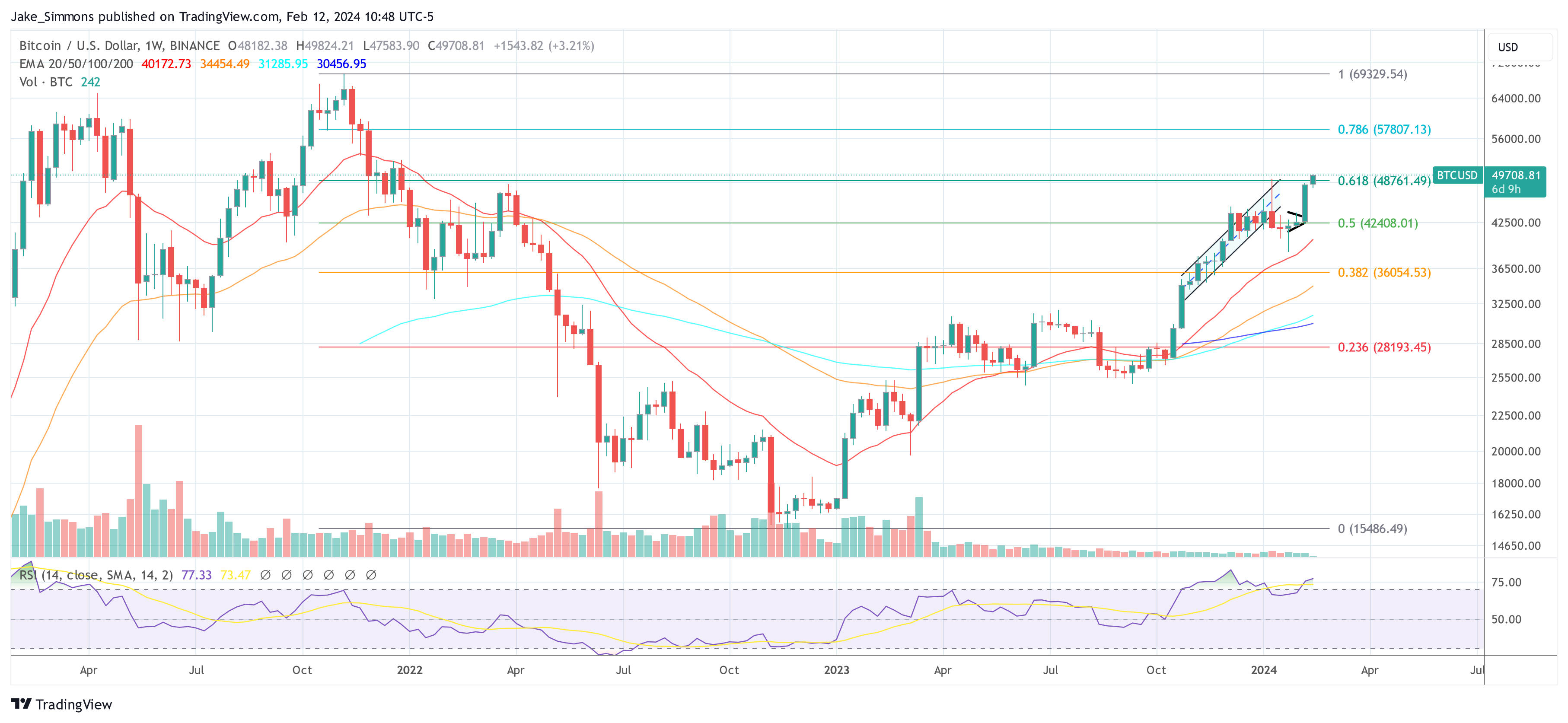 BTC price, 1-week chart | Source: BTCUSD on TradingView.com
Featured image created with DALLE, chart from TradingView.com
Learn Crypto Trading, Yield Farms, Income strategies and more at CrytoAnswers
https://nov.link/cryptoanswers
Comments are closed.