
Ethereum will see more long-term holders than Bitcoin in 2023, according to on-chain data


- Ethereum has more long-term holders than Bitcoin, according to on-chain data from IntoTheBlock.
- While seeing significant increases across the board, ETH is outperforming BTC among large holders.
- Metrics such as the percentage of coins in USD, the time held and the number of addresses were taken into account.
- Experts attribute this scope to Ethereum’s DeFi dominance, since the network, unlike Bitcoin, offers not only a cryptocurrency, but also more functionality.
Ethereum (ETH) price shows a significant correlation with Bitcoin (BTC) price and shows almost similar price movements, with momentum indicators also matching. However, a closer look reveals that ETH performs better than BTC on several counts, especially when it comes to large holders or whales.
Also Read: Ethereum Price Outperforms Bitcoin on Speculations SEC May Approve ETH Futures ETF Earlier
On-chain data from IntoTheBlock shows a commendable surge in long-term holders over the past year, with Ethereum outperforming Bitcoin. Specifically, Ethereum has a whopping 73.5 million long-term holders (those who have owned the cryptocurrency for more than a year) versus Bitcoin’s 33.61 million.
When it comes to whales, ETH has 5,370 addresses with between 1,000 and 10,000 ETH. BTC, on the other hand, only has 1,920 addresses with between 1,000 and 10,000 Bitcoin.
ETH assets by time held
The number of humpback whales (addresses with more than 5,000 ETH) is also very high: 106,000 Ethereum holders own between 10,000 and 100,000, compared to 103,670 Bitcoin holders.
108 addresses hold more than 100,000 ETH, while only four hold as much BTC.

ETH addresses by holdings
In addition, six wallets hold over a million ethers.
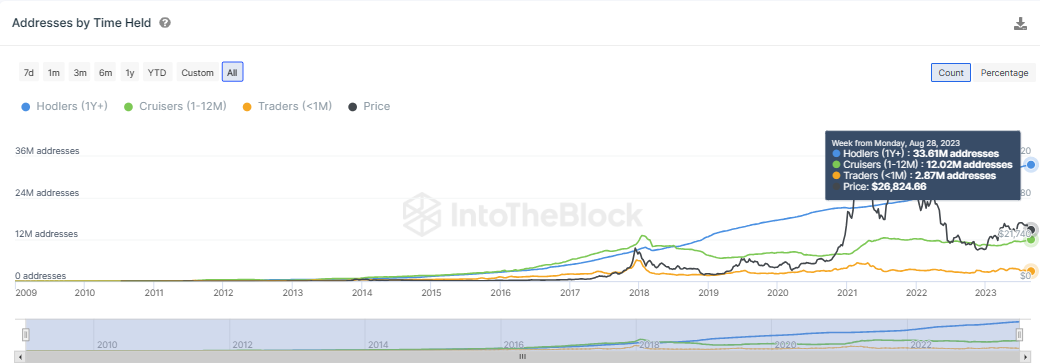
BTC assets by time held
The proportion of Bitcoin and Ethereum holdings in USD also paints a similar picture in favor of ETH.

BTC Assets by Holdings
Possible reasons for Ethereum overturning Bitcoin
Experts attribute the inequality favoring Ethereum to the network’s dominance in the decentralized finance (DeFi) space. In particular, the Proof-of-Stake (PoS) token has more functionality or use cases than Bitcoin, which is valued only as a digital currency.
Applications of the Ethereum network include:
- Hosting other cryptocurrencies and stablecoins.
- Creation and trading of non-fungible tokens (NFTs).
- Development of decentralized applications (DApps) in the areas of finance, web browsing, games and advertising, among others.
- Providing access to financial services including but not limited to crypto lending, yield farming and initial coin offerings (ICOs).
- Creation and maintenance of digital identities for individuals, companies and Internet of Things (IoT) devices.
The proportion of ETH locked in the DeFi landscape is also huge, totaling up to $22.31 billion compared to Bitcoin’s $162.6 million locked in the same domain. This explains why Ethereum has more long-term holders.
Bitcoin price is up about 31% year-to-date, while Ethereum price is up just 6.8% over the same period. Of course, the variation shows that the dynamics in the cryptocurrency market are not just limited to valuation. Although Bitcoin is the leading cryptocurrency by market cap, Ethereum has managed to attract more large holders.
Frequently asked questions about Ethereum
Ethereum is an open-source decentralized blockchain with smart contracts functionality. It serves as the backbone network for the cryptocurrency Ether (ETH) and is the second largest cryptocurrency and the largest altcoin by market cap. The Ethereum network is tailored for scalability, programmability, security, and decentralization—traits that make it popular with developers.
Ethereum uses decentralized blockchain technology that allows developers to build and deploy applications independent of the central authority. To make this easier, the network has a programming language that helps users create self-executing smart contracts. A smart contract is basically code that can be verified and enables transactions between users.
Staking is a process whereby investors grow their portfolios by locking their assets for a period of time rather than selling them. It is used by most blockchains, especially those that use the Proof-of-Stake (PoS) mechanism, where users receive rewards as an incentive for staking their tokens. For most long-term cryptocurrency holders, staking is a strategy to earn passive income from your assets and in turn use them to generate rewards.
Ethereum switched from a Proof-of-Work (PoW) to a Proof-of-Stake (PoS) mechanism in an event called “The Merge”. The transformation came as the network wanted to achieve greater security, reduce energy consumption by 99.95% and implement new scaling solutions with a possible threshold of 100,000 transactions per second. With PoS, there are fewer barriers to entry for miners given the lower energy requirements.
Learn Crypto Trading, Yield Farms, Income strategies and more at CrytoAnswers
https://nov.link/cryptoanswers
Comments are closed.