


Flare gas, a ubiquitous byproduct of oil production, releases enormous amounts of CO2, representing a huge waste of energy. However, this waste could be converted into a source of energy for innovative areas such as Bitcoin (BTC) mining. Find out how Flaring Gas and Bitcoin could form a surprising alliance.
What is flare gas?
Flare gasalso known by the English term “gas flaring”, refers to the process of burning excess gas released during oil production.
This gas is a byproduct of oil production. In particular, it is possible to observe its combustion from chimneys at oil production sites.
This excess gas is burned for various reasons. First, this gas is mostly methane. The combustion process converts methane (CH4) into carbon dioxide (CO2), which is about 25 times less harmful to the environment.
Gas that builds up around oil in underground reservoirs must be vented before oil drilling to avoid a sudden increase in pressure that could lead to explosions. Combustion of the gas helps reduce this pressure and avoid risks to workers and infrastructure.
Finally, when small amounts of gas are produced in excess or when the infrastructure for this needs to be created Extracting and transporting this gas would not be profitable; oil tankers would simply prefer to burn it rather than investing in its collection and use.
In 2022, the amount of gas flared was 138.55 billion m3, equivalent to 357 million tons of CO2 equivalent. or about 1% of global greenhouse gas emissions.
Gas flaring is the most common in Russia and is responsible for 25.5 billion people M3in Iraq with 17.9 billion M3and in Iran with 17.2 billion M3.
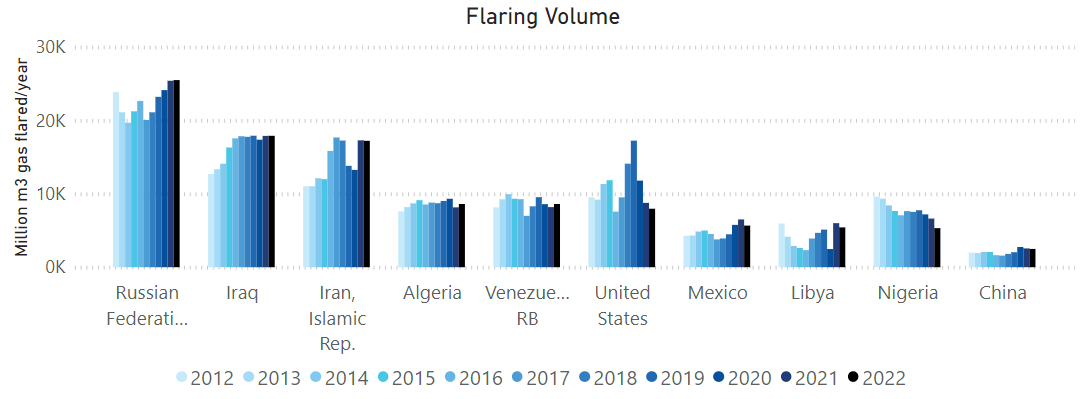
Figure 1: Amount of gas flared per year and per country
Gas flaring also has direct negative consequences for human health.
It releases chemicals into the air: Benzene and naphthalene, carcinogenic can cause headaches, tremors, irregular heartbeats, and eye and liver damage in residents.
For this reason the World Bank launched the initiative “ No routine flaring by 2030 », with the aim of manufacturers stopping the systematic flaring of gas.
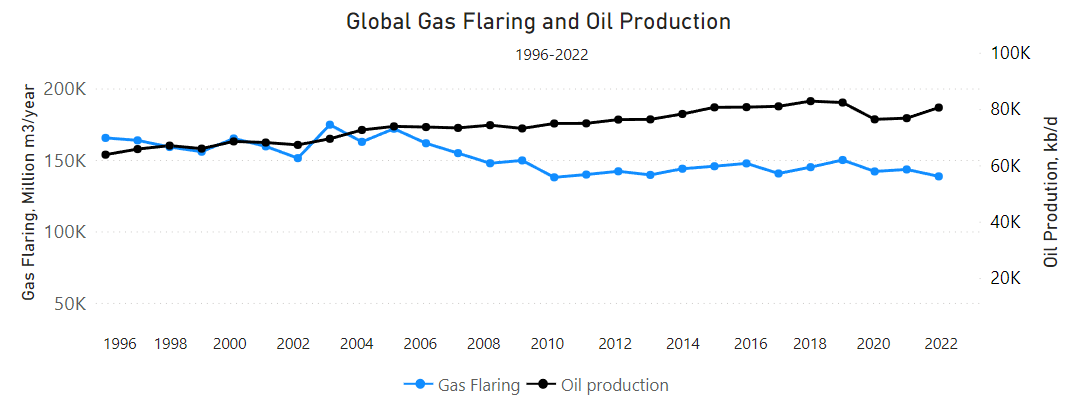
Figure 2: Amount of gas flared (blue) compared to oil production (black) since 1996
As the table above shows, The oil companies don’t seem determined to stop wasting this gas. In fact, the amount of gas flared has remained constant since 2010.
🔎 Expand your knowledge of cryptocurrencies with Cryptoast Research
Cryptoast Research: Stay Ahead of the Market
What if flare gas could be used?
A 2010 study conducted by Professor Ola Eriksson for the University of Gävle showed that one cubic meter of natural gas could produce 11 kWh. So, lThe 138.55 billion m3 of gas flared in 2022 could have produced up to 1,524 TWh. This equals Brazil’s energy consumption to that of South Korea and France.
Over and beyond, a report from the International Energy Agency shows that among the 935 billion M3 produced natural gas in 2019 around 6% (in yellow in the graphic below) were not even torched, but simply released into the air.
These 55 billion m3 of gas could therefore generate up to 605 TWh.
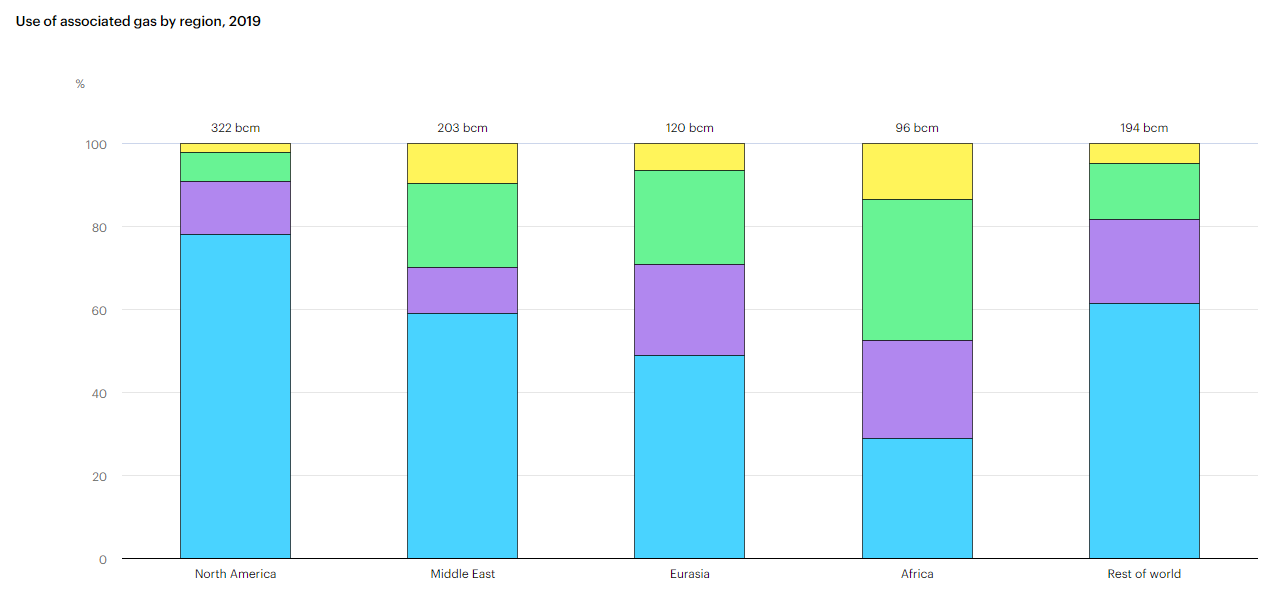
Figure 3: Gas consumption by region
But how could manufacturers use this gas? Is it doomed to burn without serving any useful purpose?
It would be very expensive to connect drilling sites to the power grid, because they are often far away from urban centers and, above all, mobile. Also, Establishing an industry nearby would pose risks to workers’ health. This is where Bitcoin mining comes into play.
⛏️ Startmining: the French company reinventing Bitcoin (BTC) mining
Why Bitcoin (BTC) mining and not another industry?
The decision to choose Bitcoin mining over other industries is based on several key factors that define it the only serious way to exploit excess wasted gas.
Unlike many industries that require fixed infrastructure and heavy installations, ASICs (the machines used to mine Bitcoin) are generally stored in containers can be easily unplugged and transported around the world.
This feature makes it easier to move mining farms quickly, as miners who left China after the government banned Bitcoin mining in 2021 can attest.
According to calculations by the University of Cambridge, Bitcoin mining consumes approximately 116.61 TWh per year. Bitcoin (BTC) mining and Its ability to stop and then move quickly in any environment makes it the only industry capable of efficiently using currently wasted energy.
Over and beyond, The 1,524 TWh that can be generated from flare gas, as well as the 605 TWh that can be generated from gas simply released into the air, could together power the entire Bitcoin network by a factor of 18.26.
In a hypothetical scenario where Bitcoin runs solely on flare gas, its carbon footprint would then be zeroBecause even without it, the entire network would still rely on environmentally harmful energy.
Currently, Although the share of energy from gas flaring in the Bitcoin network’s energy consumption is still small (around 1%), this represents a significant growth opportunity for this industry.
Thanks to its unique properties, Bitcoin could not only help reduce energy wastebut also play a positive role in the transition to more sustainable energy sources and the overall reduction of greenhouse gas emissions.
We would like to thank you Daniel Batten for his valuable contribution to this article. He generously shared with us the source of energy production from natural gas and his works were a great help in enriching this content.
💡 Find our guide to buying BTC easily
Trade Republic: Earn 4% interest per year on uninvested money
Sources: The World Bank; Figures 1 and 2 World Bank; Figure 3: International Energy Agency
Newsletter 🍞
Get a crypto news roundup emailed to you every Monday 👌
What you need to know about affiliate links. Investment-related assets, products or services may be featured on this site. Some links in this article may be affiliated. This means that if you buy a product or register on a site using this article, our partner will pay us a commission. This allows us to continue to offer you original and useful content. There will be no damage to you and you can even receive a bonus via our links.
Investing in cryptocurrencies is risky. Cryptoast is not responsible for the quality of the products or services presented on this site and cannot be held responsible, directly or indirectly, for any damage or loss arising from the use of any good or service highlighted in this article. Investments related to cryptoassets are inherently risky. Readers should do their own research before taking any action and only invest within their financial means. This article does not constitute investment advice.
AMF recommendations. There is no guaranteed high return; a product with high return potential carries a high risk. This risk tolerance must be consistent with your project, your investment horizon and your ability to lose some of these savings. Do not invest if you are not prepared to lose all or part of your capital.
Further information can be found on the “Financial Situation”, “Media Transparency” and “Legal Notice” pages.

First drawn by the lure of profit, I’m now trapped deep down the rabbit hole. Since there is no way out, I simply have to share my knowledge and convey my passion for the world of blockchain.
Marius Farashi Tasooji
9 items
Learn Crypto Trading, Yield Farms, Income strategies and more at CrytoAnswers
https://nov.link/cryptoanswers
Comments are closed.