


Uniswap is a system of non-updatable smart contracts on the Ethereum blockchain that acts as an automated liquidity protocol with a constant product formula. Prioritizing decentralization, censorship resistance, and security eliminates the need for trusted intermediaries.
Uniswap is a decentralized crypto exchange (or DEX); one of the key components of the DeFi ecosystem. Many of the problems that plague their centralized counterparts, such as the possibility of hacking, poor management, and arbitrary fees, are addressed by DEXs. Although decentralized exchanges have their challenges, one of the biggest challenges is a lack of liquidity, meaning not enough money flowing through an exchange to make trading faster and more efficient.
Uniswap tries to solve the liquidity problem of decentralized exchanges by allowing the platform to exchange tokens without the need for buyers and sellers to create liquidity.
In this article, we’ll dive deep into Uniswap by looking at what it is, its features, how it works, and more.
What is Uniswap?
Uniswap is an Ethereum-based decentralized trading protocol. It is an automated liquidity platform. With Uniswap, the execution of transactions does not rely on an order book or a centralized party. Therefore, users can do business with each other directly. Users can also switch between ERC-20 tokens without using an order book.
Due to the decentralized nature of the Uniswap protocol, there is no listing procedure. Any ERC-20 token can be released as long as a liquidity pool is accessible to traders. Uniswap therefore does not charge any listing fees.
The protocol was developed by Hayden Adams in 2018. Vitalik Buterin (co-founder of Ethereum) was the first to talk about the underlying technology of the protocol.
Features of Uniswap
Uniswap differs from other blockchain networks with the following key features:

exchange
Swapping one ERC-20 token for another is easy with Uniswap token swaps. Instead of an order book, Uniswap uses an automated market-making process to obtain real-time price and slippage information.
liquidity pool
A pair of ERC20 tokens can be traded in each Uniswap liquidity pool. The balances of each token in a pool contract are initially zero. Therefore, someone has to seed the pool with an initial deposit of each token before they can start facilitating trades. The starting price of the pool is determined by this first liquidity provider.
flash swap
This is a new feature seen in Uniswap V2. It allows users to run any logic and withdraw up to the entire reserves of any ERC20 token on the platform with no upfront fee.
oracle
Oracle is a key DeFi (Decentralized Finance) application component. As per its protocol, the Uniswap team created its own oracle. Uniswap V2 allows developers to create on-chain price oracles that are very decentralized and difficult to change. This can meet several needs for creating reliable logs.
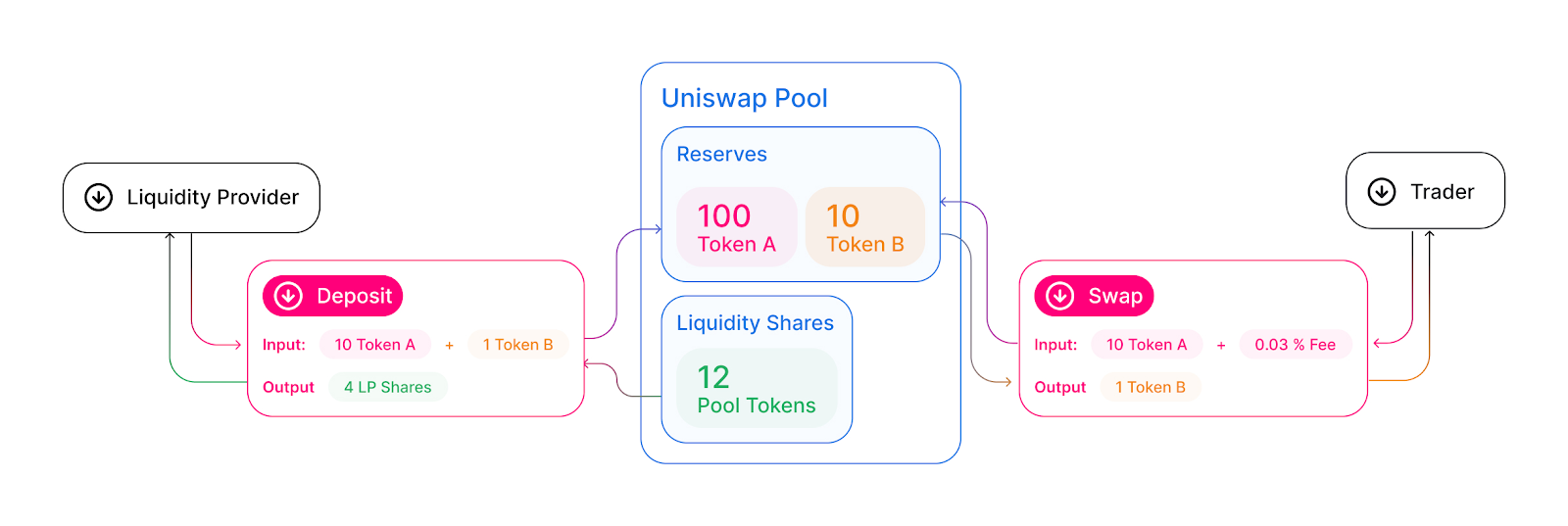
How Uniswap works
Automated Market Maker Technology (AMM) is the main innovation that allows the protocol to work. AMM controls the Uniswap pools that provide the tokens needed to execute trades. Uniswap’s AMM algorithm determines the actual price of a token during a trade based on how supply and demand changes between the tokens in those liquidity pools.

When consumers transact with one of Uniswap’s liquidity pools, they now pay a 0.3 percent transaction fee. Each participant in the liquidity pool receives a portion of these costs based on the stake of the pool. For example, if the total fees generated are $200 and you have contributed 60% of the liquidity to the pool, you will receive $120. Profits from transactions are distributed among users (the platform does not charge transaction fees).
How to use Uniswap
You need an Ethereum wallet and a small amount of ETH (which you have to pay for gas fees) to use Uniswap.
Transaction fees, also known as “gas”, are a problem that users of all Ethereum-based applications, including Uniswap, encounter as they can be very expensive. The long-planned move to the ETH2 blockchain and the more timely release of a “Layer 2” scaling solution (i.e. optimism) are attempts to address this issue.
Uniswap V3 was launched in May 2021 to make transactions more efficient and cheaper.
UNI token
UNI, a native governance token with a market cap of approximately $3.49 billion enabling greater community participation and oversight, was launched by Uniswap in September 2020. UNI owners can vote on the various developments taking place on Uniswap projects. Additionally, UNI holders can use the token to fund grants, collaborations, liquidity mining pools, and other growth-oriented projects that increase the utility and scale of Uniswap.
The founding team will be less involved in platform management as the Uniswap community expands and UNI holdings diversify. This shows that Uniswap follows the core ideas of the DeFi revolution, namely decentralization and equalization of incentives.
Investors can also trade UNI on exchanges and treat it as a speculative investment even though it is a governance token.
Liquidity mining contributes to some of the tools used for community distribution. This means that people who provide liquidity to the following Uniswap pools receive UNI:
- ETH/USDT
- ETH/DAI
- ETH/USDC
- ETH/WBTC
The Uniswap community includes Ethereum addresses that have transacted with Uniswap contracts.
This is how you can claim UNI (Uniswap token).
Those who used Uniswap can claim around 400 UNI tokens for each address they used Uniswap with. Here are the steps you can take to claim your UNI:
- Visit https://app.uniswap.org/.
- Connect the wallet you previously used for Uniswap.
- Click Claim Your UNI Tokens.
- Check the transaction in your wallet.
- That’s all. You are now the holder of a Uniswap token (UNI).
Diploma
Uniswap is an innovative DEX (decentralized exchange) based on Ethereum. One of the advantages of Uniswap is the fact that funds are not sent to middlemen. This means transactions are not subject to counterparty risk as users can trade directly from their Ethereum wallets.
While it has obvious downsides, this concept could have some intriguing implications for the development of trusted token exchanges. Uniswap could benefit from Ethereum 2.0 scaling once it is live on the network.
Learn Crypto Trading, Yield Farms, Income strategies and more at CrytoAnswers
https://nov.link/cryptoanswers
Comments are closed.