
This quote means: “Sport has the power to unite people in ways rarely possible otherwise,” by Nelson Mandela | News explained


Despite India’s enduring love for cricket, sport in general is often a force unto itself: be it the competition that divides people based on long-standing rivalries, or the ups and downs of a game that unites millions of people.
Sport also has a political dimension, and politicians have long used it to promote causes close to their hearts. One of these leaders was the late South African leader and former President Nelson Mandela. He once said: “Sport has the power to change the world, it has the power to inspire.” He added: “It has the power to unite people in a way that few others do.” Sport can create hope where there was once only despair. It is more powerful than the government in breaking down racial barriers.”
How sport separates and unites
Sport alone represents a kind of raw strength and technical prowess that can amaze most people. A gymnast performing a perfect routine, an archer hitting a bullseye, or a cricketer leaping through the air to make the most difficult catch – all of these feats visually impress the audience.
Furthermore, sport has long been linked to regionalism and nationalism. The most bitter rivalries in team sports often occur between teams whose countries have contentious political or ethnic histories. The writer George Orwell pointed out this tendency and described the sport as “war without shooting”.

The case of South Africa
At the same time, high-stakes moments provide an opportunity for people to come together around a single, straightforward goal and hope for their team to win.
Such a tactic was used in South Africa, a country that had suffered for decades under British colonial rule and an apartheid regime that made racial discrimination part of the government’s official policy. Black populations were forced to live in certain parts of cities and had limited access to most high-quality resources.
In 1995, five years after the end of apartheid, a Truth and Reconciliation Commission was established to investigate apartheid-related crimes. It was believed that this would help the country reconcile with its past and overcome divisions.
A History Channel article states: “Black South Africans wanted to destroy all symbols of the apartheid regime. At the top of the list: the Springbok, which has been the mascot of the rugby team – and the sporting symbol of the apartheid National Party – since 1906.”
“After the first free elections in 1994, all South African national teams adopted a Protea, the country’s national flower, as their emblem – with the exception of the rugby team. “In a country where rugby was the great national pastime, many white South Africans were unwilling to give up the Springbok emblem with its green and gold colors,” it said.
Mandela and the 1995 Cup
The 1995 Rugby World Cup final changed perceptions of the team, as Mandela sought to make some kind of peace offering.
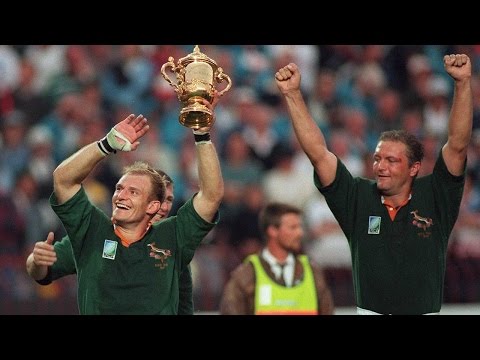
In a CNN article that quoted excerpts from journalist John Carlin’s book “Nelson Mandela and the Game That Made a Nation,” he was quoted as saying, “The crowning moment of the day came before the game had even begun when Mandela arrived “Entering the pitch was a crowd of 65,000, 95% white and wearing the green Springbok jersey, the ancient symbol of oppression beloved by its prison guards during apartheid.”
He wrote: “There was a moment of jaw-dropping disbelief, a sharp collective intake of breath, and suddenly the crowd erupted in an ever-increasing chant of ‘Nelson!’ out of. Nelson! Nelson!’”
Mandela’s support of the team was criticized by anti-apartheid activists who believed he was betraying the policy of boycotting the regime and its symbols in order to appease the white population, who also viewed him with suspicion. However, Mandela believed that outreach was necessary to bring the “Rainbow Nation” together and to include the various groups that made it diverse.
Most read
1
Fans urge Amitabh Bachchan not to watch ICC World Cup 2023 final between India and Australia, actor says: ‘I think…’
2
World Cup: Back in Shubman Gill’s sprawling village home near the India-Pakistan border, his grandparents tell stories about little “Shub” before the grand finale.
See more
The team’s victory in the final sparked collective celebration. “When the final whistle blew, this country changed forever,” team captain Pienaar said years later when Mandela died. When the team won and the trophy was presented, he was asked about the support his team had received from 65,000 fans. Then he said: “We had 43 million South Africans today.”
But that didn’t mean that the divisions that had existed for so long could be healed by just a gesture. For many years, the underrepresentation of black players in the country’s rugby team was highlighted as a sign of a lack of progress.
“Just as Mandela’s gesture in 1995 was celebrated as a metaphor for the nation’s racial reconciliation, the failure of the rugby transition is seen as a metaphor for the disillusionment among blacks who achieved political but not economic freedom,” wrote journalist David Smith 2015 Guardian column.
Comments are closed.