


Editor’s Note: This is the third in a four part series about Dale Jarrett of the NASCAR Hall of Fame. Click here to read parts one and two.
With his departure from Joe Gibbs Racing, Dale Jarrett joined Robert Yates Racing in 1995 to drive the #28 Ford in place of the injured Ernie Irvan.
En route to his back-up role, Jarrett capitalized on his opportunities, knowing that a full-time end-of-season drive wasn’t guaranteed.
A win at Pennsylvania’s Pocono Raceway and 14 top 10 finishes with legendary crew chief Larry McReynolds at the helm helped boost Jarrett’s stocks ahead of the 1996 season.
“I knew it was a one-year deal and that there were many other opportunities than those that would have been associated with Robert,” Jarrett told SPEED SPORT. “When he then decided on the second car in 1996, where we built the championship team with the ’88 car, it was just incredible.”
Robert Yates Racing expanded in 1996 with Irvan back at #28 and Jarrett at #88.
The expansion came despite team owner Robert Yates’ initial hesitation about adding a second team. Yates did not want to thin out the organization.
“Having that chance, knowing that he’s taking that chance to do something that he was really against, which is make the team bigger, because he just felt like it could be more stressful for everyone,” Jarrett said . “He didn’t want to grow beyond his means there because he wanted to focus on building the one car, the 28 car, that he had so much success with.
Jarrett (right) kisses the bricks along with crew chief Todd Parrott after winning the Brickyard 400. (Indianapolis Motor Speedway Photo)
“He wanted to keep that focus where it could be as best as possible. But then to understand through Ford Motor Co. and sponsors that with two we could have more people and better resources and make all this work.”
Among the many new hires for Jarrett’s fresh No. 88 team was crew chief Todd Parrott.
The duo saw immediate results in 1996 at Daytona (Fla.) Int’l Speedway.
“Our very first race together was the Busch Clash in 1996,” said Jarrett. “We won that and turned around a week later and won the Daytona 500. So it was up and running. What transpired over the next 9-10 years was just an amazing life experience as a competitor and knowing that every time you went to the track you had an opportunity to be in the front and most of the time you wouldn’t have a car , which is very victorious.
“You had to do things differently because that was more horsepower than I’ve ever ridden. It was more than most people ever get the chance to drive. On certain circuits you had to change your driving style. Of course it was a huge advantage to have that on certain circuits.
“It took a mindset to be willing to change things from what you knew before. Having people like Todd Parrott, Robert and Doug Yates to talk to about this was invaluable to me because I was trying to be a sponge and take all that information and then apply it to my driving and my decisions Racetrack.”
A winning mentality became standard for the No. 88 team. From 1996 through 1998, Jarrett and company never finished worse than third place overall. However, a championship had yet to be earned.
The introduction of the Ford Taurus after years of competing with the Ford Thunderbird presented teams with a hurdle to maneuver around. Nevertheless, in 1999 everything came together for the No. 88 group.
“1998 wasn’t our best year, although we still finished third in the points,” said Jarrett. “We fought at times and in places where we didn’t usually fight, it became a real fight. But that made us stronger and figuring out things we needed to know with this new car.”
While the season started with a crash at Daytona, Jarrett and the team were set for a strong season.
“From that point on it was like every single race where we were either competitive or even on the days where we might have missed setup it took us days where we were literally 25th and made it into the top 5,” Jarrett said.
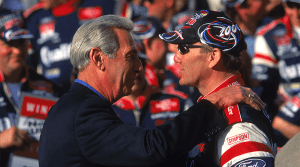 Ned Jarrett (left) congratulates his son Dale Jarrett after Dale won the 2000 Daytona 500. (Jamie Squire/Getty Images)
A sign of the team’s resilience was the Coca-Cola 600 at Charlotte (NC) Motor Speedway, where Jarrett and the No. 88 team closed a lap deficit and finished fifth. The never-ending mindset caught the attention of Dale Earnhardt, who had words of wisdom for Jarrett throughout the team’s magical run.
“I’ll never forget a conversation I had with Dale Earnhardt this year where he said, ‘Look, if you go ahead and win this championship, you’re going to remember those days when you made nothing more than you go to remember which races you won this year.’
“That’s really the truth because I’m pretty sure we won at Michigan and I think I won at Richmond when we took the points lead in the first race there. I don’t think we ever gave up after that. So I don’t know the other two races that we won.”
The other two wins came at Daytona and Indianapolis. After all was said and done, Jarrett finished the season with 29 top 10 finishes in 34 races, along with an average finish of 6.8.
While Jarrett and the No. 88 team lifted the championship trophy only once, their success continued through 2003.
Previous highlights in the No. 88 blue-and-red included a final Daytona 500 triumph in 2000 after a dominant performance that saw Jarrett edge the field from pole.
With changes on the horizon for years to come, another shot of fame came for Jarrett before the next phase of his career approached.
Find out in part four – tomorrow.
Follow @DhoffmanMedia22
Comments are closed.