


March 29, 2023
There has been little top-level news over the past 24 hours, resulting in markets being relatively quiet by the standards of the past few weeks.
Today’s podcast
- Some relative calm in the markets with little new news
- The US dollar is down 0.4% against the DXY
- Yields are generally slightly higher
- US consumer confidence surprises more
- Coming up: AU CPI indicator, German consumer confidence, upcoming US home sales
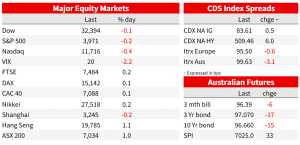
There has been little top-level news over the last 24 hours and the lack of any substantive developments in the banking environment has meant markets have been relatively quiet by the standards of the past few weeks. The US Dollar is generally weaker with the AUD and NZD gaining over 0.8%. Yields are generally slightly higher while the S&P500 closed slightly lower.
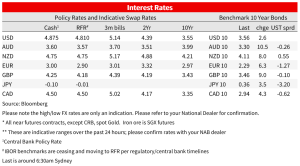
US 2-year yields hovered above 4% despite no further signs of stress in the banking system. The 2-year price is currently around 4.04% after an intraday high of 4.07%, up 4 basis points on the day. The 18 basis point range in the 2-year yield over the last 24 hours was the tightest since March 8th. The 10-year was 3 basis points higher at 3.56%. The market is now pricing in a fed funds rate of 61bps yesterday, 54bps below its current level by the end of the year. Rates across Europe are also higher, with 2- and 10-year German Bunds up 6 basis points.
On the foreign exchange markets On the back of little fresh news, the dollar is down 0.4% against the DXY. The AUD rose 0.8% on the day to 0.6706, topping the G10 rankings. The NZD rose 0.9% to 0.6251. The euro rose 0.4% while the USD fell 0.6% against the yen to 130.7.
The S&P500 closed only slightly lower , down 0.2% after paring losses from 0.6% earlier in the session. IT and communications services led to declines in the S&P 500, while the Nasdaq fell 0.4%. Energy stocks outperformed, up 1.4%, with oil extending gains. Brent oil rose another 0.8% after yesterday’s 4.3% gain. A legal battle between Iraq, Kurdistan and Turkey has halted the flow of around 400,000 barrels a day and restricted global supplies. Elsewhere, European stock markets were generally slightly positive, with the Euro Stoxx 50 up 0.1%.
Congress began hearings on the recent banking turmoil, with the Fed and FDIC officially announcing changes in regulatory and capital rules. US Federal Reserve Vice Chairman Michael Barr said: “I believe there is a need to strengthen capital and liquidity standards for banks with assets in excess of $100 billion. FDIC Chairman Martin Gruenberg said, “The prudential regulation of these institutions deserves additional attention, particularly with respect to capital, liquidity and interest rate risk.” Show changes in deposit insurance coverage.
Bullard of the St. Louis Fed added his voice to the chorus of central bankers making a distinction between responding to financial stability concerns and responding to inflation. “In my view, continued appropriate macroprudential policy can contain financial stress in the current environment, while appropriate monetary policy can continue to put downward pressure on inflation. Bullard notes that he believes stock prices are less useful than credit spreads and the dollar in assessing financial health and the impact of monetary policy. He also distinguished financial conditions from financial stress, with an increase in financial stress being due to the fact that “not all financial firms have adequately adjusted their operations to the changing interest rate environment”.
To further underline the point that the Fed cannot give up its inflation flight out of fear of financial instability alone, consumer confidence rose. It is still early to see the full impact of the credit crunch on households, however Consumer confidence indicated that consumers had paid little heed to recent bank failures. T The survey was mostly conducted after the failure of the SVB. Conference Board consumer confidence rose to 104.2 from 103.4, ahead of consensus for 101.0. The gain was in the expectation component, which rose 2.6 to 73.0, while the current situation index fell 1.9 to 151.1. In terms of labor market perceptions, easy and hard-to-get jobs have fallen to a still-high 38.8. The picture is somewhat clouded by the opposite signal from the University of Michigan survey released just over a week ago, which fell to 634 from 67.0. Elsewhere in the US, home prices in January were up 0.2%m/m in the FHFA index and down 0.4%m/m in the CS 20 city index, moderating earlier declines.
Yesterday in Australia Retail sales showed a 0.2% m/m increase in February , in line with the consensus. Looking at the volatility of recent months alongside shifting seasonal patterns, retail spending has remained broadly unchanged at elevated levels since last September. Some non-grocery soft goods spending is offset by more resilient spending on groceries and cafes and restaurants. For the RBA, data related to strong employment and the NAB business survey should not argue against a rate hike in April. Today’s monthly CPI indicator is the final data point on the RBA’s watch list ahead of the April meeting.
Come
- We expect the monthly CPI indicator to fall to 7.2% yoy from 7.4% , in line with consensus, but what the services sub-components tell about inflation trends will be as important as the headline given the limitations of the monthly indicator. The monthly CPI indicator comes with the usual caveat that it doesn’t reflect the full basket of consumer goods in each month and has a short history. However, as the RBA strives to read inflation developments as timely as possible, it is closely monitored with a focus on what the services sub-components are saying.
- Offshore the calendar is quiet. Germany sees GfK Consumer Confidence as US home sales loom. There are a few snippets of central bank talks, but nothing to make headlines. The thoughts of the BoE’s Catherine Mann are perhaps the most notable.
market prices
For more information on FX, interest rates and commodities visit nab.com.au/nabfinancialmarkets. Read our NAB Markets Research Disclaimer.
Comments are closed.