


The purchasing power of CONSUMERS is being impacted by high inflation, which could result in lower investable income. With mutual funds forming the largest component of the Malaysian mutual fund industry, let’s take a look at the potential impact on mutual fund investments and returns.
The Federation of Investment Managers Malaysia (FIMM) sees an impact on household income and the ability to save and invest given the rising inflation environment. In June, the CPI rose 3.4% yoy, mainly due to the 6.1% rise in food prices.
“Of course, as with any inflation, rising cost of living will erode investable income for investors in general,” FIMM tells The Edge in an emailed response.
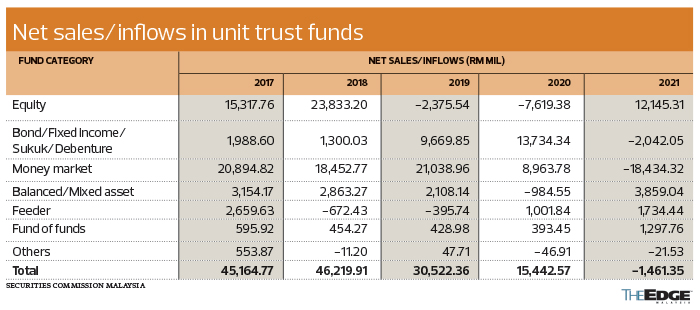
However, it is interesting to note that there was little correlation between mutual fund returns based on their track records. For example, annual returns across asset classes were high in 2017 (15.61% for equities, 11.74% for mixed assets and 3.81% for bonds), despite the 3.7% rise in inflation.
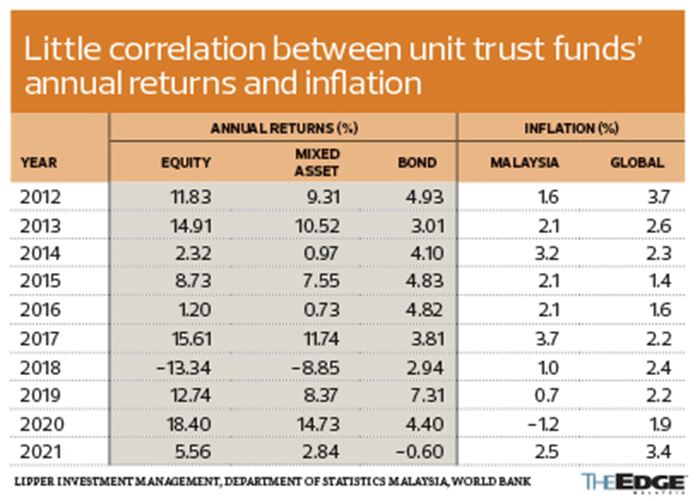
In fact, 2017 saw significant net inflows into mutual funds of RM45.16 billion, taking the industry’s net asset value (NAV) to RM426.98 billion.
Conversely, when inflation rose to 3.2% in 2014, equity fund returns of 2.32% were lower than mixed funds at 0.97% and bond funds at 4.1%. This year has raised concerns about deteriorating economic conditions in emerging markets and mounting deflationary pressures in the eurozone. There was also a sharp drop in oil prices, triggering a sell-off in global stock markets.
However, FIMM emphasizes that it cannot conclusively say that inflation will not affect annual returns, as the underlying assets are likely to face higher operating costs and lower earnings in the short term, which in turn may affect their growth potential and market prices.
FIMM, a self-regulatory organization, is committed to the development and growth of the Investment Trust Funds and Private Retirement Schemes (PRS) industry.
Danny Wong, CEO of Areca Capital Sdn Bhd, believes that inflation is not a major factor for investors in the T20 (top 20% income bracket), who are more concerned about the market outlook than investable earnings.
“However, for the M40 (middle income bracket of 40%), there could be some impact on the amount they can invest as their disposable income will be impacted. The concept of investing long term and saving more in tough times may not be cultivated by most investors,” he says.
“The M40 must allocate money for daily expenses and necessities and fulfill its lifestyle before allocating money for investments. If this continues, it will impact mutual fund flows.”
Areca, which manages RM2.7 billion in assets, has more than 33 mutual funds under its umbrella. Wong notes that during periods of high inflation and rising interest rates, investors tend to be very cautious.
“In general, rate hikes are not positive for stocks and bonds. The general perception is that the M40’s investments will be much lower when inflation is high. But the T20 will continue to invest. They’re the educated ones, so these informed investors are likely to invest more rather than sell their wealth,” he says.
The breakdown of the share of groups T20, M40 and B40 in the market for mutual funds is not immediately known.
“We don’t have data on income groups because we don’t have direct access to the data from the UTMCs.
(Unit Trust Management Companies), IUTAs (Institutional Unit Trust Advisors) or CUTAs (Corporate Unit Trust Advisors) private information from investors, such as B. Annual income, for PDPA (Personal Data Protection Act 2010) reasons. We hope to have this data for a more comprehensive demographic picture in the future,” says FIMM.
The NAV of the mutual fund industry has grown steadily over the past decade, with the exception of 2018, which saw a 0.2% decline due to a deterioration in financial markets. Three key developments this year were the escalation of the US-China trade war, pressure on emerging markets from a stronger US dollar and an increase in market volatility.
In 2018, the size of Malaysia’s capital market fell to RM3.1 trillion from RM3.2 trillion in 2017, while the FBM KLCI fell 5.9%.
According to Securities Commission Malaysia Annual Report 2021, NAV of mutual funds as of December 31, 2021 was RM526.89 billion – up 1.42% from RM519.53 billion as of December 31, 2020. The percentage of total The NAV of mutual fund industry to market capitalization of Bursa Malaysia Securities Bhd was 29.45% compared to 28.59% last year.
During the year, 63 mutual funds were launched, while 15 funds closed and four reached maturity. This brought the number of mutual funds offered by the 39 locally incorporated UTMCs to 740.
Last year there were net outflows from mutual funds of RM1.46 billion, with the money market and fixed income segments reporting net outflows of RM2.04 billion and RM18.43 billion, respectively. This was mainly due to the expected elimination of the tax exemption for interest income from corporate investors, which came into effect on January 1, 2022.
The mutual fund industry recorded total gross revenue (excluding distribution reinvestment) of RM404.52 billion in 2021, compared to RM353.36 billion in 2020. The bulk was distributed by UTMCs, with total gross revenue of RM240.54 billion.
Wong says withdrawals from trust funds are likely due to potential weakness in the market rather than a need to address inflationary pressures. “The current high inflation has been triggered by supply-demand dynamics rather than overspending and a hot economy. So it is temporary for people.”
He says NAV will only go down in a financial crisis, stressing that there is no strong evidence of a global recession. “Even if there is a recession in the US, it could be a technical recession, maybe just two quarters long and that doesn’t mean Malaysia will follow suit.
“Most emerging markets, particularly in Asia, will continue to see growth as the region has not yet fully opened borders. Other than that, we don’t see any drastic rate hikes. Instead, China is cutting interest rates to boost growth, which bodes well for Asia.”
In terms of asset allocation, it should be based on an individual’s profile and investment horizon. “Allocation should not change over the years, maybe just be adjusted a bit and tactically rebalanced, unless fundamental changes like high recession risks are triggered.
“When you start investing, you know it’s not going to be a smooth process in the long run. That’s why there are small adjustments in response to the changed market situation.”
According to FIMM’s 2022 Investment Management Survey, initial results suggest that most investors and UTMCs prefer investing in Asia Pacific, citing growth potential and diversification. However, details of the survey are not available as FIMM is still compiling information from its members.
Comments are closed.