


This post contains sponsored advertising content. This content is for informational purposes only and is not intended as investment advice.
AT A GLANCE
- Investor demand for ESG products has led equity index providers to ensure their indices reflect overall ESG developments
- Demand for cobalt and lithium has surged as electric car sales more than doubled between 2020 and 2021
Earth Day 2022 followed a report months earlier by the Intergovernmental Panel on Climate Change (IPCC) that warned global temperatures could rise by more than 2°C in the 21st century. Together with the agreement signed at COP26 in November 2021, this shows the magnitude of the climate challenge.
Several trends in the financial markets show a growing awareness of the need for environmentally sustainable solutions. Below are four areas worth looking at: ESG solutions in stock index markets, the changing biofuels market, a thriving battery metals market powered by electric cars, and the growth of the voluntary carbon offset market.
ESG stock index
As the environmental, social and governance (“ESG”) ecosystem evolves, ESG investing must keep pace to continue to provide robust solutions to market participants. In the equity space, this development is leading index providers to ensure their indices reflect the overall evolution of ESG investing.
Scan the QR code above for more expert analysis of market events and trends today
Underlying this ESG development is tremendous growth in ESG investing, including derivatives such as CME Group’s E-mini S&P 500 ESG Index Futures, which have become the world’s most liquid ESG equity index futures contract.
To further align with the rapidly evolving ESG landscape, starting May 2022, S&P Dow Jones Indices (S&P DJI) will change the eligibility requirements for its ESG indices.
The updates to the exclusions and eligibility requirements reflect the growing need for index providers to properly consider the business activities of companies, ultimately ensuring that ESG investors can accurately assess the behavior of those companies in the index.
Recent trends in E-mini S&P 500 ESG index futures illustrate how investors can find solutions that meet their ESG needs. The average daily volume (ADV) in ESG futures has already increased by over 100% in 2022 and has been growing steadily since the contract’s inception.

Since its inception in November 2019, ESG futures contracts have surpassed $94 billion in notional traded value and surpassed 13,500 open contracts as of mid-April 2022, representing nearly $3 billion.
The rise of electric vehicles
With the help of advanced technology and electric vehicles (EVs) continuing to increase their share of the global automotive market, it seems clear that cobalt and lithium are crucial to meet the growing demand for electric vehicles and to satisfy the large-scale move away from the internal combustion engine for battery-powered transport.
According to the International Energy Agency (IEA), sales of electric cars more than doubled between 2020 and 2021. A total of 6.6 million electric vehicles were sold last year, accounting for almost 10% of the global market. China is the largest market for electric vehicles, with sales up 179% to 3.4 million new registrations, overtaking Europe with 2.3 million units (+64% yoy). The American EV market, while smaller than China or Europe, also showed strong growth, rising 123% year over year to 700,000 units.
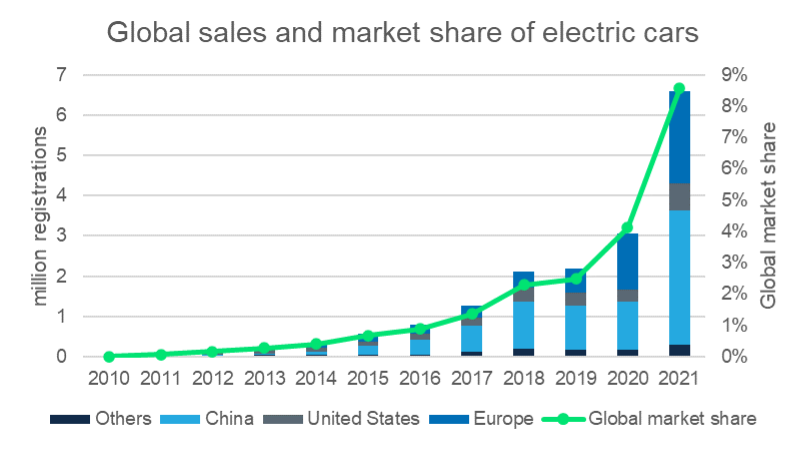
Source: IEA
Viewed in a broader context, increased adoption of electric vehicles is part of the transition to a low-carbon economy. This transition is accelerating as world leaders commit to emissions reductions and net-zero targets. As has been widely noted, decarbonizing transport and power generation will require a significant amount of metal – aluminum, copper, nickel, cobalt and lithium are all likely to be in high demand.
The IEA estimates that demand for lithium could increase by up to 40 times in 20 years and demand for cobalt by 20 to 25 times. when governments around the world are serious about achieving the goals of the Paris climate agreement. There is a degree of uncertainty about the exact growth rates — as these will be influenced by both evolving technologies and government climate policies — but it’s hard to imagine the cobalt and lithium markets not growing to accommodate the energy transition.
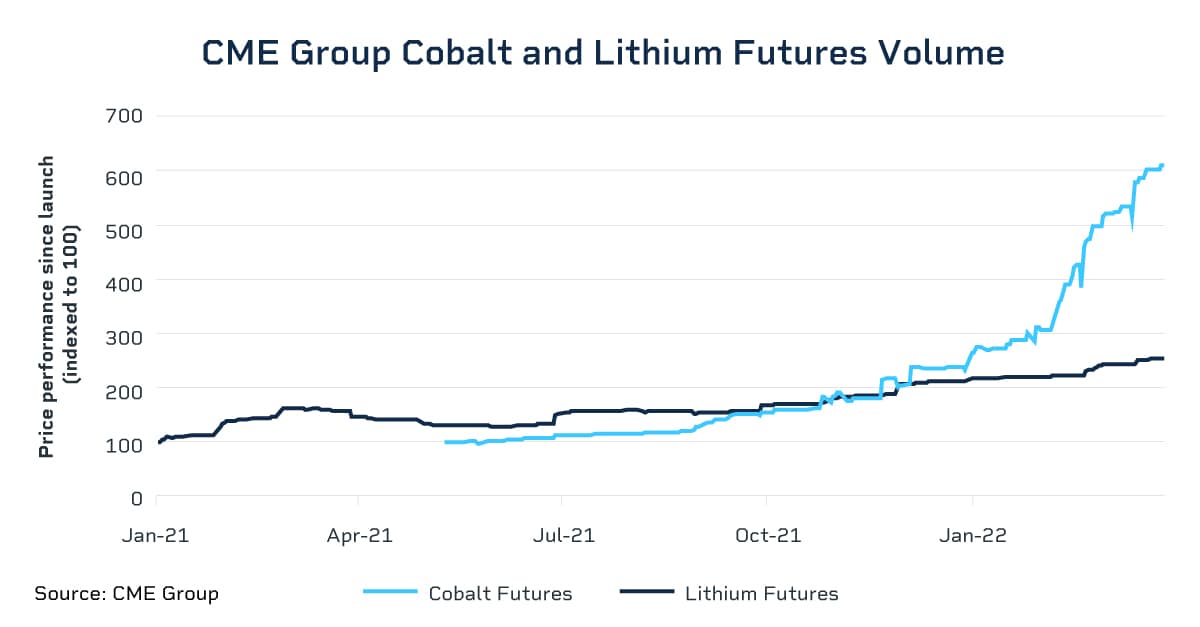
CME Group offers trading in both cobalt and lithium futures. As demand grows rapidly, prices in both contracts are trending higher. Cobalt is now trading at $34/kg, more than double where it was when it was launched in December 2020. Lithium prices have risen even faster, from $13/kg in May 2021 to over $40 in February 2022.
Increasing use of bioenergy
Bioenergy growth is expected to become a larger feature of markets as economies move toward further decarbonization. In the European Union (EU), the recently expanded Renewable Energy Sources Directive II (RED II) encourages continued use in both biofuel feedstocks and waste feedstocks. The EU has targeted a minimum share of 40% for renewable energy sources by 2030, up from 32% in previous iterations of the directive. The EU has also pledged to cut greenhouse gas emissions by 55% by 2030. These stricter targets should give a boost to bioenergy markets.
The USA is also a leader in the production of renewable diesel. These initiatives are expected to further fuel the supply of agricultural feedstock and waste markets needed to support growth prospects for renewable diesel production in the US and hydrotreated vegetable oil (HVO) production in Europe fulfill.
The rise of voluntary carbon markets
Strong demand for voluntary carbon markets continues, driven in part by companies’ commitments to reduce their carbon footprint to help achieve net-zero carbon emissions targets by 2050.
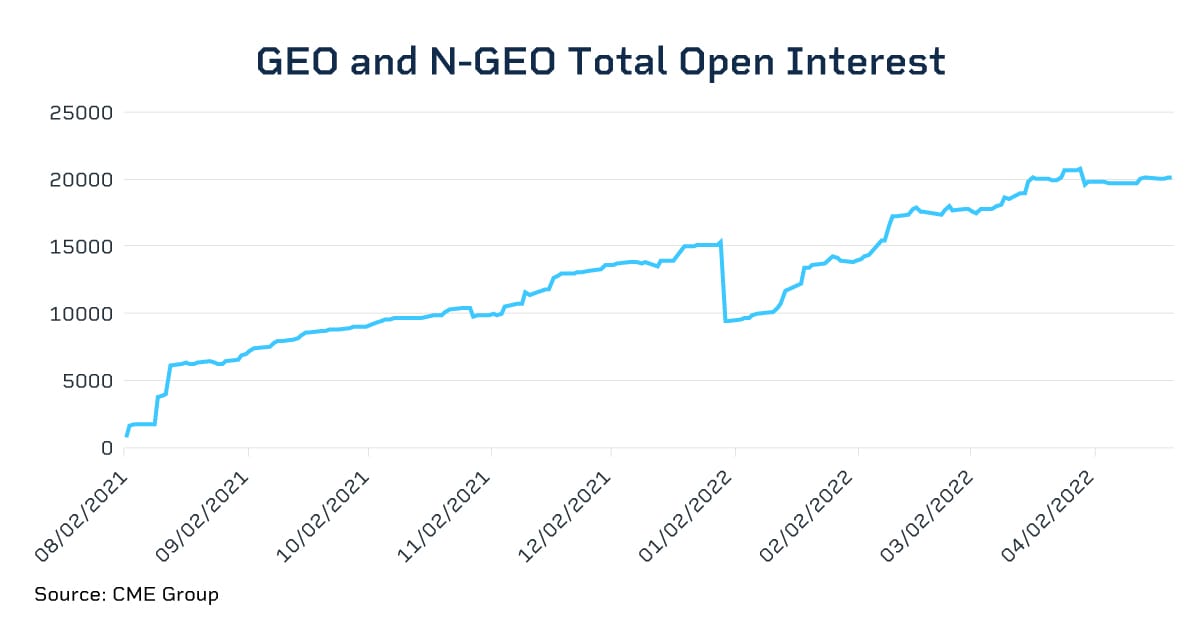
In 2021, CME Group introduced the Future Global Emission Offset (GEO). A record volume of 1,810 contracts (the equivalent of 1.81 million carbon credits) was reached on March 10th. A week later, on March 16, the Nature Based Carbon Offset (NGO) futures contract traded at a record 4,277 contracts, or 4.27 million carbon credits.
ING Bank estimates that growth in demand for voluntary offsets could increase to 15 times by 2030 and 100 times by 2050 compared to 2020 levels. As interest grows, this will remain a market to watch.
In all of these markets – equities, biofuels, metals and carbon offsets – we see market participants addressing risks related to an evolving set of climate challenges. New tools have been developed to manage these risks across multiple asset classes. This shows not only the strong demand for risk management solutions, but also how nearly all markets are affected by environmental concerns.
Comments are closed.