


Disappointing manufacturing data in China drove the recent pullback after PMIs from the country, which accounts for 55% of global copper consumption, unexpectedly slipped into contractionary territory.
But concerns about global growth, inflation and interest rates, and an energy crisis in Europe have dogged the metal for months. Copper prices are now down a third since hitting an all-time high of over $5 a pound in early March.
No fun with basics
Amid all the economic gloom and doom, a bombshell announcement from the world’s top copper producer this week seems to have gone largely unnoticed or ignored by big speculators in the futures markets, which have been net short on copper for the past seven weeks.
Chile’s state-owned company Codelco announced last week that it expects production this year to reach between 1.49 million and 1.51 million tonnes, down from an earlier forecast of 1.61 million tonnes.
On Wednesday, Codelco chairman Maximo Pacheco told a newspaper that the forecast for 2023 is 1.45 million tons, but significantly there is no prospect of improvement.
“For the five-year period between 2023 and 2027, the best forecast we have is an average of 1.5 million tonnes.
“Structural Projects [to maintain output levels] are effectively behind schedule and over budget.”
The “best forecast” would represent the lowest output in at least a decade, compared to an average attributable output of 1.74 million since 2010, according to sister company Miningintelligence.
Next year’s Codelco production would be more than 400,000 tons below its 2015 peak. A 400ktpa mine would be the fifth largest in the world according to 2021 production tables.
Two lost decades
Codelco’s struggles are Chile’s struggles: water scarcity, declining grades, depletion rates, tight project pipelines, industrial action, tax hikes and regulatory uncertainty, and ever-growing investment budgets.
According to the US Geological Survey, Chile produced a quarter of the world’s primary copper production of 21 million tons in 2021. On a proportional basis, Chile’s position in the world of copper does not match Saudi Arabia’s in crude oil, but the combined production of the 13 members of OPEC.
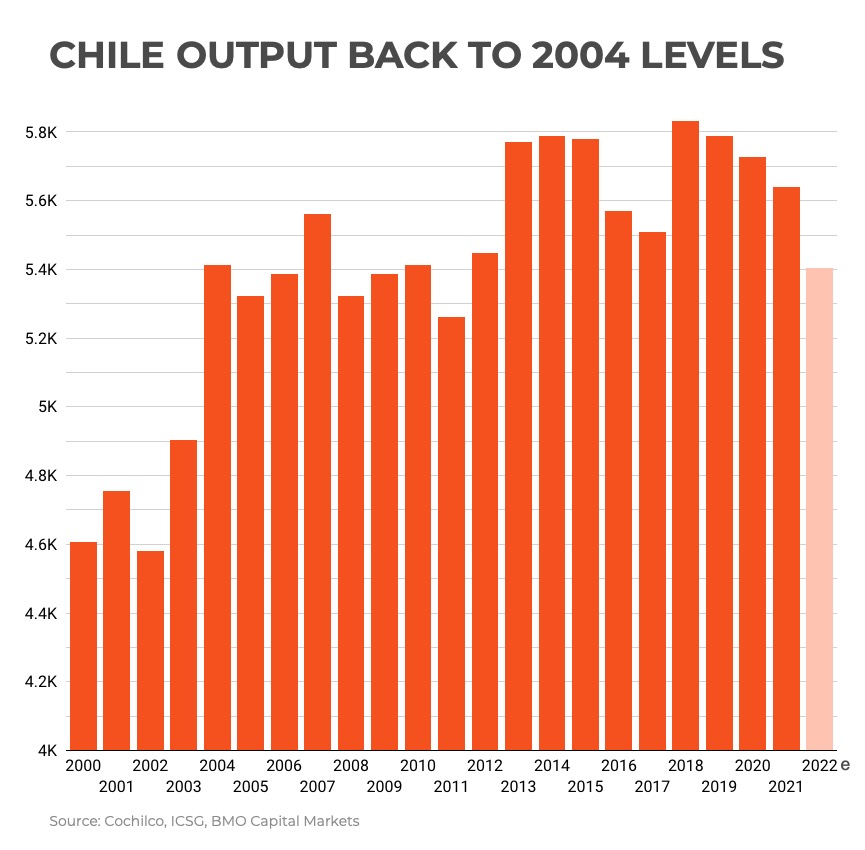 Source: BMO Global Commodities Research – Chile’s ongoing problems in copper production
In a recent report, BMO Capital Markets says that Chile is now heading towards two “lost decades” in terms of copper production growth:
“After ramping up steadily in the 1990s and early 2000s, production levels have stagnated, with forecasts of more than 6 Mtpa of production never coming true.
“And this is not due to a lack of investment as there are a number of large new mines coming onto the market during this period. Rather, it is a function of the decline in existing wealth.”
BMO notes that Chile’s SX-EW production in particular “continues to trend inexorably downward” and is now some 500,000 tonnes below the 2009 peak.
Comments are closed.