


- Market timing is investors’ worst enemy
- And over the long term, buy and hold is investors’ best friend
- Although most investors know this, they tend to lose a lot of money
Despite the advent of artificial intelligence (AI), I firmly believe that the human brain remains the most fascinating and influential element in financial markets.
In order to become an experienced investor, it is important to analyze the fundamentals, technicals and delve into behavioral finance. This area of research is crucial as it examines how human behavior significantly affects market movements.
With that in mind, let’s discuss the buy and hold strategy. To start, I’d like to share a well-known image (below) that many people may know or have come across:
Annual growth rate of the S&P 500
This image tells us a simple story: market timing is a lose-lose game for the average investor.
Let’s then take a closer look at the period between 1990 and 2019 when we had:
- Dot com bubble
- twin towers
- subprime crisis
- European debt crisis
We also lived through the so-called “lost decade”, which is the period from 2000 to 2009, when the US stock market had a negative return, which is quite rare.
Nevertheless, there is an average annual return of 7.7%.
Everything’s ok? Not really.
Because to (almost) quadruple your money, you would have gone through the following hard times:
Dot com bubble
- Maximum Drawdown: -50.5%
- Duration of the downturn: around two years and six months
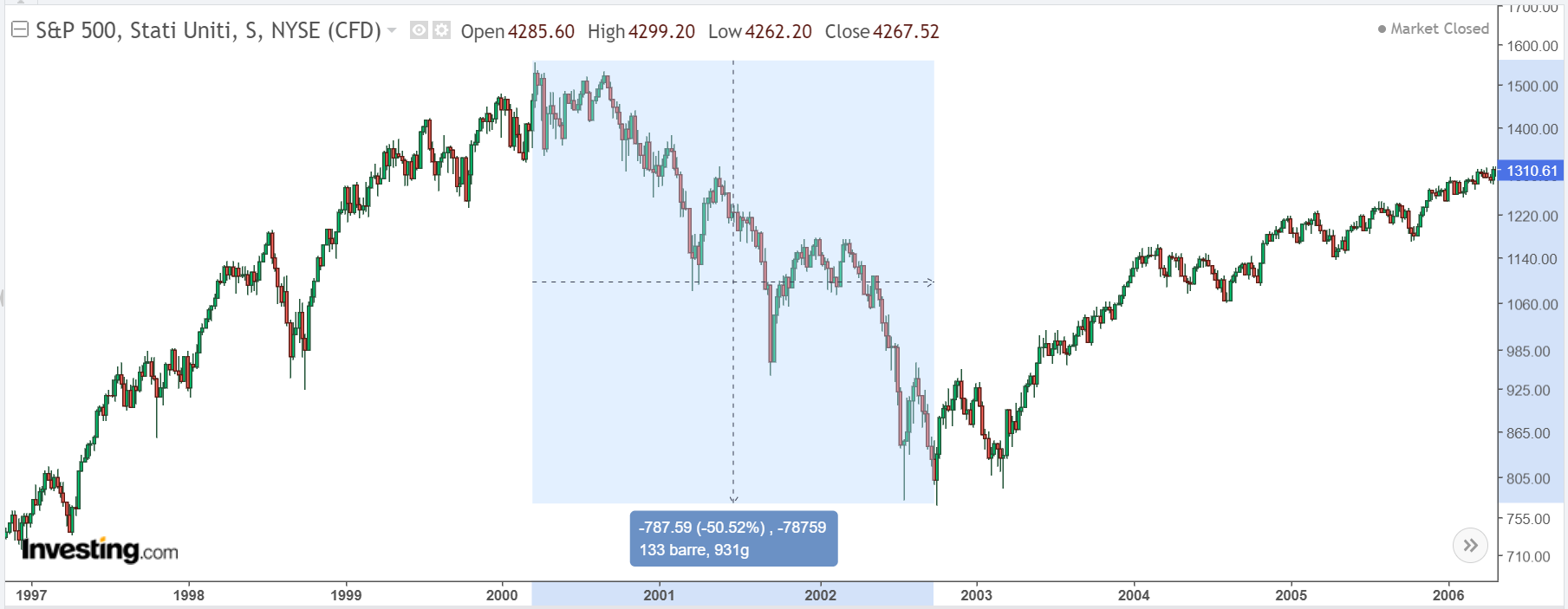
subprime bubble
- Maximum Drawdown: -57.5%
- Duration of descent: about 1.5 years
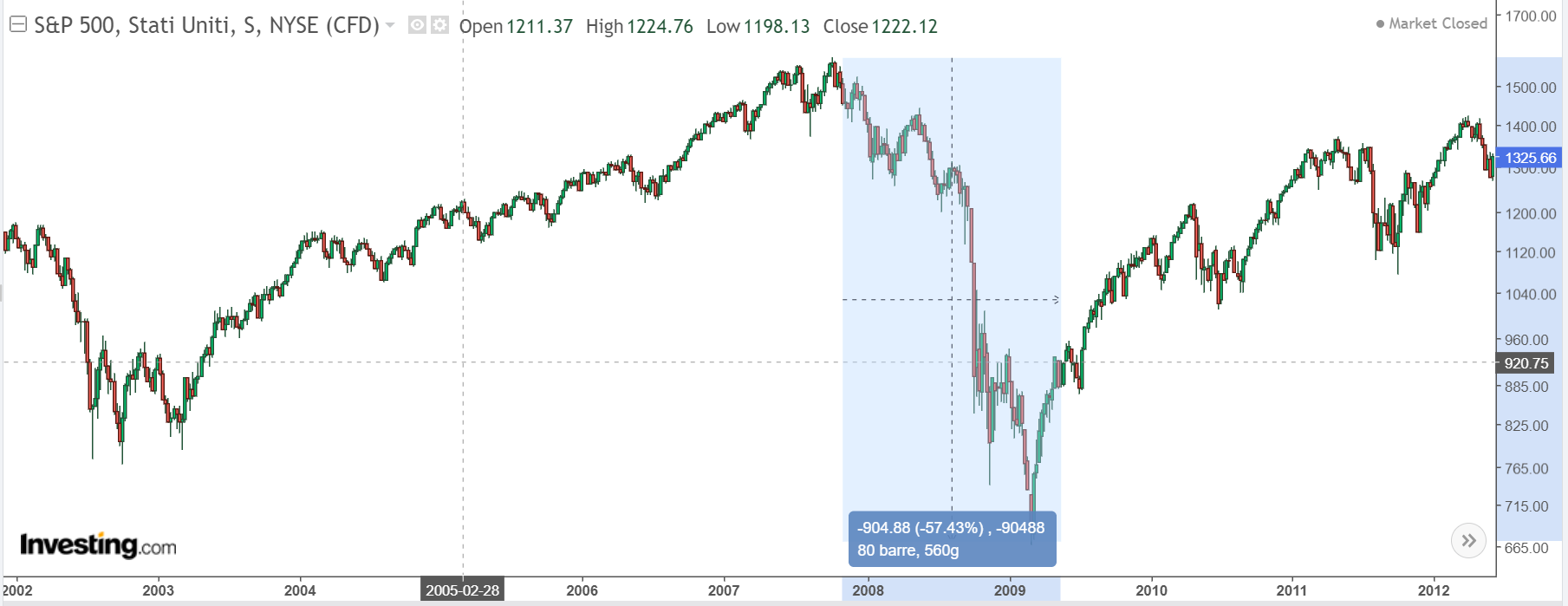
In such events, the investor should have done something straightforward: turn off everything, stop following the markets, follow nothing and nobody, and isolate yourself completely.
The challenge is emotional and social as it is difficult to witness such declines and resist the urge to conform to others.
Why are investors losing money?
Consider a period of 29 years. Whether it counts as long or short depends on the individual perspective.
With the average human life expectancy now exceeding 85 years, investments over the age of 29 account for around 30-33% (or even less) of a person’s total life expectancy.
Depending on one’s point of view, this can be seen as either a significant or a relatively small part of one’s life.
Investing in an essential part of our lives can bring significant benefits, although it may seem tedious in a world where a video on TikTok is ignored if it lasts longer than 30 seconds.
Maybe that period is too long, but that’s how markets work.
Have you ever noticed that when you open a new account with a broker, there are always notices that say “70-80% of users lose money?”
And then, in my opinion, THE QUESTION of the century is this:
Why, despite being aware of these facts, do most investors continue to hunt for the top stocks, try to time the market and end up losing money or missing out on potential gains?
Based on observing human behavior over the years, I have identified five possible motivations:
1. Ego
Most investors THINK they can outperform the market, picking the best performing stocks and figuring out when is the best time to buy and when to sell. THINK! But then you’re losing money, or at least making less than simply buying an ETF on the S&P 500.
2. Boredom
Buying an ETF and holding it for 29 years while ignoring everything is no fun. It’s more fun to buy and sell, get in and out, and always feel the thrill that means more betting than investing.
3. Social proof
The investor seeks validation from other people. We are social animals. If we do buy and hold, everyone will criticize us for doing something that 99% of people don’t do. So we feel uncomfortable; We are “contrary” to the masses. This uneasiness leads us to (when we fail) to ally with others and lose money as a result
4. Ignorance
Let’s be honest. If only a few people are making good money in the markets, so are people who KNOW how the markets work. Everyone thinks they know it, but few really do. Many investors simply invest at random or based on baseless assumptions in their heads in their heads and end up losing money in the long run. This is known as the “Dunning-Kruger” effect, a cognitive bias in which individuals who are inexperienced and unqualified in a field tend to overestimate their preparation, mistakenly considering it to be above average.
5. Anxiety/Fearlessness
The human brain reacts emotionally to market extremes; Our reptilian, prehistoric brains, especially when panicking, tend to do what it’s been used to doing for centuries: run away. That’s why people sell (rather than buy at better prices) when markets crash, primitive man wins out, and they run away (except to miss the big upswing that always comes just after the worst).
So get bored, damn it, and those 10, 20, 30 years just fly by!
If you have other factors or reasons that you think are affecting investor performance, let me know in the comments section below.
InvestingPro’s tools help savvy investors analyze stocks. By combining Wall Street analyst insights with comprehensive valuation models, investors can make informed decisions while maximizing returns.
Start your InvestingPro Try it now for 7 days for free!
Find all the information you need on InvestingPro!
***
Disclaimer: This article is for informational purposes only; It does not constitute a solicitation, offer, advice or recommendation to invest and is not intended in any way to induce the purchase of any assets. Let me remind you that any type of asset is valued from multiple points of view and carries a high level of risk. Therefore, the investment decision and the associated risk remain with the investor.
Comments are closed.