


- Wall Street consensus expects a recession to hurt SPX and stocks in the first half of 2023.
- The consensus is usually wrong when looking back at the historical performance of stock markets.
- Our S&P 500 forecast for 2023 is inconsistent due to a delayed US recession.
- The Bank of Japan’s expansion of yield curve control means higher interest rates for the United States as well.
Consensus is the most overused term in financial markets and a bastion of certainty for fund managers and strategists alike. If your benchmark is one of the major global indices, in this case the S&P 500 (SPX), then consensus is where you want to be. There is little incentive for mutual funds and money managers to make bets on the left field, since failure can cost you your job or your fund.
2022 wasn’t a great year with fund managers chasing stock markets on the way down and largely missing out on the two big rallies, one in the summer and another in November.
The long US Dollar position was spectacularly unwound following the US Consumer Price Index (CPI) release in October and we saw a huge risk rally in the S&P 500 and other major equity indices. That has finally run out of steam as the Federal Reserve (Fed) once again dashed bullish hopes.
The Federal Reserve has been very consistent this year in stating that it will raise interest rates to fight inflation and will not back down. However, the Fed does not have much credibility on its side and the market has repeatedly tried to question it. We’ve had numerous Fed Pivot rallies, but each time they have been wiped out by hard data and by the Federal Reserve itself. The most recent example came just last week with a scatter chart showing interest rates above 5% for the whole of 2023.
What do fed fund futures tell us that the Federal Reserve doesn’t?
Fed Funds Futures (March 2023 black, June green, September blue and Dec 2023 red)
As we can see from the chart of fed fund futures maturities above, the market does not believe that the Federal Reserve will push rates above 5% and keep them there. From the chart above we can see that the market is expecting a rate hike by June with the Fed funds at 4.845% for June 2023, below the 5.1% dot chart. But in September the Fed fund market is already pricing in a move to 4.75% and by December 2023 it is pricing in a move to 4.45%.
This is because the bond market is betting on a recession to force the Fed to pivot.
Who do we believe: the market or the Fed?
The consensus is for a recession, but not a severe one. We can infer this from analysts’ earnings estimates for the S&P 500. Forecasts have gradually come down, but not enough to price in a deep recession. They expect a rather flat development with a quick recovery due to the Fed’s interest rate cuts. The latest forecasts are for flat EPS in 2023 and modest EPS growth in 2024.
Looking at earnings estimates for next year, it’s clear that none of the big companies are forecasting an earnings recession. Because of this, there is still significant downside risk in equities. pic.twitter.com/vCCzEf2vNN
— PassedPawn.eth (@passedpawn) December 7, 2022
Even so, Wall Street strategists remain very confused (if not!)
Whatever kind of recession we get, when we get one, the news isn’t good. The average decline in the S&P 500 in a recession since 1960 is a sharp 33.6%, yikes!
A recession is always bad for stocks, but the depth of the GDP decline is meaningless as an indicator of the depth of the market decline. The average recession-related decline in the S&P 500 since 1960 is 33.6%, from 13.9% in 1960-61 to 56.8% during the Great Financial Crisis. pic.twitter.com/Gx8SFHxJ3Y
— Gina Martin Adams (@GinaMartinAdams) December 7, 2022
So the crucial question remains, will we get a recession?
As we’ve shown above, it seems inevitable, but it can be delayed. Employment remains tight in the United States and much of the rest of the G7.
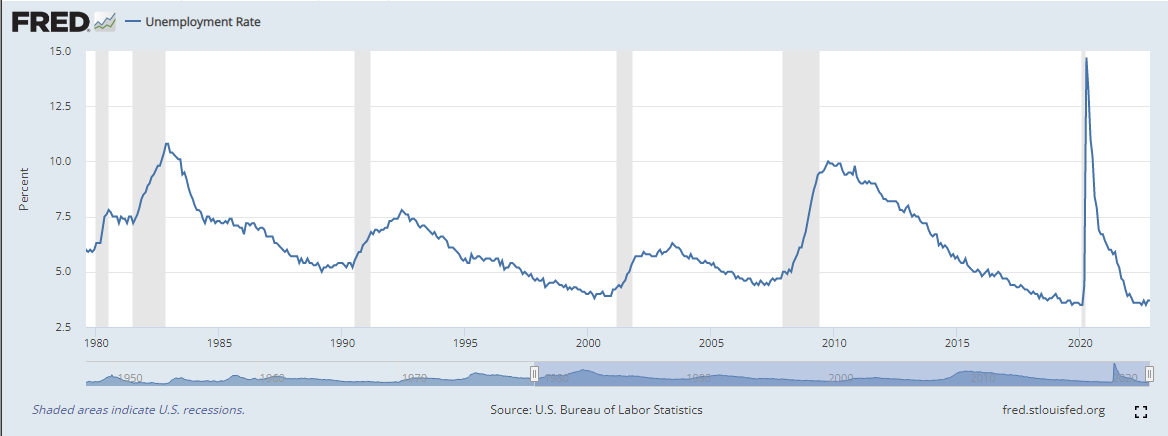
Unemployment Rate in the United States (Source: fred.stlouisfed.org)
Adding to scarce employment is slowing inflation and rising wages, pushing up real wages. Yes, my base case is that inflation is high and will remain so, but it’s definitely coming down.
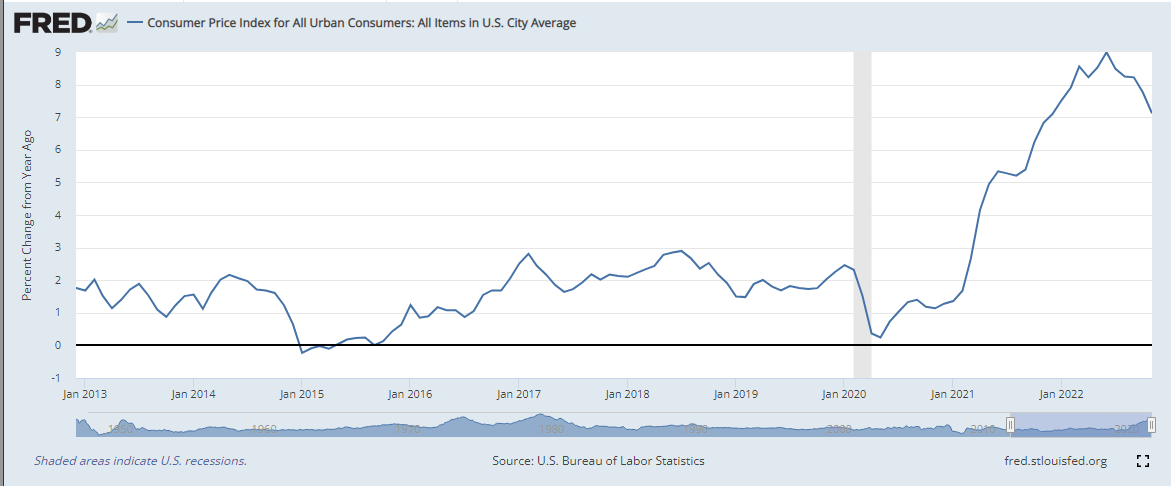
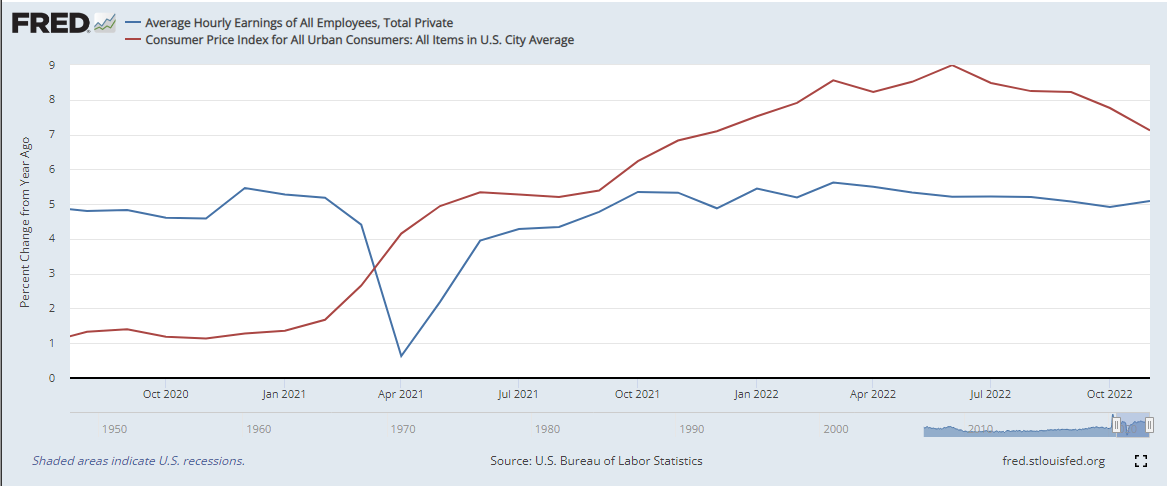
Source: fred.stlouisfed.org
The latest US gross domestic product (GDP) print has been positive and if you take a look at the latest chart from the US Bureau of Economic Analysis (BEA), it looks like GDP growth is moving in the right direction and accelerate.
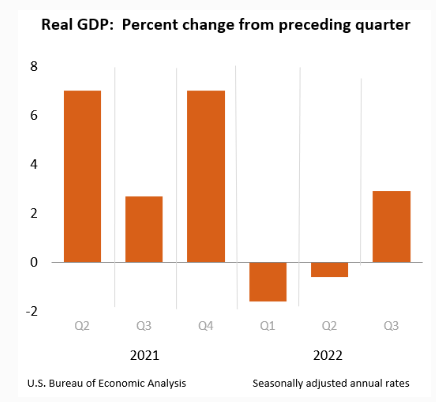
Source: BEA.gov
The Atlanta Fed’s latest BIPNOW forecast shows US fourth-quarter GDP growth of a still-healthy 2.8%. What if there is no consensus for a recession? What if this is a longer term project, similar to the 1970s? Are we in an inflationary growth phase and will the real recession begin in 2024? That would be the opposite view, or at least one of them. It’s rare to make money by sticking with the crowd.
Real incomes rise due to the delayed effects of wage negotiations and the faster effects of falling inflation. Rising real incomes should support consumer spending, delaying the US recession by up to a year.
Coming back to interest rates, I’m writing this article just after the Bank of Japan (BoJ) announced its shock decision to effectively abandon zero interest rates – or expand its yield curve control (YCC). This is not good news for risk assets. Simply put, Japan is the world’s largest buyer of US Treasuries. Keep in mind that prices usually fall when buyers step back. This action by the BoJ slightly reduces the attractiveness of US Treasury bonds and means that capital is more likely to flow back to Japan.
That should also mean that bond prices will remain challenged and I think yields and inflation will remain stubborn. The Federal Reserve’s pivot theory got a little tougher after this latest BoJ postponement for 2023.
S&P 500 (SPX) forecast for 2023: A contradictory one
With all of those hypotheses out of the way, let’s get to the good stuff, the predictions. When trading, it is important to remember that predictions are a piece of cake. You should not be biased and let price and market guide you when trading. However, everyone loves a prediction, so let’s get that caveat out of the way.
I should say that I’m trying to take the opposite view here, as that’s my nature. My starting point is that economic growth will remain strong for at least the first half of 2023. There could be signs of a recession in the second half, but I don’t think the US will enter a recession.
I believe the S&P 500 will peak in January and then slide if panic sets in that we are actually not getting a Federal Reserve pivot. But again, just like 2022, we will see a strong summer rally as earnings, employment and GDP remain strong. This may take the S&P 500 as high as 4,700. However, with 2024 looming, the second half of 2023 will be challenging. Keep in mind that markets are always forward looking and will eventually predict a 2024 recession with accompanying high interest rates, making it a toxic combination for those who hold risky assets like stocks.
Overall, I expect a sharp decline in H2 2023, leading the S&P 500 ended the year slightly lower at 3,600.
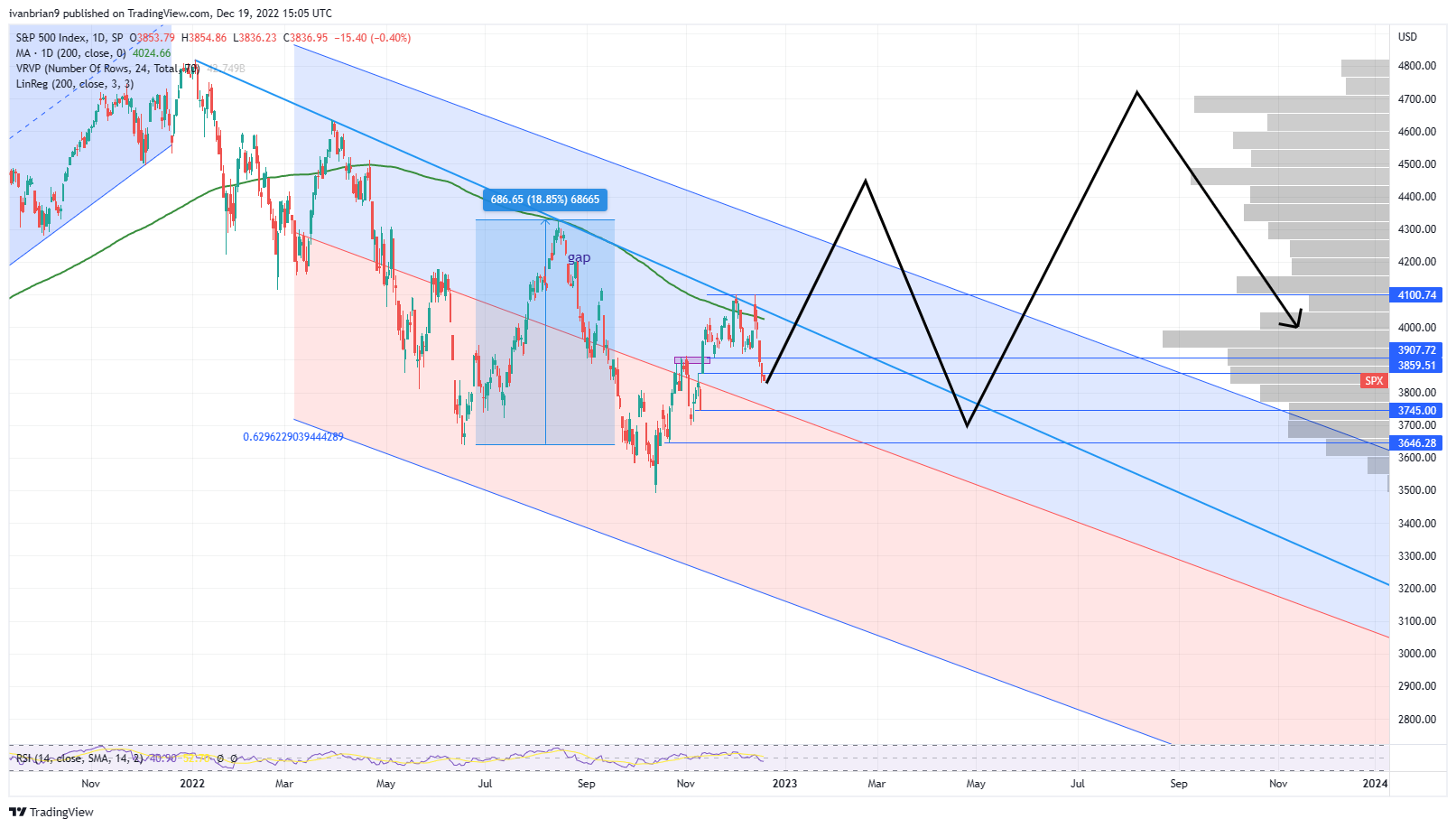
SPX daily
Whichever way we look at it, the options market is not pricing in major left events. Like either a melt up or down. The other view, which is definitely not opposed, is a crash. Option protection and SKEW do not price in tail risk. But then they rarely do! Let’s hope my first contrarian view is the more likely one!
There you have it. Remember to trade what is in front of you, not what you want in front of you!
CBOE Skew Index (200-day MA Advanced Forward) as a contrarian indicator correlating with
S&P 500..Skew measures the extent to which the market
expect extreme results (black swans). The market does not (a falling index – see red line).
means they are too complacent
6/6 pic.twitter.com/qThGz5wrqS
— Ricardo V Lago (@ricardovlago) December 20, 2022
Good luck for 2023 to all our readers.
Comments are closed.