


While Western sanctions have yet to cripple Russia financially, Moscow’s increased war effort is still transforming the economy.
Russian President Vladimir Putin (C) talks to his bodyguard while Defense Minister Sergei Shoigu (L) looks on during the Navy Day parade in St Petersburg, Russia in July. ©Getty Images×
In short
- Russia’s economy has not been decimated by Western sanctions
- But the military mobilization has major economic consequences
- The Kremlin’s war effort will require even more resources
In the nearly 10 months of war between Russia and Ukraine, many institutions within the Russian economy have changed significantly. Back in April 2022, the head of the Russian central bank, Elvira Nabiullina, warned that a “structural change” in the economy would begin in the third quarter of this year. what really happened
According to official figures, Russia’s gross domestic product (GDP) fell by only 0.4 percent in the first half of 2022 compared to the first half of the previous year. The industrial production index fell by 3.1 percent in September 2022 compared to the previous year. These figures do not look like the crisis that was widely predicted after the West imposed tough sanctions restricting Russian exports of oil, gas, coal, metals and timber, and imports of many types of goods and services.
After the war began in February, more than a third of the world’s largest foreign companies restricted their activities in the Russian market, and 15 percent announced they were leaving Russia and relocating local divisions. The largest foreign companies operating in Russia have lost $200-240 billion since the end of February 2022.
Why hasn’t Russia’s economy collapsed yet? One reason is that mining activity has remained at near pre-existing levels.
×
facts
Mining in Russia, 2022 vs. 2021
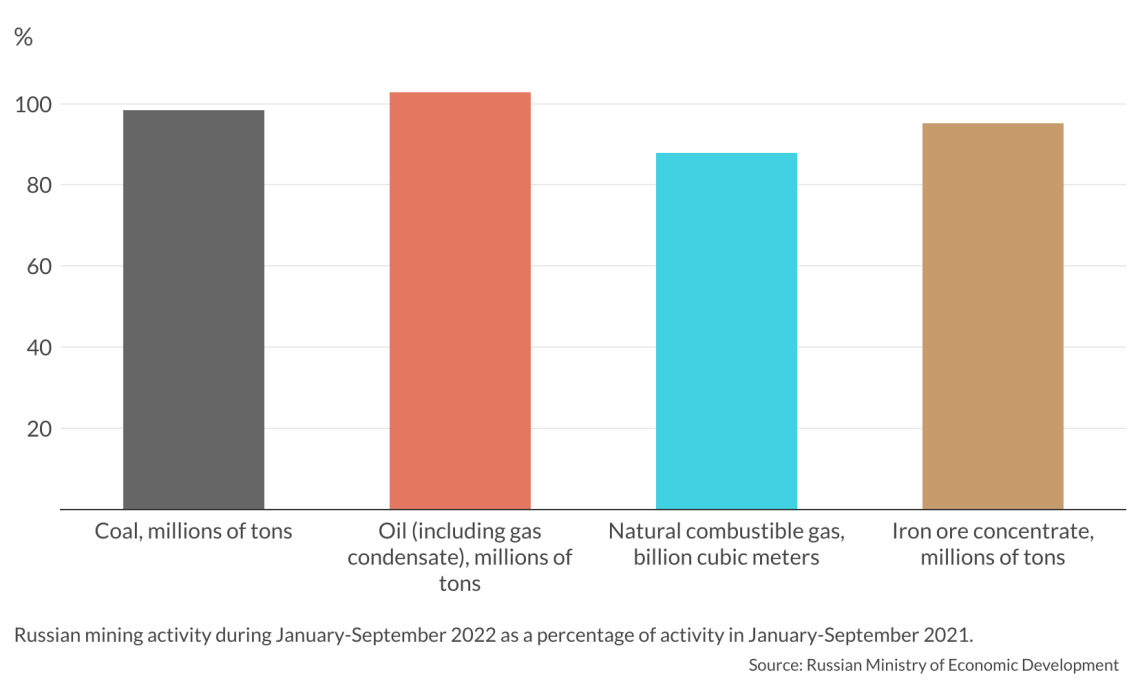
In other areas of the Russian economy, a catastrophic decline was recorded only in the auto sector, where the production of cars almost halved between January and September 2021 and January and September 2022. The stability of the Russian economy to date is due in large part to the delayed impact of sanctions, the most painful of which will take full effect in the fourth quarter of 2022 and early 2023.
higher gear
But what about the “structural change” in the economy hinted at by Russia’s top central banker?
An important phase in the transition of the Russian economy was the transition to military mobilization. The Russian leadership is struggling with manpower shortages on the Ukrainian front, while deliveries of Western military equipment have bolstered Kiev’s armed forces. This led to the loss of Russia’s strategic initiative and the start of a counter-offensive by the Ukrainian military. In September, the Kremlin responded with several radical decisions directly related to the state of the economy.
With the current conscription of the military, the Russian economy has become even more archaic and primitive.
First, on September 21, a “partial mobilization” was announced by decree of Russian President Vladimir Putin. Defense Minister Sergei Shoigu named a target figure of around 300,000 recruits; According to official figures, this goal was achieved at the end of October. Citizens drafted into the army were generally part of the workforce, including those in high-performing roles, such as clerk. B. Business owners. The officially announced average age of conscripts – 35 years – supports this observation.
In addition, after September 21, another 700,000 people left Russia, including a significant number trying to avoid conscription. Remarkably, during 2022, 31 percent of Russian IT professionals had already moved to another country or were planning to move within the next year, according to a Ventra survey conducted in early September. The company notes that since the announcement of partial mobilization in Russia, that number has only increased.
The mobilization could cause an additional 0.5 percentage point contraction for the Russian economy, thanks to a slowdown in the IT industry and related sectors and in small and medium-sized enterprises. With the current conscription of the military, the Russian economy has become even more archaic and primitive.
direct control
An important feature of this development was the organization of new institutions for public administration. On October 21, President Putin established a new military council, the stated goal of which is to strengthen “coordination of the activities of the federal executive bodies and the executive bodies of the subjects of the Russian Federation during a special military operation.” Headed by Prime Minister Mikhail Mishustin, the body was supposed in practice to ensure increased production of everything necessary for the Russian army, from weapons to military uniforms. To this end, orders for specific companies and their budget funding are managed directly at the level of the heads of government.
To this end, the government approved new labor regulations in the military-industrial complex. In particular, employees of these organizations can be called upon to work on vacation or overtime without their consent. Already in the summer, parts of the factories of the defense industry were shifted around the clock.
The economic situation could also be affected by the “medium-level response” regime introduced by President Putin on October 19 in the Russian regions bordering Ukraine. It is about “carrying out mobilization measures in the economic sphere” to “meet the needs of the Armed Forces of the Russian Federation, other troops, military formations, bodies and the needs of the population”.
These include the introduction of a special mode of operation for transport, communications and energy, as well as the temporary relocation of residents to other areas. “High” and “basic” preparedness regimes will be introduced in the rest of Russia, empowering the government to implement several “special” measures. Such regulations clearly create additional risks and uncertainties for entrepreneurial activity.
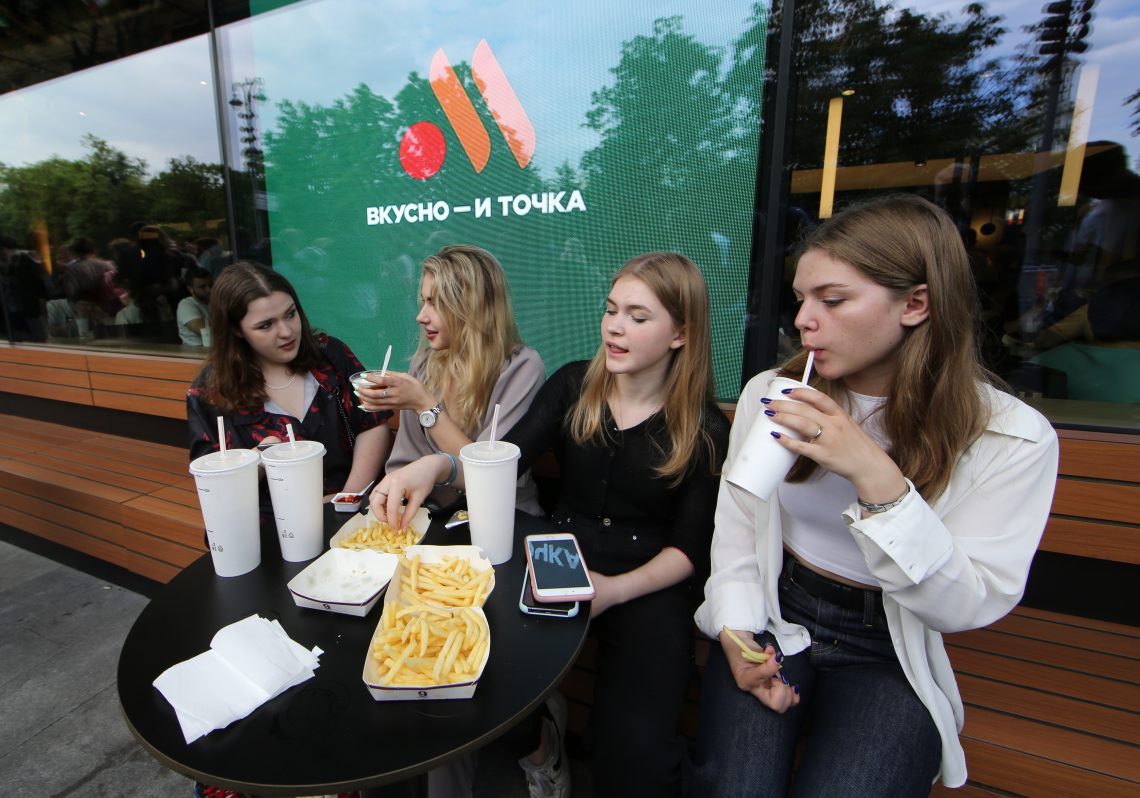 The exodus of Western companies from Russia has not brought economic ruin so far. Weeks after McDonald’s sold its 847 stores in the country to a local businessman, Moscow diners flocked to the opening of Tasty – Period. ©Getty Images
Another step towards mobilizing the economy is the transfer of private assets to state control. On May 24, the State Duma passed a bill “On external administration of organizational management”. This document provides for external management of foreign companies that have announced their withdrawal from the Russian market. Affected are companies that decided to withdraw from the Russian market without obvious economic reasons, “due to anti-Russian sentiment in Europe and the United States, while their activities significantly affected the stability of the economy”. Decisions about such companies are made by a commission under the Ministry of Economic Development of Russia on the proposal of other ministries and heads of regions.
After all, in the draft of the federal budget for 2023 that has already been passed, a record-breaking 23 percent of the expenditure is secret items. Compared to 2022, these costs have almost doubled.
×
scenarios
How will the situation develop further? If the “hot” phase of the conflict lasts until the end of 2022 and beyond, the mobilization of the Russian economy will become even more evident. The Kremlin will need greater concentration of resources for military purposes, even as revenue streams become more limited. This dynamic can further accelerate the formation of a mobilization model of the Russian economy.
If the most intense phase of the conflict ends in the near future, much will depend on the conditions of such a turning point. In the event of a long-term peace between Russia and Ukraine with international guarantees (which remains unlikely), there would be a possibility of phasing out the movement towards economic mobilization. But this scenario can become reality only with radical changes in political life and domestic policy in Russia.
Comments are closed.