
Opinion | Hong Kong's economy must reinvent itself to become more than just China's super-connector after a lost half-decade


Clearly, Singapore's superior performance was not just because it was Singapore's superconnector South East Asia. Instead, Singapore established itself as an important hub in global value chains in a number of high-value-added industries – including electronics, petrochemicals, pharmaceuticals and biotechnology, as well as precision engineering. In contrast, Hong Kong's economy is too specialized in a few closely related services – finance and insurance, real estate, trade and logistics, business services and tourism – and is too dependent on growth on the mainland.
Singapore and Hong Kong's crypto targets are on track despite the launch of Bitcoin ETFs in the US
Proponents of the Hong Kong model say this in comparison SingaporeIt is more productive because it is more market-oriented, less dependent on government intervention, and therefore less prone to government errors and corruption. About three decades ago, economists such as Alwyn Young argued that Hong Kong's growth model was more sustainable than Singapore's because Hong Kong's growth was driven by total factor productivity (TFP, a measure of innovation), while Singapore's growth was driven primarily by factor accumulation (Sweat instead of inspiration).
Young's predictions did not come true. Over the past 30 years, there is little evidence that the Hong Kong economy experienced higher TFP growth or was more innovative than the Singapore economy. As Hong Kong's economy became more specialized and dependent on the mainland, its gains in efficiency may have been outweighed by losses in diversity and resilience.
Employees lower the Chinese mainland flag in front of screens displaying the index and stock prices outside Exchange Square in Hong Kong. Photo: Reuters
As a super-connector, Hong Kong has reduced its economic diversity
The literature on regional integration is largely positive: economies grow faster when they integrate into larger markets. However, the literature also highlights some risks to smaller economies – risks that Hong Kong should always have been alert to. For example, companies and talent may leave the company to find better opportunities in larger, faster-growing markets. The manufacturing sector could be hollowed out, and the loss of manufacturing reduces opportunities for learning and upgrading technologies.
In addition to these integration risks, Hong Kong has also abandoned an important instrument of macroeconomic stabilization – monetary policy – due to its fixed exchange rate.
The Hong Kong dollar peg hits 40 with little fanfare, but traders are hesitant
Instead of enjoying the best of both worlds, Hong Kong as a super-connector combined with the US dollar peg may have experienced the worst of both worlds over the past two years. ChinaThe structural problems have meant that there has been no recovery after the Corona crisis, while the Peg of the US dollar has deprived Hong Kong of the ability to lower interest rates or the exchange rate to support the economy.
Looking ahead, interest rates in the United States are expected to be cut this year; This would ease pressure on the Hong Kong dollar and allow interest rates in Hong Kong to be reduced to a level that better suits its context. But Hong Kong's over-reliance on mainland growth is unlikely to diminish any time soon. With China's GDP growth expected to slow to 3 to 4 percent over the next decade, one would have to be blindly optimistic to believe that Hong Kong's growth would not be affected.
00:42
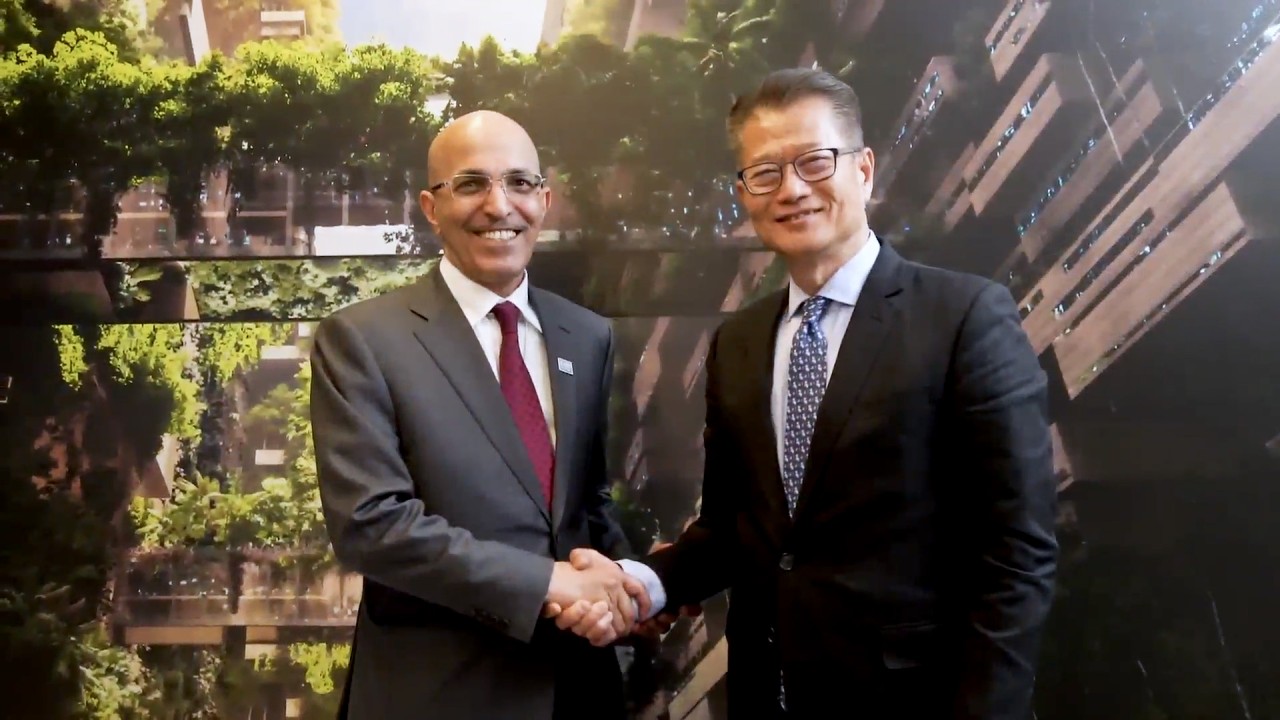
Hong Kong's finance minister discusses deeper economic cooperation with his Saudi counterpart in Davos
Hong Kong's finance minister discusses deeper economic cooperation with his Saudi counterpart in Davos
It has also restricted Hong Kong's political space and undermined its international character
The Covid-19 pandemic forced Hong Kong to choose between its ties to the mainland and its ties to the rest of the world. Rightly or wrongly, the former was given priority over the latter. But because China's zero Covid policy Hong Kong was increasingly misaligned and out of step with global norms and practices, feeling isolated and perceived as “just another Chinese city”. More than that National security law, Zero-Covid has significantly damaged Hong Kong's reputation as an international city. It also showed how maladaptive the Hong Kong government had become. As the virus became more transmissible and less deadly and the rest of the world outside of China adapted to life with the virus, Hong Kong stuck with its draconian zero-Covid restrictions – even after Covid-19 became endemic in the city Early 2022 – showed the rest of the world that policymaking in Hong Kong had become less pragmatic and scientific.
Forecasts suggest that tourism numbers in Hong Kong will return to pre-Covid levels by the end of 2025
Zero-Covid also had catastrophic consequences for Hong Kong: it neither saved lives nor protected the economy. Compared to other jurisdictions in East AsiaHong Kong has seen more deaths during the pandemic, even as it has unnecessarily delayed the economic recovery.
Zero-Covid has also caused more damage to Hong Kong's economy than the National Security Law. At the height of the zero-Covid madness in early 2022, tens of thousands of business and financial professionals left Hong Kong – many of them for Singapore. And the trauma continues, not least because the Hong Kong government has not convened an independent inquiry into its handling of Covid-19, without which the authorities would not have the opportunity to learn from their mistakes and companies will continue to stick to their guns that the quality is there The political situation has worsened and residents will continue to be skeptical and cynical about the government – exacerbating Hong Kong's existential crisis.
1:00 p.m
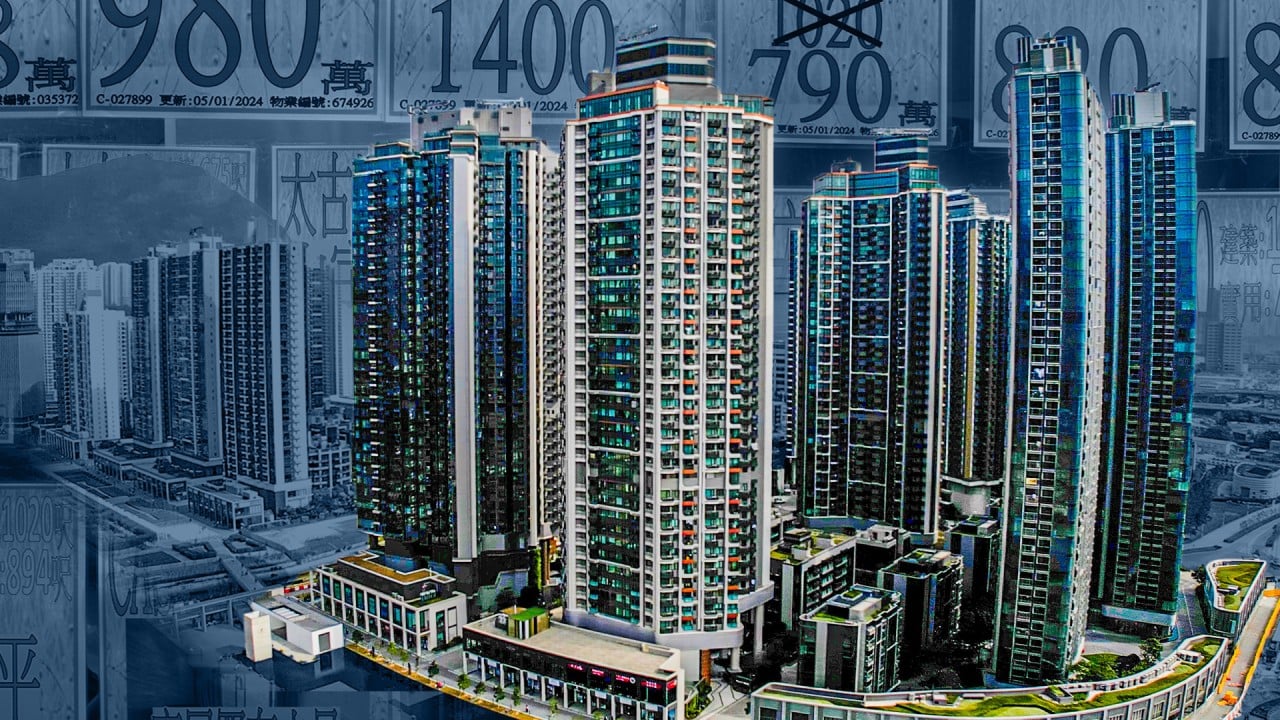
How Hong Kong's real estate market became one of the most unaffordable in the world
How Hong Kong's real estate market became one of the most unaffordable in the world
Avoid stagnation and blind optimism
There is a tendency in many of the Hong Kong government's public statements to blame external factors for Hong Kong's problems – high interest rates in the US, geopolitical tensions, Western efforts to contain China – while ignoring or downplaying domestic factors such as China's downturn. Hong Kong's US dollar peg and zero Covid. While these stories may be understandable from a political communications perspective, they do more harm to Hong Kong in the long run.
First, these narratives do neither the Hong Kong people nor the economy any favors. They give the impression that all of Hong Kong's problems are caused by outsiders or enemies abroad. This not only damages Hong Kong's reputation as an international city, but also fails to help Hong Kongers understand the complex challenges the city faces in a less globalized, more polarized world. These narratives create simplistic, binary and ultimately false stories that Hong Kong is caught in a battle between East and West, between good and evil. This polarizes society even more.
Hong Kong should promote and preserve its uniqueness to attract tourists: experts
Second, these narratives give the authorities a crutch and an excuse not to delve deeper and more self-critically into what Hong Kong needs to do to remain relevant. Why should we bother changing when we can easily scapegoat the West or blame others for Hong Kong's problems?
Third, these narratives are often based on blindly optimistic predictions about the rise of China and the decline of the West. While this is a possibility, it is by no means guaranteed, no matter how sincerely or strongly we hold these beliefs. They also promote excessive optimism in the face of our problems and failures. While optimism is usually a good state of mind, we should avoid the denial, defensiveness, and self-deception that writer Lu Xun described so well in The True Story of Ah Q.
Rather, Hong Kong policymakers should seize the opportunity presented by the current economic malaise to conduct a wide-ranging exercise on how Hong Kong's economy should be adapted or even reinvented for the future. Not only would this signal to the world that Hong Kong intends to remain a major hub of the global economy, it would also give Hong Kongers more reason to be confident about Hong Kong's future.
Donald Low is a lecturer and professor of practice and director of leadership and public policy executive education at the Hong Kong University of Science and Technology (HKUST). This commentary is based on his remarks at a policy dialogue on “Hong Kong in a polarized world: Still a super-connector and East-West mediator?” organized by HKUST and the Education University of Hong Kong.
Comments are closed.