
In Cambodia’s “underground” crypto economy, Tether is becoming the currency of choice for China-linked activities


While currency As Phnom Penh's exchanges also provide legitimate trading to the city's Chinese community and a daily solution to China's burdensome currency controls, Tether's role in Cambodia's vast underground economy is now coming under increasing scrutiny.
Dirty game: China is taking on increasingly sophisticated money launderers
In November, the U.S. Department of Justice seized nearly $9 million in assets that it traced to more than 70 online fraud victims after an investigation into crypto wallets at Tether Holdings, the company behind USDT, and the Crypto trading platform OKX had carried out. Tether said it had frozen an additional $225 million “Pig slaughter” cyber scam in Southeast Asia. The US government and Tether did not say where they traced the assets to or who might hold the receiving cryptocurrency wallets. However, Southeast Asia has become the epicenter of money laundering particularly through online gambling and cyber fraud Laos, Myanmar and Cambodia.
“The relative newness and complexity of cryptocurrencies make them fertile ground for scams and Ponzi schemes that target less informed investors,” said cybersecurity expert Ngo Minh Hieu, who works for the Vietnamese government’s National Cyber Security Center and others independent start-ups works.
Tether Holdings' supporters claim that the issued cryptocurrency is pegged to US Treasury bills. Photo: AFP
Tether Holdings' backers claim that the cryptocurrency it issues is tied to U.S. Treasury bills – although critics have questioned whether it really has sufficient assets to fund everything it coins.
Even those who run Phnom Penh's ecosystem of brick-and-mortar crypto exchanges and online USDT exchanges admit they are running a parallel financial service in the developing economy.
“We are an underground bank,” one exchange owner told This Week in Asia, responding in Chinese. “The questions you ask may relate to the privacy of our customers. Please understand that we cannot speak to you.”
English-speaking Filipinos caught up in Chinese fraud jobs: whistleblowers
Among the restaurants, clothing stores and hairdressers that target Chinese expats, a half-dozen neon signs denounce exchange rates in Chinese of around 7 yuan per USDT. Some shopkeepers sit behind glass counters, others in marble-walled rooms adorned with chandeliers and magnificent vases, trappings of the wealth on offer.
But even as sales begin, there are warnings about Cambodia's cryptocurrency boom.
“A lot of people lose money on their phone, you have to be careful,” said one employee.
Expert Ngo Minh Hieu says that there is no absolute security in the hustle and bustle of the crypto world.
“Hacking cryptocurrency exchanges and wallets also poses a significant risk,” he said.
SIM cards, personal data
It is impossible to estimate the extent of Tether's impact on the Cambodian economy. But there are around 84 billion USDT in circulation worldwide.
Banks, exchanges and platforms are thriving and their promises of frictionless, reliable digital solutions to money flow problems are often promoted via social media and encrypted channels.
A financial platform registered in Cambodia, Huione Pay, has a branch that looks like any other bank, except that tellers talk to customers about USDT exchange options. However, the main activities take place online.
Huione operates a network of interconnected Telegram channels with dozens of “exchange groups” offering various assets for sale.
Huione’s analysis of publicly available USDT exchange activity provides insight into how Tether facilitates transactions in Cambodia.
Some Chinese-language chats ask about “purely white assets,” indicating that money comes from a legitimate source, while others do not ask about such origin.
Some offer products and services such as selling mobile SIM cards from different countries, while others provide “first-hand data on overseas Chinese in Europe, America, Southeast Asia, Japan And South Korea“.
From romance scams to fake jobs, Asia Pacific is the new ground zero for cybercrime
While it's difficult to confirm based on such vague advertisements, both services offered are crucial tools for fraudsters who distribute dozens of SIM cards to workers so they can disguise identities and pass contact information to potential brands.
Other conversations appear to be coded: discussions of “cars” appear to mean bank cards used to receive money from fraud victims, while the letter “u” indicates USDT, the currency accepted in most deposits and transactions in the EU Dark trade.
One of the cryptocurrency trading groups promoted by Huione offers online investigative services related to checking criminal background information, corporate records and bank statements, and at one point the advert is aimed at a potential customer base: “[We] Welcome the scammers who come by and ask for information.”
Bank officials did not respond to This Week in Asia's repeated requests for further details about their activities.
In the region's border areas and special economic zones, perfect working conditions for criminals have been created, so to speakJeremey Douglas, UN Office on Drugs and Crime
Tether's greater appeal to criminal groups in Southeast Asia is beyond question, security experts say.
“In some ways, perfect working conditions for criminals have been created in the region's border areas and special economic zones,” said Jeremey Douglas, regional representative of the United Nations Office on Drugs and Crime. He explained that cryptocurrencies – particularly USDT, which are traded on the TRON exchange platform – were heavily used by cybercriminals and the region's governments were unable to keep up.
“The capabilities of criminal groups operating online gambling, fraud, money laundering and underground banking are far more advanced than most law enforcement agencies in Southeast Asia,” Douglas added.
On December 8th, the USA British And Canadian Governments imposed sanctions on 14 individuals and companies linked to online fraud and human trafficking in Cambodia, Laos and Myanmar.
The list includes Cambodia-registered companies ZhengHeng Group Co Ltd, Heng He Casino, KB Hotel, Pacific Real Estate Management Co and Golden Sun Sky Co Ltd; Cambodian tycoon Hum Sovanny; and She Zhijiang and Dong Lecheng, both Chinese nationals who were naturalized through Cambodia's passport purchase program.

13:19
The dark world of the Asian online casino industry
The dark world of the Asian online casino industry
Out of reach
The National Bank of Cambodia has launched Blockchain, the digital ledger technology that enables cryptocurrencies, to enable QR payments and transfers between registered banks.
But cryptocurrencies have been banned in the country since 2017.
Meas Soksensan, spokesman for Cambodia's Ministry of Economy and Finance, said he had not been informed of the U.S.-run Tether investigation and that the National Bank of Cambodia could not be reached for comment.
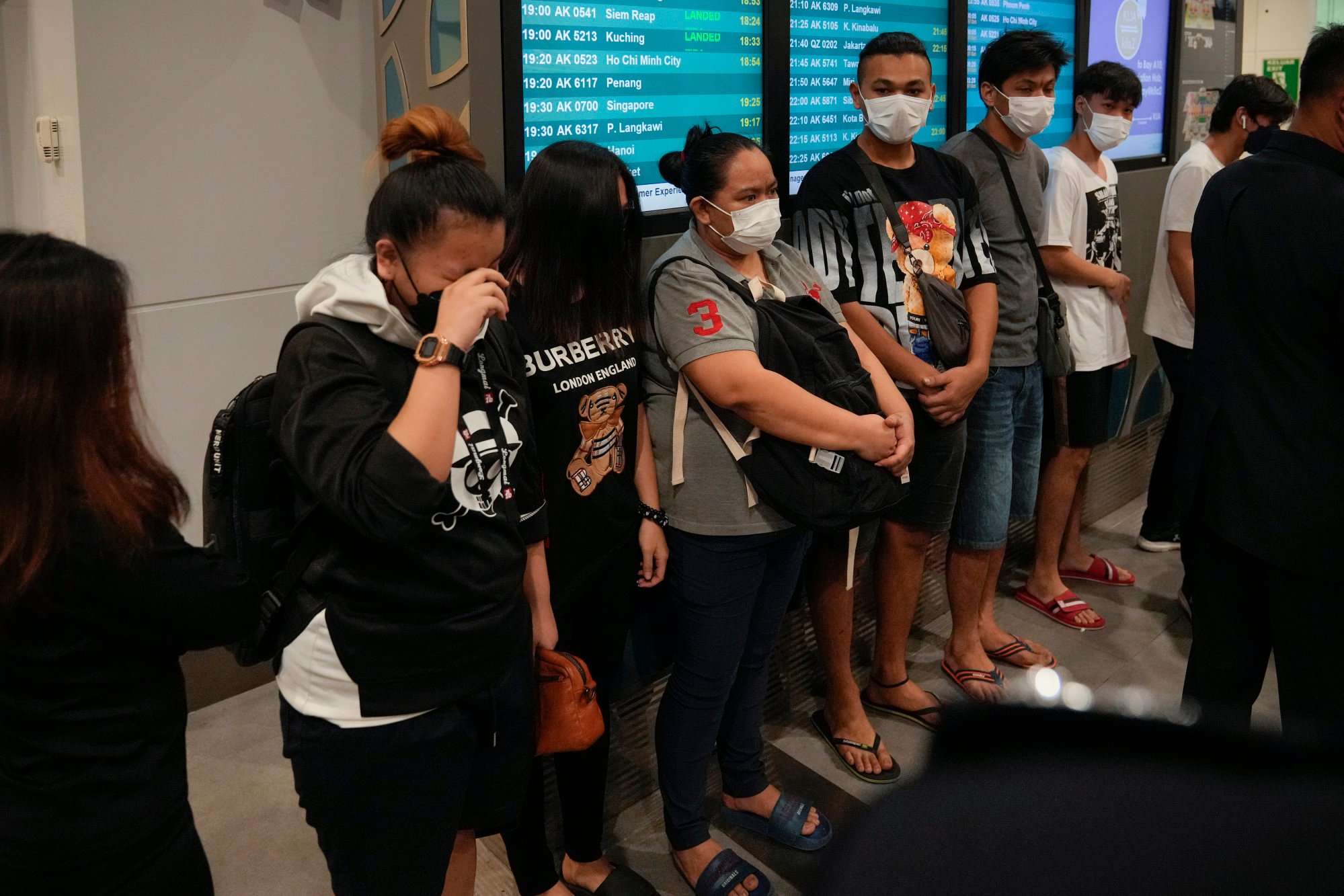 Malaysian youths rescued from human traffickers in Cambodia arrive at Kuala Lumpur Airport in October 2022. Photo: `
The cryptocurrency is spreading throughout Cambodia's numerous casinos, the physical trading centers that cater primarily to Chinese people or the Chinese diaspora, customers skirting gambling bans at home – as well as a countless number of online gambling sites operating out of the Southeast Asian country become.
Cambodia's multi-billion dollar cyber fraud industry flowed from the same casinos in the capital, Sihanoukville, and surrounding areas VietnamLaos and Thailand.
In a September report on casinos and cyber fraud in Southeast Asia, the UN Office on Drugs and Crime reported that cryptocurrencies appear to be increasingly being used for illicit financial flows, estimating between $7.5 billion and $12.5 billion in illicit Funds flowed through a Southeast Asian country that did not name it.
Cambodia banned its burgeoning online gambling business in 2020, yet the sites are still readily available.
I think most governments in Asia are not prepared for this developmentBen Lee, gaming consultant
Ben Lee, managing partner of regional gaming consultancy IGamiX Management and Consulting, said cryptocurrencies are entrenched in the casino industry due to the ease of cross-border transfers.
“I think most governments in Asia … are not prepared for this development,” he said, adding that casinos care more about revenue than the type of money flowing through their facilities.
Tether appears to be the cryptocurrency of choice for online gambling companies serving Chinese markets, said Jonny Ferrari, a colorful U.S. entrepreneur who has worked in the casino industry in Cambodia since 2015, explaining that it allows criminals to exploit theirs Flowing money through several shell companies.
“No one has the ability to trace it back that far,” he said.
Comments are closed.