


UK household incomes are expected to improve in 2024 and the coming year will see a “turning point” for the UK's stagnant economy thanks to falling inflation, interest rate cuts and tax cuts, according to a report.
The EY Item Club has raised its forecast for UK growth in 2024 to 0.9% from the 0.7% it previously predicted last October.
According to EY's latest economic forecast, growth is expected to pick up again in 2025 and gross domestic product (GDP) is expected to rise by 1.8%, compared to the previously forecast 1.7%.
But its growth forecast for the overall GDP outcome in 2023 has deteriorated, with the group cutting its forecast to growth of just 0.3%, after previously predicting a 0.6% rise in GDP.
This comes amid fears that the UK may have entered a technical recession – defined by two or more consecutive quarters of negative output – in the final quarter of 2023, following a contraction in the third quarter and poor recent economic indicators for the closing months of last year .
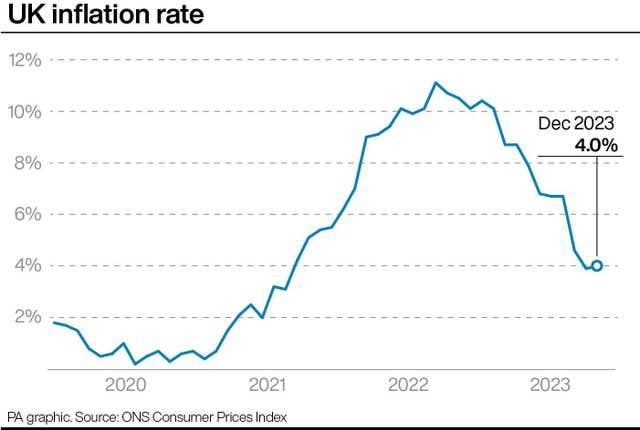
However, household incomes are expected to improve as consumer price index (CPI) inflation is expected to fall to the Bank of England's 2% by May, according to the EY Item Club.
The inflation rate is expected to average around 2.4% for the whole of 2024, which is below the 2.8% previously forecast by the economic researcher in its autumn forecast.
This positive inflation forecast is expected to lead to a “significant” reduction in the key interest rate for 2024.
(PA graphics)
It now predicts interest rates will fall from the current 5.25% to 4% next year, with the first cut due to take place in May.
These interest rate cuts are expected to lead to a decline in borrowing costs, which will likely boost spending as people will have more disposable income, the group said.
Hywel Ball, EY's UK chief executive, said: “Although challenges remain, the forecast suggests that the period of economic stagnation in the UK is slowly coming to an end.”
“Households and businesses still face a challenging outlook in 2024, partly due to the delayed impact of interest rate increases, but a slowdown in inflation and expected cuts in bank rates are likely to help maintain economic momentum as we move forward of the year.”
The story goes on
“Corporate investments, which have been disappointing for some time, are also likely to pick up again in the medium term.
“A slight decline is forecast for 2024, which should, however, be followed by an increase in investment spending in the following years.
“Falling inflation and market interest rates, as well as the possibility of further tax cuts in the Chancellor’s Spring Budget, suggest that the UK is at a turning point in 2024 and is about to enter a more positive phase of growth.”
According to the EY Item Club, house prices are expected to be “broadly stagnant” this year, rather than falling by 4% as forecast in the autumn forecast.
The report suggests that low unemployment rates and healthy household finances will continue to support homebuyer demand and limit the number of forced sales.
The report forecasts that the unemployment rate will not rise significantly as economic sentiment is expected to improve and the labor market remains flexible.
(PA graphics)
But last year's rate hikes are likely to cause financial hardship and could lead to some home repossessions.
This year, another 1.5 million households with fixed-rate mortgages will switch to more expensive rates, which could impact GDP growth.
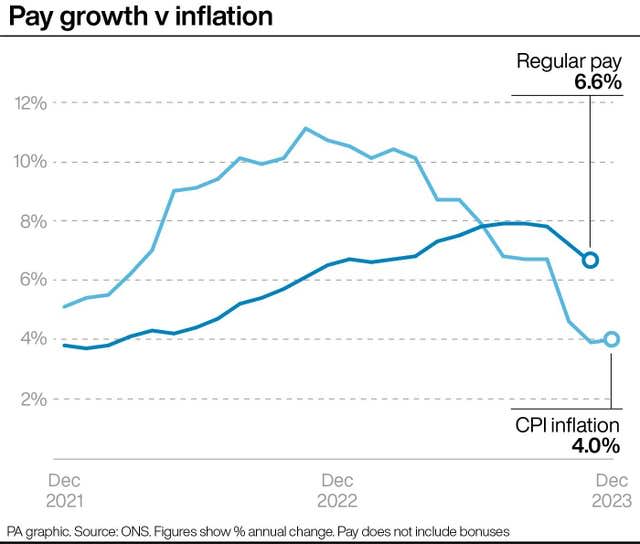
With household incomes “pleasingly” higher than inflation and lower energy costs easing pressure on the cost of living, consumer spending is expected to rise to 0.9%, up from the 0.7% previously forecast.
Martin Beck, chief economic adviser at EY Item Club, said: “While it remains possible that the UK may have slipped into a technical recession in the fourth quarter of 2023, the mood music around the economy is rightly improving.”
“However, there are risks to the forecast. Ongoing geopolitical tensions could drive up energy prices, which could slow the decline in inflation and increase costs for households and businesses.
“Although the Bank of England is expected to cut interest rates this year, the timing and extent of these cuts remain uncertain and persistently high interest rates could prolong financial stress.”
Comments are closed.