


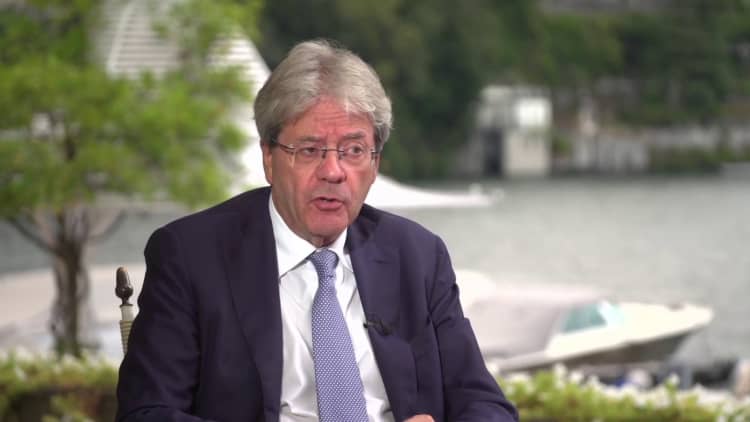
Europe is facing the effects of a “double crisis” but the region can avoid a recession, Paolo Gentiloni, the EU’s economic affairs commissioner, told CNBC on Saturday.
“I think we are facing the implications of the double crisis,” Gentiloni said, referring to the geopolitical implications of Russia’s all-out invasion of Ukraine and the consequent economic impact on the European continent.
“From a geopolitical point of view [the crisis] “Of course it also had an impact on the US and the whole world, but from an economic point of view it had a serious impact on Europe and Germany in particular,” he said.
Russia’s invasion of Ukraine in February last year sparked serious fears in Europe that the region was about to enter a major economic downturn.
However, the region has now managed to secure alternative sources of energy, which until then have mainly come from Russia, and some governments have been able to relieve consumers struggling with high energy bills.
According to the International Monetary Fund, the euro zone ultimately grew by 3.5% in 2022. The institute expects a growth rate of 0.8% for the euro zone this year and 1.4% in 2024.
“We had an amazing 2022, growing faster than the US and China,” Gentiloni told CNBC’s Steve Sedgwick at the Ambrosetti Forum.
“The slowdown started in the last quarter of 2022 and it’s there, but please don’t call this a recession because I think we can avoid a recession, we’re avoiding a recession,” he said.
Energy Independence Challenge.
The European Commission, the EU’s executive branch, releases new economic forecasts for the entire region on September 11th. They will give an indication of the growth situation in the region.
However, recent economic data has raised concerns of a slowdown. For example, European business activity shrank in August to its lowest level since November 2020.
Inflation has eased in recent months, but the latest data showed the total was stable at 5.3% mom in August. While lower than at the start of the year, it’s still well above the European Central Bank’s 2% target.
“Why is our economy slowing after a strong post-pandemic recovery? I think because of the challenge of gaining energy independence, which was very costly for our families and fueled inflation,” Gentiloni said.
Comments are closed.