
China and Colombia control cattle trade, but will the U.S. have a cow if Beijing moves into Latin America?


Colombia’s key cattle industry is expecting rapid growth in exports to China after the two sides signed deals, and China’s smartphones will find a booming market in the South American country, Colombia’s consul general in Hong Kong said this week.
Analysts say increased trade ties will consolidate China’s position in Latin America. They point out that the region has historically been more aligned with the United States – its largest trading partner.
Beef exports to China will grow based on a bilateral protocol signed in September that covers sanitation measures for exportable agricultural products, Colombian Consul General Luis Fernando Orozco Barrera told the Post on Tuesday.
Colombia’s cattle industry employs nearly a million people, or about 7 percent of the country’s workforce, he said. Last year, Colombia exported around 45,000 tons of beef worldwide, worth $200 million. And as of August this year, global beef exports in 2023 totaled 22,000 tonnes, worth $90 million.
“As for export forecasts to China, we expect at least 2,500 tonnes to be exported monthly – almost $15 million,” he said.
Colombian Consul General Luis Fernando Orozco Barrera spoke to the Post. Photo: Colombian Consulate
“To give some perspective on the importance of this, consider that… the Colombian livestock population is, in macroeconomic terms, 3.3 times larger than the coffee sector, and we are the third largest [largest] “Global coffee producer,” Orozco said, citing data from government and industry groups.
Although China already imports beef from countries such as Australia, Brazil and the United States, the market can absorb more, said Zhao Xijun, a finance professor at Renmin University.
“From a demand perspective, what we get now is not enough to supply the entire market,” Zhao explained.
Colombia has identified China as the world’s largest beef importing country, accounting for 25 percent of global imports, Orozco said.
Colombian President Gustavo Petro also visited his Chinese counterpart Xi Jinping in Beijing on October 25 and signed 12 economic cooperation agreements. One of them involves sharing “planning and guidance” in agriculture for the next five years, Orozco said.
02:17
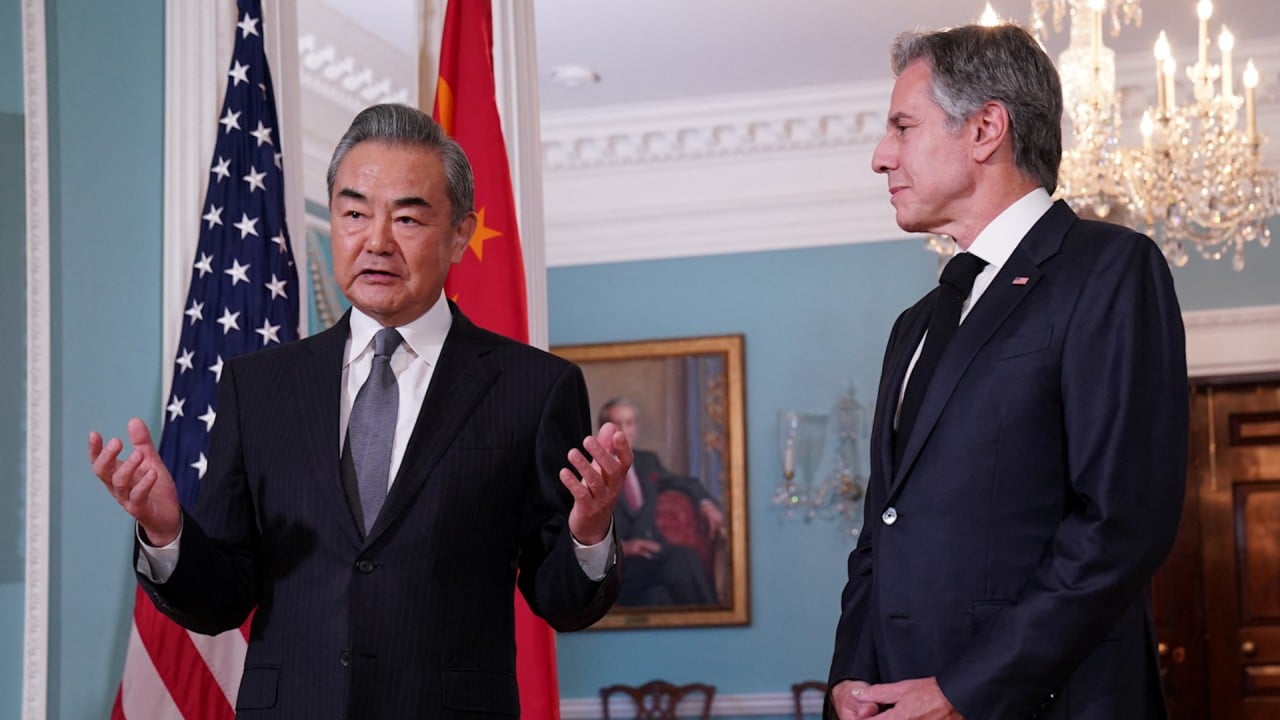
China’s Wang Yi calls for “in-depth” Sino-American dialogue ahead of talks with Antony Blinken in Washington
China’s Wang Yi calls for “in-depth” Sino-American dialogue ahead of talks with Antony Blinken in Washington
Also last month, the two countries upgraded their bilateral ties to the level of a “strategic partnership,” a term that usually means managing the relationship through dedicated problem-solving and information-sharing frameworks.
For China, Orozco said, Colombia is a growing market for consumer electronics such as smartphones.
Colombia has experienced an economic boom over the past decade, increasing the disposable income of many of its 52 million citizens.
In the first quarter of 2023, Xiaomi and Oppo were the second and third largest smartphone vendors in Colombia, respectively, after South Korea’s Samsung. According to market research company Counterpoint, the two Chinese brands achieved a combined market share of 28 percent between January and March.
After Huawei’s smartphone leap, Beijing is setting high goals for advanced manufacturing
“The technology industries, particularly computers and mobile phones, play a key role in bilateral trade exchanges,” Orozco said. He noted that Colombia has 71 million mobile subscribers.
“All this makes Colombia very attractive if we also take into account that in 2024 we will carry out the public tender for 5G networks in the country,” he added.
Total two-way trade between the countries was $22.64 billion last year, with China exporting $15.6 billion of that.
Others of the twelve deals signed on October 25 have not yet been completed DecarbonizationWater conservation and the development of Colombia’s digital economy.
Because of its geographical proximity and longstanding alliances, Colombia – like much of Latin America – has traditionally leaned toward the United States as its main source of business.

02:13
30 Chinese migrants found at sea by Colombian navy
30 Chinese migrants found at sea by Colombian navy
But China has already signed a free trade agreement with Chile and is seeking another with a group of South American nations that includes Argentina and Brazil, the region’s largest economy. China was Colombia’s second-largest trading partner last year, behind only the United States, in terms of record revenue from imports and exports.
The 12 agreements signed with China will help Colombia “diversify trade opportunities by creating alternatives to its traditional and long-term, near-exclusive partnership with the United States as its main trading partner,” said Enrico Cau, an associate researcher specializing in Asia at the Taiwan think tank the Strategy Research Association.
This diversification, he said, will give Colombia more influence in negotiating other trade deals.
“From a policy perspective, China’s growing influence in the Latin American region appears to be not only an attempt to diversify trade opportunities, but also the potential need to free Latin American countries from heavy dependence on the US,” Cau said.
Comments are closed.