


Photo courtesy of Flickr.
I skipped writing a column last week because I was getting tanned in Jamaica. Tan. Burn. However. Please don’t touch my shoulders.
The people of the island are hospitable, kind and love to talk about the things they see and know.
Jamaica forecasts about 2.45-2.5 million visitors in 2022 with total spending of $2.9 billion, according to the island’s tourism director. That would be twice as many visitors and a 50% jump in sales compared to the previous year. Forecasts for 2022 are still behind pre-COVID-19 numbers, but numbers are getting significantly higher each month. And levels don’t lie.
During the holiday I met other couples from countries as far away as Italy, Norway and Belgium. However, the Jamaicans assured me that the percentage of visitors from the US was “almost all, mon”. I paid with an American credit card. I tipped the staff in US dollars. I purchased products in the boutique in US currency. Jamaica is a playground for fun-loving Americans — including those who spend remaining stimulus payments and those who typically have discretionary income without such payments.
Jamaica’s improved numbers make sense given that Americans spent about $114 of their $2.7 trillion “excess” savings over the past few months. (I have already referred to the term excess savings. It is the amount of household savings that is expected relative to the size of the economy and saving trends.) In addition, US wage incomes remain healthy.
Every time I’ve traveled since the pandemic began, I’ve made a habit of asking locals what they’ve seen – were there more or fewer visitors? Do you spend more? What are you buying? Where you go? I almost automatically made a version of this before the pandemic. I called it a “channel check”. I went to eat and noticed how many seats were sold and if people paid extra to get appetizers and desserts. I would ask delivery people their quantity. When shopping, I would conduct a visual survey to determine the number of people with armfuls of bags compared to those making seemingly token purchases.
Unfortunately I don’t think I would have any luck convincing the tax authorities that this was a business trip. Nonetheless, it was a blissful week for the S – sun, sand and an assessment of the American economy. I’ve said that I believe the US is in a recession right now, although the high employment numbers don’t “feel” it. When gross domestic product (GDP) growth for the second quarter of 2022 is released, it will likely show that the US has experienced two consecutive quarters of negative GDP growth. That’s a common, if imprecise, definition of a recession. American sentiment in Jamaica suggests that this recession will ultimately be less painful than the shock of 2020 or the Great Financial Crisis of 2008. This bodes well for a stock market decline of 30% rather than 50%. The S&P 500’s recent drop of about 25% from peak to trough means most of the damage has likely already been done.
The people of Jamaica told us that the pace of American visitors has picked up in recent months, even as the States have been warming. I don’t play golf and I don’t drink much, but the Jamaicans told me that people who didn’t reserve in advance couldn’t get on the course. A popular street bar had attracted so many American tourists that it recently sold for $8 million. I checked out the place. I’m not saying they overpaid, but the cabin-style restaurant’s business must have been exceptional.
For this spending to directly help the US economy, you want it to be made in the States and not elsewhere. However, it is an indication of US consumer appetites. They have tons of savings, higher wages, and a strong desire to spend that money. The Federal Reserve is trying hard to slow down the economy to control inflation. Given the current willingness to spend, you have a lot to do.
What did I miss when I was gone?
When I left the States, Americans were concerned that the world would fall apart. I came back and it’s worse. According to the American Association of Individual Investors (AAII) sentiment survey, the number of optimists in the stock market has fallen below 20% again.
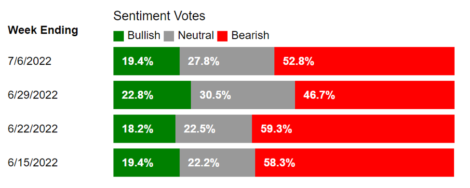 Chart courtesy of American Association of Individual Investors.
That’s about half as many cops as usual.
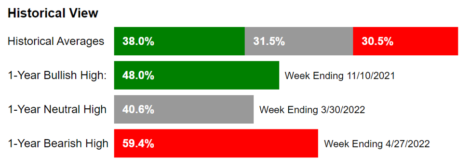 Chart courtesy of American Association of Individual Investors.
When I was gone, the number of bulls dwindled and more people turned bearish. There is now a 33.4 percentage point gap between the readings. This is the second percentile of any metric since the survey began in 1987. The level of bearishness on this metric is extreme and is corroborated by a number of other sentiment gauges.
As a lateral thinker, I’m happy about that. It suggests that the bottom for the stock market is likely nearing. As a realist, I still have concerns. We can be near bottom and still get bashed in the stock markets over the next few months as we near the midterm elections. That often happens in election years, and you should respect historical stock market cycles, man.
Allen Harris is the owner of Berkshire Money Management in Dalton, MA and has over $700 million under management. Unless expressly identified as original research or data collection, some or all of the data cited is attributable to third party sources. Unless otherwise stated, any reference to specific securities or investments is for illustrative purposes only. The advisor’s clients may or may not hold the securities discussed in their portfolios. The Adviser makes no representations that any of the securities discussed have been or will be profitable. Full Disclosures: https://berkshiremm.com/capital-ideas-disclosures/ Direct inquiries to Allen at [email protected]
Comments are closed.