
California — the world’s fifth-largest economy — is preparing for a third straight year of drought


According to forecasters, there is little relief in sight from the multi-year mega-drought that has drained western U.S. reservoirs, fueled wildfires and helped drive up costs in California’s breadbasket to the nation.
From April through June, chances remain high that little rain or snow will fall from northern California and Oregon across a wide swath of the Rocky Mountain states to Texas and the US Gulf Coast, according to NOAA’s Climate Prediction Center, which is part of the National is weather service.
special report: Western Drought Watch
At the same time, warmer-than-normal temperatures will affect most of the contiguous US, with the exception of parts of the Pacific Northwest.
Scientists say the western US is broadly experiencing its worst mega-drought in 1,200 years, made worse by climate change.
“With nearly 60% of the continental US experiencing mild to exceptional drought conditions, this is the largest drought coverage we’ve seen in the US since 2013,” said Jon Gottschalck, chief operational prediction branch, at NOAA’s Climate Prediction Center.
NOAA
The impact on California cannot be overstated. The state’s GDP was $3.35 trillion in 2021, accounting for 14.6% of the total US economy. If California were a country, it would be the fifth largest economy in the world, more productive than India and the UK.
Promise too much?
California produces over 25% of the country’s food supply. The agriculture sector is a nearly $50 billion industry that produces over 400 key commodities, according to the California Department of Food and Agriculture.
California has had an estimated nearly $20 billion in annual farm sales at risk from drought in recent years, as detailed in Esri’s Drought Aware app, which compiles layers of public data in one place to show how conditions in the US have changed over two decades and how many farms may be at risk.
The last time the state faced a drought of this magnitude, like in 2014, food economists said consumers could expect a price hike of about 3%, directly related to water conditions. A post-pandemic inflationary recovery is also playing a role at the moment.
However, the experts predicted that the state’s agricultural industry could feel the effects for years to come. According to a study reported by the Los Angeles Times, last year’s severe drought has already caused California’s agricultural sector to lose an estimated 8,745 jobs and shoulder $1.2 billion in direct costs as water cuts forced growers to set aside farmland and pump more groundwater from wells.
Read: As drought ravages the West, any investor not focused on climate risk is “really kidding,” says this portfolio manager
California water officials told state agencies Friday to expect even less water from state sources than the small amount they were promised earlier in the year as major reservoirs remain well below their normal levels.
California’s water use rose in January despite calls for austerity, even as Gov. Gavin Newsom stepped aside before mandatory cuts.
“The smarter we are now about how we use water, the more sustainable we will be if the drought continues,” Wade Crowfoot, the state’s natural resources secretary, said earlier this week. “Water is a precious resource, especially in the American West, and we need to move away from practices that are clearly wasteful.”
Farms in the Central Valley have long pumped more groundwater during droughts, and water levels have been falling for decades. In 2014, another major drought, state legislatures passed the Sustainable Groundwater Management Act. It established a framework for groundwater management and called on local authorities to develop plans to address chronic overpumping problems.
But the drought that began in 2020 will require more protection as reservoirs like Lake Oroville and Shasta Lake remain below historic levels and less water is expected to seep down the mountains from melting snow this spring, a result of climate change.
Current projections call for the state to see about 57% of its historical mean flow from April through July, Alan Haynes, hydrologist in charge of NOAA’s California Nevada River Forecast Center, told the Associated Press.
Some officials told the ` the state must plan for more droughts in the future by spending money to build canals to protect against water loss, improve groundwater reservoirs and give people even more financial incentives to make their properties more drought-friendly. The state’s plans to expand water storage facilities received a boost Thursday when the federal government announced it will borrow $2.2 billion to help build a new reservoir.
But critics of California’s water policy say the bigger problem is that the state promises more water each year than it has to give. This has led to a continued reduction in supply at state and state reservoirs, said Doug Obegi, a water attorney with the Natural Resources Defense Council.
“We basically have a system that’s pretty much bankrupt because we promised so much more water than can actually deliver,” he told the Associated Press.
Great Lakes: From Drought to Flood
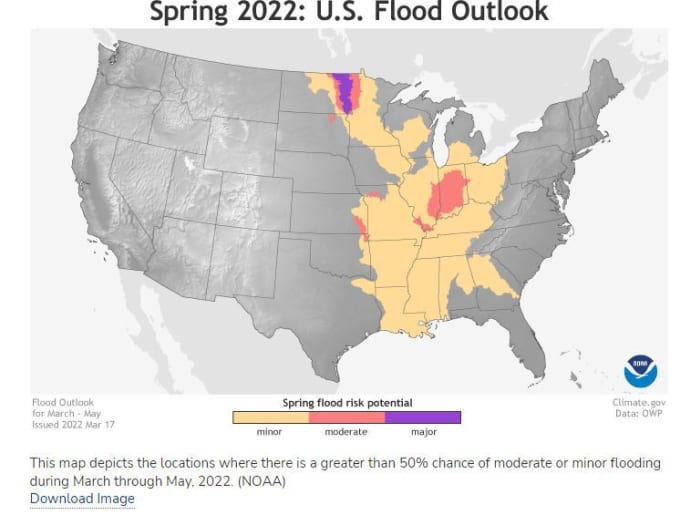
Above-average precipitation is most likely in parts of the Great Lakes, Ohio Valley, mid-Atlantic and west coast of Alaska, NOAA said.
NOAA
Much of the eastern half of the continental US is at low to moderate risk of flooding, including the Southeast, Tennessee Valley, lower Mississippi Valley, Ohio Valley, and portions of the Great Lakes, upper Mississippi Valley, and middle Mississippi Valley, the forecast shows.
“High flood risk potential is expected for the Red River of the North in North Dakota and moderate flood potential for the James River in South Dakota due to late fall and winter rainfall that saturated soils and increased water flows,” said Director Ed Clark , NOAA’s National Water Center.
The spring snowmelt in the western US is unlikely to cause flooding.
The Associated Press contributed to this.
Comments are closed.