
As Putin seeks safe re-election, Russia's economy defies sanctions, critics | business and economy


Russia's success in circumventing Western sanctions has helped its economy far exceed expectations ahead of Vladimir Putin's all-but-certain re-election on Sunday.
Since the Russian invasion of Ukraine in February 2022, the Russian economy has repeatedly defied critics' gloomy predictions.
That resilience appears set to continue as Russians head to the presidential election between Friday and Sunday that is expected to ensure Putin's rule until at least 2030.
At the start of the war, the International Monetary Fund expected a prolonged recession and predicted the economy would contract by 8.5 percent in 2022 and 2.3 percent in 2023. While Russia's economy contracted in 2022, the decline was, according to the government only 1.2 percent figures. Last year the economy officially grew by 3.6 percent.
According to Castellum.AI, a global risk platform, 16,587 sanctions have been imposed on Russia since the start of the war – most of them against individuals. Around $300 billion in Russian assets were frozen.
Further restrictions apply to international debt markets and industrial imports. The most consequential sanctions restrict natural gas exports and cap Russian oil prices.
“I can’t say the sanctions had a big impact on me,” Nikolai Zlatarev, a Moscow resident and education worker, told Al Jazeera. “My weekly shopping is a little more expensive and I buy more Russian brands. But I doubt drinking Dobry Cola instead of Coca-Cola will change the election.”
Due to high oil prices and increased military spending, Russia has managed to mitigate much of the impact of sanctions. But the costs of ongoing conflict and the possibility of further sanctions are likely to weaken production in the medium term.
Russia's economy has developed better than expected since the invasion of Ukraine [File: Elena Chernyshova/Bloomberg via Getty Images]“Increased spending caused by war can stimulate economic activity. But it also represents a redistribution of income away from government services and towards the army,” Konstantin Sonin, a political economist at the University of Chicago, told Al Jazeera.
Military spending has risen sharply in recent years, rising from 3.9 percent of gross domestic product in 2023 to about 6 percent in 2023 – the highest since the collapse of the Soviet Union. This year, military spending is expected to account for almost a third of government spending.
Significant investments in military hardware and software as well as social welfare benefits for the families of soldiers killed in war have boosted wage growth.
Meanwhile, Russia's vast energy sector keeps money flowing into state coffers as local companies make significant efforts to replace Western imports.
“Import substitution is always accompanied by trade restrictions,” Sonin said.
“Most critically, Russia continues to sell large quantities of fossil fuels. It is true that oil and gas exports have fallen due to the sanctions, but increased prices have kept overall revenues high,” he said.
Sonin added: “It is important to remember the size of Russia’s fossil fuel sector. Domestically, oil accounts for about a third of tax revenue and half of all export revenue.”
The Kyiv School of Economics estimates that Moscow earned $178 billion from oil sales last year and that revenue could rise to $200 billion by 2024 – not far from $218 billion in 2022.
In May 2022, the European Union agreed to cut 90 percent of its oil imports from Russia. Then, in December 2022, Australia and G7 members announced a price cap on Russian crude oil – known as Urals crude – to further strain Moscow's financial position.
Under the rules, non-G7 oil traders can use Western ships and financial or insurance services only if they pay $60 a barrel or less – well below the market price.
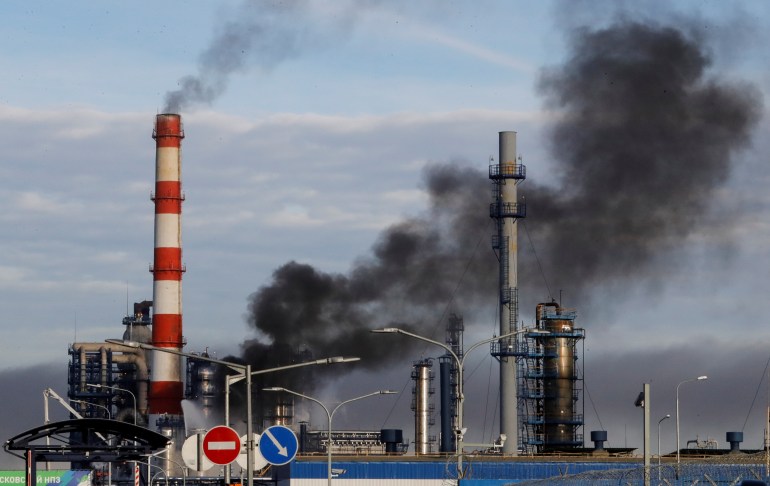 Russia's huge fossil fuel sector has helped its economy withstand sanctions [File: Tatyana Makeyeva/Reuters]However, according to Switzerland-based energy trader Mohammed Yagoub, Russia has proven adept at countering these measures.
“Russia has built a large 'shadow fleet' of tankers with opaque ownership and no Western connections in terms of finance or insurance. “In addition, Russia has found many non-Western oil buyers at discount prices, led by China and India,” Yagoub told Al Jazeera.
“Last month, most Russian Urals currencies were sold for more than $60. But Western countries are cracking down,” Yagoub added, referring to a reported request for information from the U.S. Treasury Department to shipping companies suspected of violating the cap.
“Last year the Kremlin was lucky. Western countries don't want to completely phase out Russian oil because a shortage of supplies would trigger global inflation. So they behaved just as well as they did before the war.”
Russia has also found ways to circumvent import restrictions by sourcing goods from countries that act as middlemen for Western goods. For example, Serbia's phone exports to Russia increased from $8,518 in 2021 to $37 million in 2022.
Some observers dispute that the pressure campaign against Moscow has failed.
“Sanctions work,” Liam Peach, a senior emerging markets economist at Capital Economics, told Al Jazeera.
“You can assume that journey times for tankers are longer [previously travelling to EU countries]along with high insurance premiums, have increased the cost of selling oil by around $30 per barrel.”
“In addition to increased military spending, reduced oil revenues will cause the deficit to widen to 3 percent this year, from 1.5 percent in 2023,” Peach said. “This will require cutting government spending in other areas such as health and education, which will slow growth over time.”
Peach also pointed out that declining exports have led to sharp currency devaluations, making imports more expensive. To curb price increases, the Bank of Russia raised interest rates by 8.5 percent in 2023, which will also slow economic activity.
 The British Ministry of Defense estimates that more than 350,000 Russians were killed or injured in the war in Ukraine. [File: Russian Defense Ministry Press Service via `]Elsewhere, Putin is grappling with a labor shortage exacerbated by his military mobilization efforts. The British Ministry of Defense estimates that more than 350,000 Russians were killed or injured in the war.
Re: Russia, an analysis and policy network, estimates that nearly a million Russians, about 1 percent of the workforce, have emigrated since the invasion.
These losses have exacerbated looming demographic challenges, as Russia's birth rate was already below the replacement level of 2.1 before the war.
“The result is that economic growth will be more constrained on the supply side and GDP will likely fall from around 3 percent this year to 1.5 percent by the end of the decade. National production will be particularly weak during periods of low oil prices,” Peach said.
“But I don’t think a gradual economic downturn will pose a major threat to Putin,” Peach added. “Russia has experienced a number of crises in recent decades. As long as inflation and the ruble remain broadly stable, low growth is unlikely to bring down the government.”
For Zlatarev in Moscow, conditions are far better than during the well-known economic crises of the 1990s.
“Compared to back then, everything is fine. Even though the costs of this conflict are high, Putin is still viewed as a positive,” she said. “Most people I know said they would vote for him.”
Comments are closed.