
Amid a weak economy and political pressure, Artbo is supporting Colombia’s emerging contemporary art market


Artbo in Bogotá, Colombia’s leading art fair (until November 25th), opened its 19th edition in a new location and on a new date. Visitors to the VIP preview yesterday (November 22) toured booths on five floors of the sprawling Ágora Bogotá convention center, with panoramic views of the city and the surrounding Andes mountains in the background.
Despite the falling value of the Colombian peso and political unrest over the recent elections, dealers contacted by The Art Newspaper reported strong buyer interest and some sales. Leon Tovar, who founded his gallery in Bogotá in 1991 before moving to New York in 2012, placed a small untitled work by Colombian artist Santiago Cárdenas for $30,150 and a large wooden sculpture from the Seeds series by Peruvian artist Jaime Miranda- Bambarén for $55,000. Examples of the latter were scattered throughout the lobby near the entrance to the fair. Tovar represents both artists.
Seed sculptures by Jaime Miranda-Bambarén in the lobby of the Agora Bogotá Convention Center. Courtesy of Artbo
“I was a little surprised because the political situations in Latin America are sometimes extreme,” says Tovar. “But they are very positive here, we have had some sales in the early hours of the morning.”
Among the most popular works at Artbo are Sergio Ferro’s handmade ceramic soup cans at Bogotá gallery Salón Comunal’s booth. A Colombian twist on the Warholian Campbell classic, Ferro paints the names of local varieties of the dish, like “Sopa de Lentejas,” on small vases. The soup cans, which cost about $60 each, were nearly sold out within hours of the fair opening.
María Paz Gaviria, who has been Artbo’s director since 2012 and the daughter of former Colombian President César Gaviria, says one of the fair’s strengths is that it has remained distinctively Latin American over the years. Around two-thirds of the 33 galleries participating in Artbo’s main exhibition area come from Colombia, with the rest coming from countries such as Argentina, Brazil, Chile, the USA, Spain and France. The fair typically welcomed around 70 galleries in the years just before the Covid-19 pandemic hit (in addition to the main art galleries, Artbo hosts separate areas for design, large-scale installations and smaller goods such as zines, posters and tote bags). and magazines).
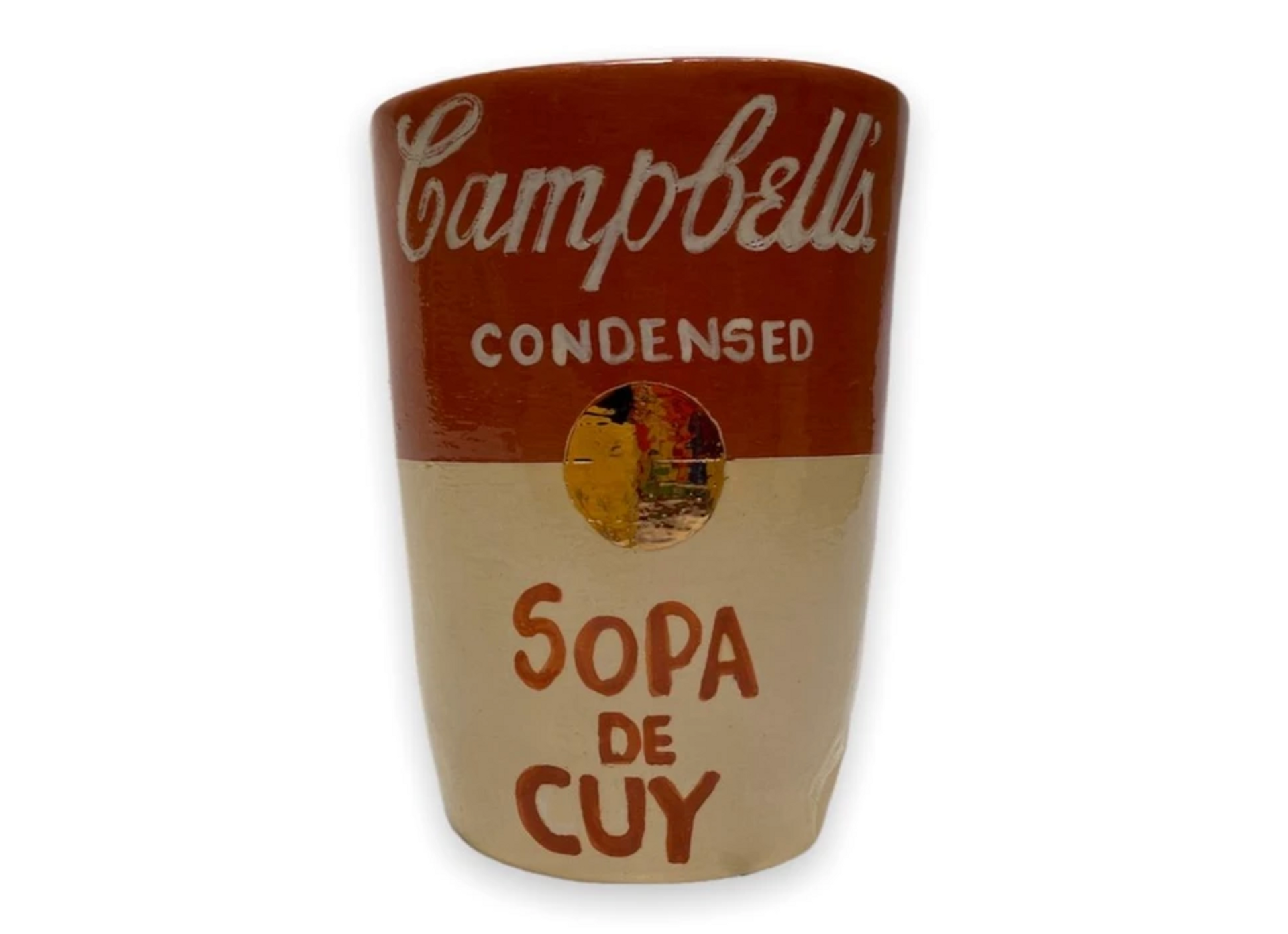
Sergio Ferro’s handmade ceramic soup cans at the Salón Comunal gallery stand in Bogotá
Courtesy of Salon Comunal
“Artbo has positioned itself as the fair with the most Latin American content, in terms of composition, with emerging art, as a place of discovery and as a boutique fair,” says Gaviria. “For this reason, it has always attracted perhaps the largest number of international trade fair visitors in Latin America.”
These international customers can be a lifeline for traders in Colombia.
“The art market in Colombia has always been very fragile. So this is a very, very important moment for the local art scene,” says Paula Bossa, curator and operations manager of the Casas Riegner gallery in Bogotá. “We always expect international visitors and although the dates are a bit complex, it was a nice surprise to see some very interesting visitors.” At the Casas Riegner stand, you can sample the ceramics by Colombian artist Luz Lizarazo, which deal with the female form, between $600 and $3,000; A drawing by the artist is also available for $3,800.
While the VIP preview was well attended, this year’s edition of Artbo overlaps with the American Thanksgiving holiday and there were very few visitors from the US in attendance. Normally the fair takes place at the end of October, but this year these dates coincided with Colombia’s regional elections and the fair’s previous venue, another convention center near the Ágora Bogotá, serves as one of the largest polling stations in the country.
“Market conditions are closely linked to political conditions. Of course that is always the case. And that’s exactly the case with Artbo,” says Gaviria. “We just experienced a mayoral election here in the city of Bogota, and a few weeks ago you saw a very dramatic change in the price of the peso, which of course affects the art market.”
Economic problems
The value of the Colombian peso fell last week after new government figures showed the country’s economy contracted in the third quarter of the fiscal year. This marked Colombia’s first year-over-year economic contraction since 2020, as both high interest rates and inflation continue to curb spending (galleries on Artbo tend to sell works priced in US dollars). Last month, candidates backed by President Gustavo Petro, Colombia’s first leftist president, were defeated by opposition candidates in regional elections that were widely seen as a referendum on the president’s first year in office. For decades, violence raged in Colombia between powerful drug cartels, right-wing paramilitary groups and left-wing guerrilla movements.
Contemporary art is particularly difficult to sell in Colombia because there is still a strong preference for traditional art forms, although dealers say there is no shortage of young, talented artists creating groundbreaking works.
“I think the modern market is strong, but the contemporary market is just starting, so it is quite difficult and difficult for contemporary galleries to stay afloat. We are a new market,” says Katy Hernández, director of Galería Espacio Continuo in Bogotá. The gallery is offering Ana María Ruedas Celosía (2023), a fabric and plaster hanging, for $9,000. “We have great artists here in Colombia, but we need international visibility,” adds Hernández
This opinion is also shared by Omayra Alvarado-Jensen, the managing director of the Instituto de Visión, which runs galleries in Bogotá and New York. She says that the gallery sold works largely to international collectors at Artbo this year, and that its Colombian market is smaller because of the Colombian economy and the value of the peso (Alvarado-Jensen often offers special rates to Colombian collectors and institutions, she says ). ).
“We have wonderful artists, very powerful and refreshing practices and producing people from very different backgrounds,” continues Alvarado-Jensen. “When you live in a place like Colombia, where there is – unfortunately – so much social and political unrest, it is a place where great art can happen.”
Comments are closed.