


COLOMBO, SRI LANKA –
Former Sri Lankan Prime Minister Ranil Wickremesinghe has been sworn in as the country’s president and has pledged to form an all-party government capable of securing a multi-billion dollar International Monetary Fund bailout.
Wickremesinghe’s victory followed the resignation of President Gotobaya Rajapaksa, who fled to Singapore after hundreds of thousands of Sri Lankans marched through the capital on July 9, overrun the presidential palace, picnicked on the lawn and even swam in the president’s pool.
However, due to his close ties to the Rajapaska, Wickremesinghe is also unpopular with many protesters. He served as Prime Minister under Gotabaya and despite promises that he would form an all-party government, most of his appointments in the new cabinet were chosen from among the Rajapaksa loyalists.
The Rajapaksa family ruled for 17 years and is widely blamed for the bankruptcy of this country, with debts totaling $51 billion and foreign exchange reserves of just $1.7 billion. The central bank says it needs $7 billion for debt commitments and to keep Sri Lanka going for the rest of this year.
Ganeshan Wignarjara, a senior fellow at the Institute of South Asian Studies at the National University of Singapore, said the crisis was predicted at least four years ago, but the Rajapaksas refused to listen and the initial inquiries to the IMF in April came much too late .
In this photo provided by the Office of the Sri Lankan President, Sri Lanka’s newly elected President Ranil Wickremesinghe signs the sign after taking his oath during his swearing-in ceremony in Colombo, Sri Lanka July 21, 2022.
“The Sri Lankan economy is in danger of collapsing after defaulting on its debt. Growth is -4 to -6% in 2022 and inflation is between 50 and 70% this year and there are three quarters of a million poor people that have been created by this crisis.
“So it’s a terrible situation in Sri Lanka,” he said, adding that Wickremesinghe needed time to put his country’s finances in order.
Colombo officials are expected to meet the IMF in August and the negotiations are expected to include Sri Lanka’s top three lenders – Japan, the Asian Development Bank and China.
At the recent meeting of G-20 finance officials in Indonesia, US Treasury Secretary Janet Yellen called on China to help restructure Sri Lanka’s debt, telling journalists, “Sri Lanka clearly has no capacity to repay this debt.”
“And I hope that China will be willing to work with Sri Lanka to restructure the debt – it would probably be in both China’s and Sri Lanka’s interests,” she said.
Wignaraja also said China must play a positive role in resolving the crisis but added that fears of a Chinese debt trap were overdone as Beijing held only 14% of Sri Lanka’s total debt.
“China has given Sri Lanka $13.2 billion for infrastructure projects since 2006. These projects had mixed results; some good projects, some bad projects.
“The total debt burden is about $7.6 billion. It suggests increasing Chinese debt, but not that Sri Lanka is already caught in a Chinese debt trap,” he said.
A deal with the IMF could be months away and the people of Sri Lanka are still grappling with hyperinflation, acute food and fuel shortages and power outages. Schools remain closed and many people are working from home.
The shortage of medicines has prompted doctors to warn people of death, particularly in remote rural areas where distribution of essential supplies, including rice, has ground to a halt as the country runs out of fuel.
Protesters and politicians from all political parties are also calling for an independent investigation into the Rajapaksa family, their wealth and allegations of corruption.
Sri Lankan investigators have previously claimed that more than US$2 billion was transferred to bank accounts in Dubai run by people close to Mahinda Rajapaksa, Gotabaya’s brother, when he was president more than seven years ago. Mahinda dismissed these claims as “nonsense.”
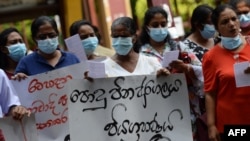
Health workers hold placards and shout slogans against Sri Lankan President Ranil Wickremesinghe during a protest in Colombo July 23, 2022.
The number of protests has dwindled since Rajapaksa fled the country, but dissatisfaction with the government remains high as many protesters are deeply skeptical and are trying to keep up their tent camp outside the presidential complex. However, the army and police began violently dismantling the camp on Friday morning, leading to clashes and arrests.
“Our government, the Sri Lankan government, is killing the innocent people in the rural areas of this country. They have nothing to eat,” said Keith Gibson, a musician and protest leader.
“They only drink water – and this corrupt regiment kills the people and they don’t lead and they don’t have a solution for the country, you know, and the people suffer,” he said.
His opinion was shared by Sulaimaan Saim, a medical student who recently returned from studying in Belarus. He said people who once drove luxury vehicles now ride in tuk-tuks and people who once rode in tuk-tuks are now forced to walk.
“The government has messed around too much. They messed around with our money. They took people’s money. They basically stole it,” he said.
“Now we are at zero, nothing, absolutely nothing, we have nothing, our country is really messed up. We have no gas, we have no food, we have no gas. We have no medicine. People die. Waiting in lines for fuel for four or five days is really bad,” he said.
Comments are closed.