


John Ross, former director of economic and business policy in London, receives an interview with Xinhua in Potters Bar, Britain, on June 18, 2019. (Xinhua/Ray Tang)
by John Ross from Great Britain
When Chinese friends asked me to explain the anti-China rhetoric about the economy in the West, I first told them that one had to distinguish between what people in the West think and what various media and governments in the West think. Most people in the West are not too concerned with the China issue because they have their own problems, such as the economic situation in their own countries, inflation and the decline in real wages.
But the Western media and governments are actually obsessed with the situation because they cannot come to a realistic assessment of the situation. The realistic assessment of the situation is that China's economy has been growing much faster than China's national economies not only since 1978 but also in recent times. Let's take the last year, 2023, because the data is only just available. The US economy grew by 2.5 percent this year. The Chinese economy grew by 5.2 percent. China's economy grew more than twice as fast as that of the United States, but Western media claims there is a deep crisis in China and that the US economy is doing incredibly well, but this is contradicted by the facts.
According to my calculations, China's economy has grown by just over 20 percent in the past four years since 2019. The US economy grew by 8.1 percent, the Eurozone grew by around 3 percent. China's economy grew 2.5 times as fast as that of the United States and almost seven times as fast as the euro zone.
A long time ago I was told that when facts and theory don't agree, there are only two things you can do. One is to be a rational person who gives up on theory, the other is to be a dangerous person who gives up on the real world, and unfortunately we have seen in the US media that the second choice is made. They have participated in a lot of fake news and claims.
The Chinese economic model leads to very rapid growth. In order to double China's GDP and its GDP per capita between 2020 and 2035, China must grow by 4.7 percent per year in the longer term. On average, this means that the country had to grow by around 15 percent between 2020 and 2023. In fact, China grew faster during this period, by about 17 percent. If this growth follows this trend, a side effect of China's development will be that the Chinese economy will become larger than that of the United States, but China's goal is not to overtake the US economy. The aim is to provide the Chinese people with the highest possible standard of living.
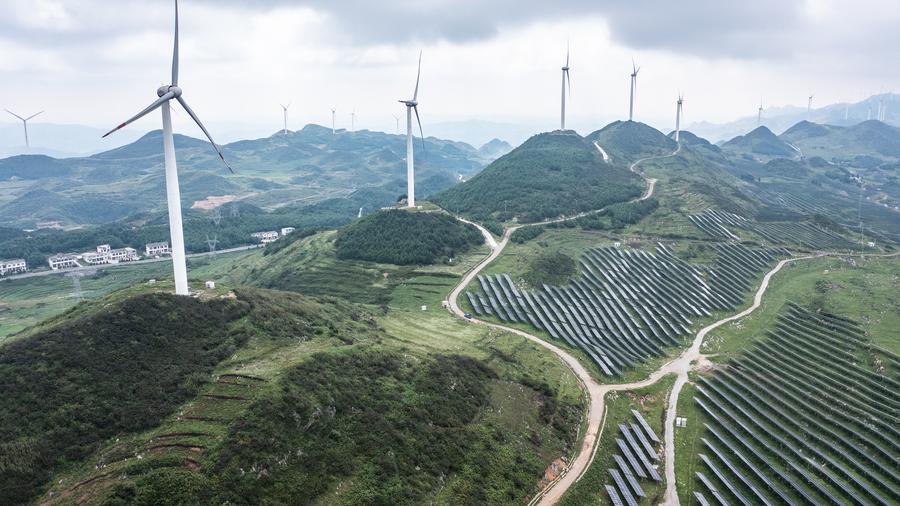 This aerial photo taken on July 6, 2023 shows a photovoltaic (PV) power plant in Ertang City, Weining Yi Hui and Miao Autonomous County, southwest China's Guizhou Province. (Xinhua/Tao Liang)
You can't cheat on the facts. However, this does not prevent fake news about China from appearing in many Western media outlets. There are mutliple reasons for this. Firstly, in my opinion there is no doubt that the US intelligence services are intervening in this matter. The same false claims appear in numerous newspapers on the exact same day and it is not credible to believe that this is a coincidence. We know from public research that the United States spends billions of dollars each year influencing so-called private media by paying journalists and breaking stories.
Some of it is just sloppy journalism, but there is arrogance behind it. Many white people cannot imagine that the Chinese people, or any other people except those descended from Europeans, could be the most successful.
Unfortunately, we are witnessing the US attempt to slow China's economy because the United States has set itself an impossible goal: that the US economy remain the largest in the world. But the United States was unable to stimulate its own economy. If the United States wants to compete by boosting its own economy, that's no problem for anyone. What is unacceptable and dangerous is that the United States is trying to compete by slowing down China's economy and trying to prevent the Chinese people from achieving the best possible standard of living. They won't accept that. No country in the world will say, “We will not have the best possible standard of living so that the United States can become the leading economy in the world.”
To compete by attempting to slow other economies, the United States subordinates rational economic activity to this goal and harms other countries and economies. If you take my own land. Huawei, for example, used to be a very important part of the UK telecommunications system. The US government insisted on removing Huawei from the UK telecoms system, which means we will get 5G later and it will be more expensive, which has a negative impact on the UK economy.
Some of his closest allies are willing to subordinate their own interests to those of the United States. But others, the vast majority of countries in the world, do not. They don't do this because they are neither pro-China nor pro-America. They are professionals themselves. But because they want to develop their own countries, they disagree with some of the things that the United States expects them to do in the interests of the United States. And the United States doesn't like that it can no longer control them.
China is a large economy, and its development objectively helps other countries in their pursuit of national independence. For this reason, the United States views the successful development of China's economy as a threat because it makes it more difficult for the United States to order other countries to do what the United States wants against its own interests. Most countries are not friends with China to oppose the United States. They are friends with China only to develop their own countries.
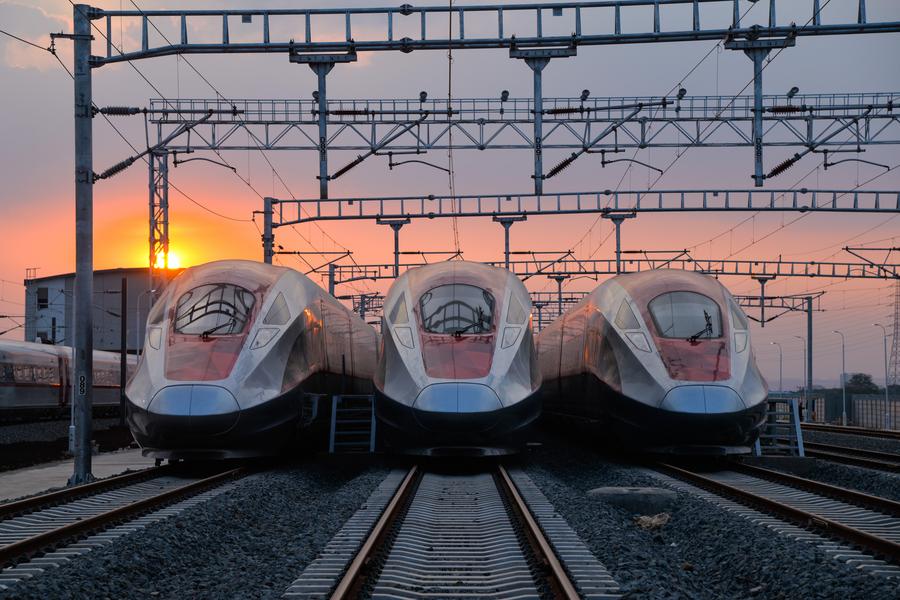 This photo taken on August 17, 2023 shows electric multiple unit (EMU) high-speed trains on the Jakarta-Bandung high-speed railway in Bandung, Indonesia. (Xinhua/Xu Qin)
In business, a win-win situation is not just about nice words. It's true – economists have known this since the founding of the field. In addition to developing its own economy, China's development objectively benefits all sorts of countries around the world. That's why so many of them want to take part in the Belt and Road Initiative or apply to join BRICS. The majority, not just many, but the majority, more than 70 percent of the world's countries have joined the Belt and Road Initiative, for example. So that the United States can spread the story that everything in China is catastrophic. Instead, the other countries want to have good relations with China. China now has far more major trading partners than the United States, so the United States may say everything is disastrous in China, but other countries' trade numbers tell them a different story, and their companies believe China is a more important market for them and is a more important import or export destination than the United States.
Since the international financial crisis in 2008, Western economies have never really recovered from the crisis in terms of growth rates. Therefore, China's rapid economic growth has been the strongest factor in the development of the world economy. It is very important that China's economic growth continues in this way, especially for its own population, but of course also for the rest of the world.
China's system is its greatest advantage. China can rely on government investment to run its economy and at the same time has a very strong private sector. If you want to put it like that, the Chinese economy can run on two legs. The US economy does not want to have a powerful state sector for ideological reasons and in the interests of capitalism. So it's as if the US economy only has to walk on one leg.
This is the most fundamental reason why the Chinese economy will continue to grow this way. China has achieved the fastest economic growth of any major country in human history. Look at it historically: When the People's Republic of China was founded in 1949, China was almost the poorest country in the world. It has now achieved moderate prosperity by its standards and will develop into a high-income economy in the next few years according to the World Bank's criteria. This means that someone born in the poorest country in the world becomes a citizen of a high-income economy. For large economies, nothing like this has ever happened in all of human history. That is the advantage of socialism.
Decades ago, in the 1980s, I thought from the standpoint of theoretical economics that China's economy should be very successful. I wrote an article in 1992 about why economic reform will succeed in China and fail in Russia. Back then, people said to me: Why are you so interested in China? Shouldn't you be interested in Japan or Germany? I said it's because China's economic policies are right. It will be extremely successful. If you don't believe me now, come back and we'll discuss the matter after 10 or 20 years. Now no one asked me, “Why are you so interested in China?”
My view of China's success was based on very basic questions of economic theory, since all countries are subject to the general laws of economics, and I saw that China was pursuing policies consistent with this. Of course, one country's policies cannot be mechanically replicated somewhere else. China insists on applying the general laws of economics to its own specific national conditions. That's why China is so successful.
Editor's Note: John Ross is a senior fellow at the Chongyang Institute for Financial Studies, Renmin University of China. He is the former Director of Economic and Business Policy for the Mayor of London.
The views expressed in this article are those of the author and do not necessarily reflect the positions of Xinhua News Agency.■
Comments are closed.