


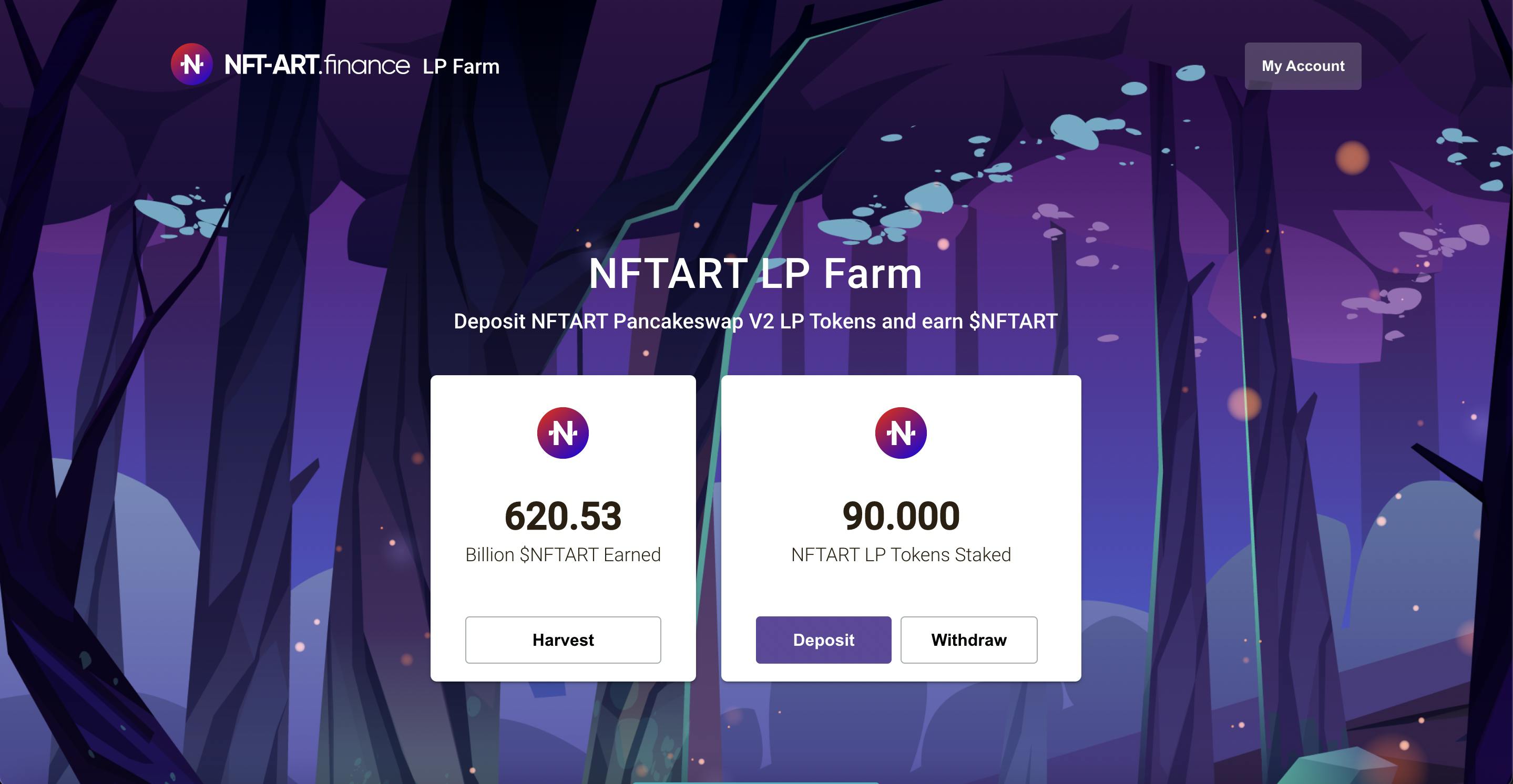
September was full of surprises and great news for the $NFTART community. Just last week we announced the successful launch of NFTART on Avalanche, opening the doors to new owners and adding additional value to $NFTART. This week we’re excited to share another great milestone for the Enterverse as we launched our very first native farm on the BNB chain!
This means artists, collectors, and DeFi degenerates alike can use their tokens to generate additional profit while also injecting liquidity into $NFTART. There are many reasons to get into farming and staking, but there are also risks to be aware of. At https://farm.nft-art.finance/ we have compiled the basics of staking and yield farming and how to get started with farming with $NFTART so that you can use the full scope right from the start. Read on for all the details and remember DYOR. Happy farming!
What do the new farms mean for $NFTART?
The farm on https://farm.nft-art.finance/ is built on the PancakeSwap v2 liquidity pool, so all the liquidity in their farms will help expand the v2 pool liquidity on PancakeSwap, which has the highest volume having . This means more liquidity where it’s needed, resulting in less price impact from trades. Those who jumped at the chance to join the $NFTART genesis pool for DIBS when dibs.money launched took home some sweet rewards, and we’re excited to offer you another chance to grab some nice APYs with to reap additional value for $NFTART for old and new owners alike within our own ecosystem.
What is yield farming?
Yield farming refers to the practice of providing liquidity to a protocol in exchange for transaction fees and additional token rewards. Essentially, liquidity providers provide liquidity to a pair (like $NFTART-$BNB) and share a percentage of their transaction fees proportional to their share of the pool. Representing the funds wagered, liquidity providers receive an LP token that can be wagered to earn additional rewards.
Yield farming rewards you with transaction fees and staking rewards, and you get the benefit of holding two tokens instead of one, diversifying your portfolio.
Yield farming carries additional risks compared to staking. The risk of temporary loss is ever present for yield farmers and one should keep this in mind before starting farming.
What is temporary loss?
When you provide liquidity to a pool, you are exposed to a temporary loss. It occurs when there is a price change between the deposited assets compared to when they were deposited. The greater the price differences, the greater the loss in value of the token compared to simply holding both assets separately. The loss is considered impermanent as the value lost can be repaid provided that the price ratio of the two assets returns to that at the time of deposit. In this sense, the loss is not realized until the assets are withdrawn from the pool. To some extent, the fickle loss is offset by both transaction fees and staking rewards, but one should always beware of this when yield farming.
For a more in-depth look at fickle loss, we recommend reading this article from enter.blog as well as this article from Uniswap.
$NFTART as mitigation for impermanent loss
Due to the deflationary and reflective nature of $NFTART, an impermanent loss produces a slightly different outcome when $BNB is the falling or stagnant asset. In this case, $NFTART converts to $BNB without being subject to transaction tax since the conversion occurs off-chain and users effectively get a 10% rebate on the converted funds if they split the pair, plus an additional 10%. discount if they would sell it. This gives a discount of sorts to temporary losses when $BNB is the falling asset in a $BNB/$NFTART pair.
What are APRs, APYs and Multipliers?
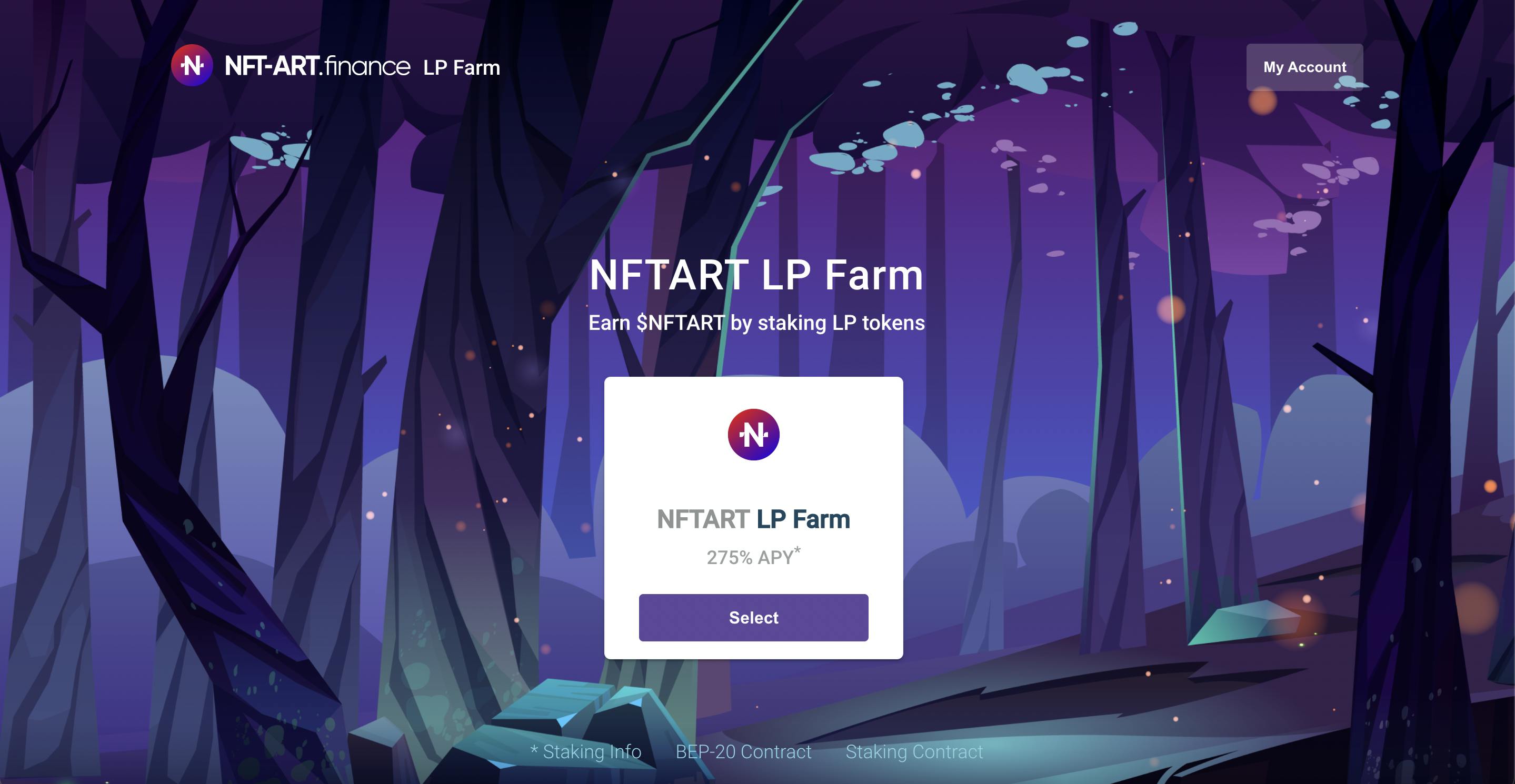
APR stands for Annual Percentage Rate and means the interest rate for a specific pool or farm for the year. If a pool or farm has an APR of 100%, after one year you will receive 100% of your wagered funds in rewards.
APY stands for Annual Percentage Yield and denotes the yield of a specific pool or farm for the year. The key difference between APR and APY in this context is that APY accounts for compounding while APR does not.
Multipliers denote the level of bonuses paid to a particular establishment.
Curious about current TVL, APR and APY stats?
We have compiled all relevant resources in this short knowledge base article.
An additional note on the APY: The APY is based on a current estimate and is subject to fluctuations over time depending on several factors such as (i) TVL, (ii) PancakeSwap transaction volume, (iii) and others. enter is not responsible for tokens lost in the process of providing liquidity, staking or farming PancakeSwap.
How to farm $NFTART-$BNB on nft-art.finance
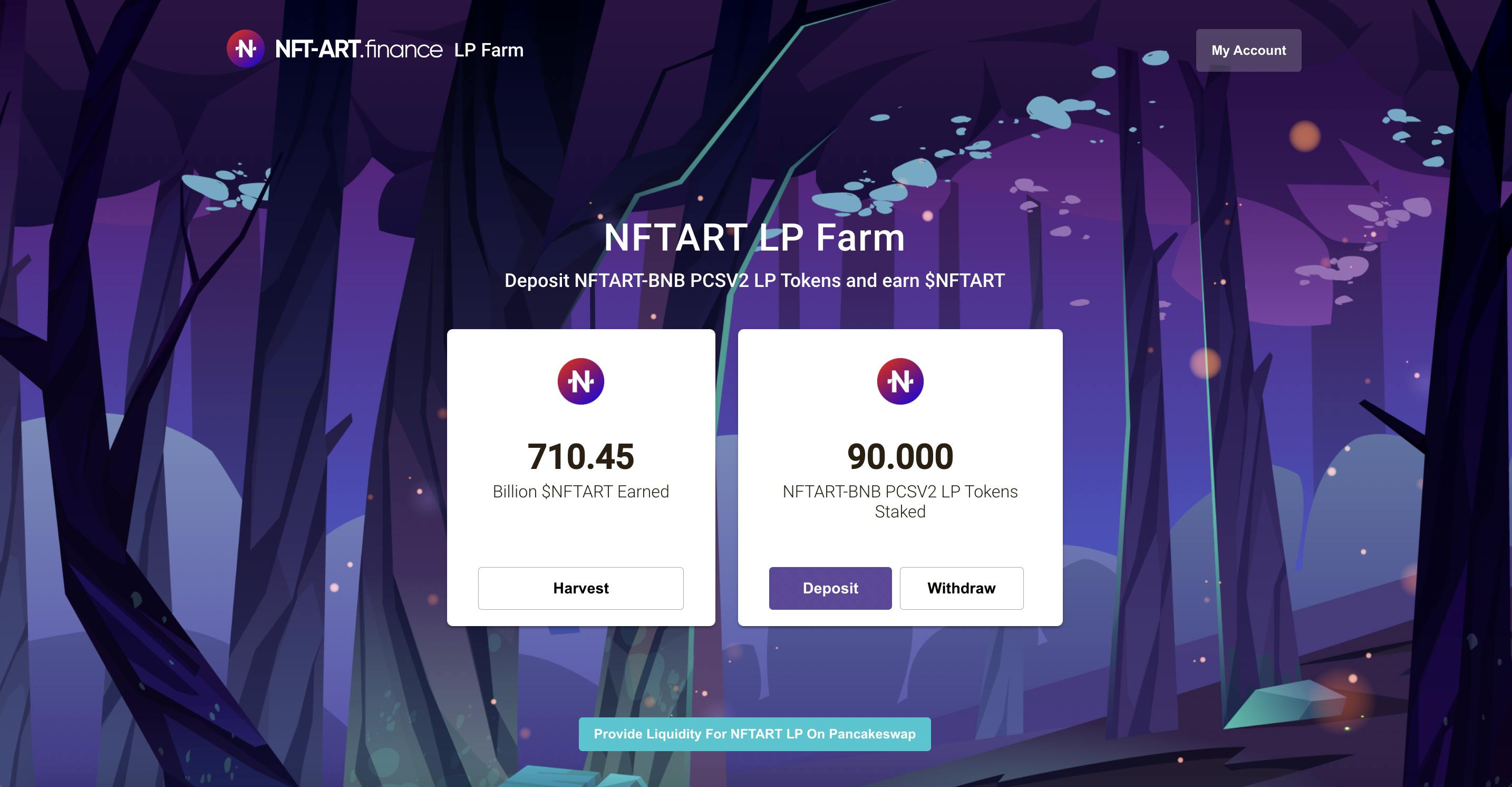
Before you can start farming, you need a 50/50 split of $NFTART-$BNB. If you have that, you can navigate to PancakeSwap and add the liquidity here. Here you will find the $NFTART contract address. If you have $NFTART-$BNB LP tokens from previous farming, you can simply subtract them from the current farm and add them to the new farm.
After adding liquidity and getting your LP tokens, you will receive rewards in the form of transaction fees. By using the LP tokens on nft-art.finance, you will receive additional rewards in the form of $NFTART. You can harvest your rewards whenever you want, but be aware of gas fees before hitting harvest.
If you want to deposit and split your LP tokens, withdraw them from the farm and go to PancakeSwap to split them up to get your tokens.
NOTE: $NFTART is deflationary and the 10% transaction fee is retained when transferring to or from LP tokens. The LP tokens have no taxes when moved or used. The total tax for creating and breaking LP tokens is 20%.
Learn Crypto Trading, Yield Farms, Income strategies and more at CrytoAnswers
https://nov.link/cryptoanswers
Comments are closed.