


DeFi has been growing in popularity since 2020. Every year the number of users increased. The combined TVL of all DeFi protocols also increased. One of the big engines behind this DeFi popularity is yield farming. It’s a great way to earn passive income.
So what is yield farming? And where can you do that? Is it safe and does it have any risks? There are many questions to be answered here! Let’s look at what yield farming is.

Source: Pexels, Karolina Grabowska
What is yield farming?
Yield farming gets your cryptocurrency locked and rewarded for it. They use DeFi to get the most out of your investment. In other words, maximizing your returns. Since everything happens on DeFi platforms, no third parties are involved. There are several ways to get involved in yield farming.
- Staking your crypto on a PoS chain — In return, you receive a reward or interest. Meanwhile, help secure the specific network. In general, this is not part of DeFi. You can, Howeveralso stake your coins in DeFi protocols.
- Liquidity Provider — You join a liquidity pool on a DEX. To do this, you need two different coins, but they each have the same value. You pay a small fee to the DEX. The DEX, in turn, pays this to the liquidity providers. Sometimes this is in new LP tokens. However, there are also platforms that offer one-way staking. This means you only need to lock one token to start earning a return.
- Lend your crypto to a DEX — The DEX uses a smart contract for this. The return is in the form of the interest that borrowers pay you directly for the loans they borrow.
- Borrowing crypto on a DEX — A pawn can use a token as collateral. In return, he receives a loan for the other token. Now you can farm more yield with the borrowed coin. This leads to double returns. First of the collateral you are allowed to keep. Second, from the borrowed tokens that you farmed again.
Stablecoins and Strategies
For most pools, they use a stablecoin. These are linked to the USD. However, using stablecoins is not a requirement. Popular stablecoins used on DeFi platforms are DAI, BUSD, USDT and USDC.
It gets really interesting when you get a pool token as an LP. It may be that a platform shapes this. Compound does this for example. You will receive cDAI (Compound DAI) for the DAI you have deposited. If you deposit another coin, this is cCoin. For example, Ethereum becomes cETH.
This is when things can get complex as platforms start adding layers. For example, you can add the cDAI to another protocol. This protocol mints a new token that represents your cDAI. And so it can go on. It can sometimes be difficult to keep track of all of this. On the other hand, it is a great example of how the DeFi Lego blocks work. However, if one of the Lego bricks fails, the whole chain can collapse.
How do you calculate the rate of return?
The yield calculation in yield farming is done in two different ways. One is the annual percentage rate of charge or the annual percentage rate of charge. On the other hand there is APY or Annual Percentage Return. The difference between the two is that with APY you add a compound return. With compounding, you add rewards to your main investment. So you get a bigger return.
However, it is important to understand that these numbers are subject to change. They are nothing more than projections and estimates. The reason they can change fairly quickly is because DeFi is a rapidly changing environment. With yields constantly changing, growers are constantly looking for better options. Therefore, they move their capital a lot.
Farmers can also keep their strategy secret. The reason is pretty simple. Since you’re sharing the rewards in a pool, fewer people mean higher rewards. As more people join, the rewards dilute.
In general, you get returns in three different ways.
- As a percentage of transaction fees.
- For the sake of the lenders.
- In the form of governance tokens.
APR and APY should be noted that they are from TradFi. That’s why they talk about annual yields. With DeFi, it makes much more sense to look at daily or weekly returns. In other words, DeFi should come up with its own way of calculating yield.
What is TVL?
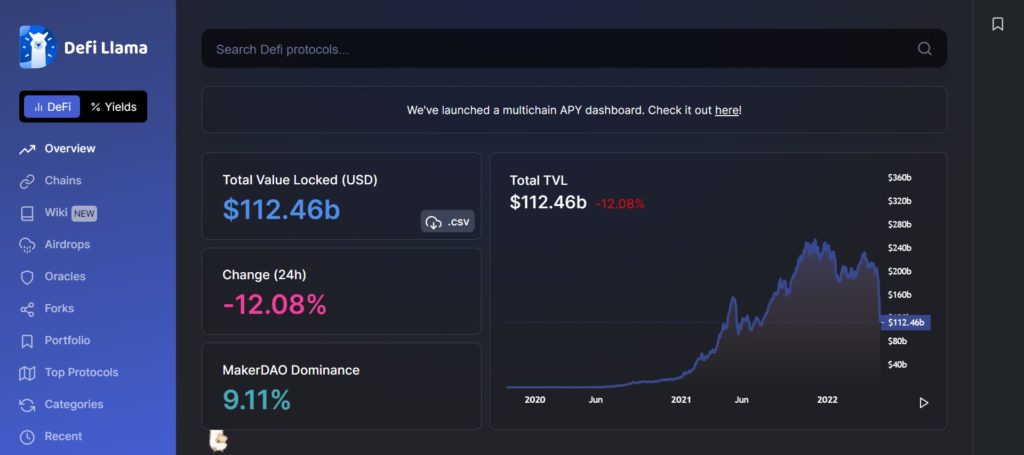
The term TVL stands for Total Value Locked. This means how much money all traders have locked in a DeFi platform for lending or other services. Among other things, it informs you about the health of the entire DeFi farming market. On the other hand, it also shows a good way to see how much market share a platform has.
DeFi Llama and DeFi Pulse are two good places to track TVL. They show many details about complete chains or individual platforms.
Source: DeFi Llama
Diploma
Here we are at the end of the first part of what yield farming is all about. We have commented on this in detail. We also showed you the role of stablecoins in yield farming. In addition, we examined how complex strategies can become.
By now you also know the difference between APR and APY and what TVL is.
In Part 2, we will look at some of the risks of yield farming and discuss some well-known yield farming platforms. See you there.
⬆️Get $125 for SIGNING UP to MEXC Exchange (FREE $25 in your MEXC wallet + 1 month ACCESS PRO membership worth $99). MEXC supports US traders on all trading pairs and services.
(To get your ALTCOIN BUZZ ACCESS PRO membership, DM us with your “newly registered MEXC UID” and “Telegram ID” on our Twitter @altcoinbuzzio)
⬆️For more cryptocurrency news, visit the Altcoin Buzz YouTube channel.
⬆️Most importantly, find the most undervalued gems, latest research and NFT buys with Altcoin Buzz Access. Sign up now for $99 per month.
Learn Crypto Trading, Yield Farms, Income strategies and more at CrytoAnswers
https://nov.link/cryptoanswers
Comments are closed.