


Without a doubt, the DeFi space is growing. With the emerging solutions, businesses and people understand the potential of DeFi. Decentralized finance has improved prospects for increased financial inclusion around the world and the tools for using and managing digital assets.
Source: https://academy.moralis.io/blog/what-is-defi-a-brief-introduction-to-decentralized-finance
Staking and yield farming are popular solutions in DeFi trading to generate returns on crypto assets. Each has a different approach to how participants pledge their crypto assets in decentralized applications or protocols. In addition, the underlying technologies reveal other distinctions between the options.
There was staking before yield farming and mining before staking. Over time, blockchain developers are discovering new ways to provide passive income opportunities that allow users to leverage their existing resources to acquire more crypto assets.
Yield farming has been a huge hit in 2020, thriving alongside DeFi and all of its glittering new features. Crypto investors have inevitably forgotten about staking because providing liquidity to DEXs is many times more profitable than staking.
But do the risks of yield farming still mean staking is a better solution for investors?
This article will focus on staking and yield farming to understand how you can get productive returns from crypto assets using either strategy.
What is yield farming?
Yield farming, also known as liquidity mining, makes money from cryptocurrencies by temporarily lending crypto assets to DeFi platforms in a permissionless environment. The core product of the DeFi market is decentralized exchanges (DEX), and to enable trading they rely on investors willing to help them. A yield farmer earns a portion of the platform’s fees by supplying liquidity to a DEX like Uniswap, which is paid by token swappers using the liquidity.
Farmers can contribute their wealth for as long as they wish. The user receives money daily for durations as short as a few days or as long as a few months. The more they lend, the greater the rewards.
Yield farming pools are very competitive due to their high yield rates (APY). Interest rates often fluctuate, forcing liquidity farmers to switch platforms regularly. On the other hand, the farmer has to pay gas fees every time he leaves or enters a liquidity pool. Finding high APY LPs on the Ethereum network is nearly impossible during periods of significant network congestion.
Yearn Finance, for example, combats this problem with a product called Vaults that implements automatic yield farming tactics. DeFi’s farmer wealth is deposited in a vault at Yearn Finance, which constantly rebalances its wealth among all of DeFi’s LPs to participate in farming’s best yield opportunities. The vault also reinvests money to expand its size, resulting in more meaningful yields for future yield growing opportunities.
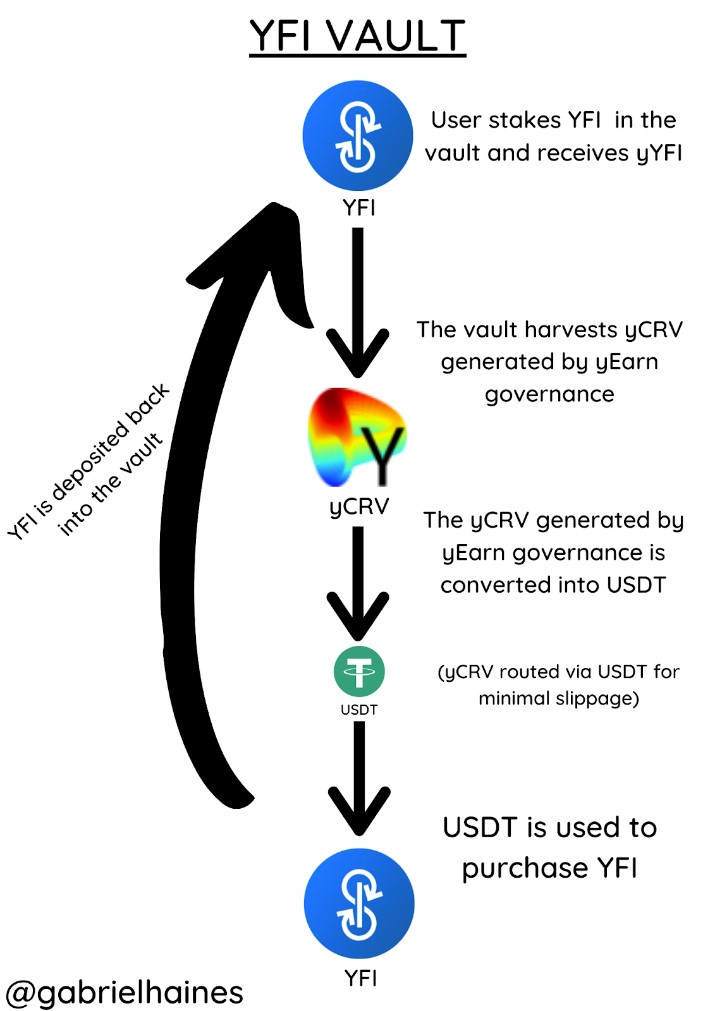 Source: https://medium.com/talking-crypto/the-yfi-vault-v2-earn-yfi-with-your-yfi-4c308c0c9116
The real benefit of the arrangement is that investors who lock their coins in the yield farming system can earn interest and often more bitcoin currency. As the value of these extra coins increases, so does the investor’s profits. According to Jay Kurahashi-Sofue (VP of Marketing at Ava Labs), yield farming is akin to the early days of ride sharing. “To spur growth, Uber, Lyft, and other ridesharing services incentivized early adopters who recommended additional users to the platform,” he explains.
Yield farming is an excellent technique to get your bit out of the pool for free and is considered safer than crypto staking. That’s not to say there aren’t risks associated with yield farming. There is no reward without risk, as the saying goes.
fraud risks
Yield farming is a method to get your virtual assets working on multiple networks. Let’s imagine you are using Binance’s smart chain, which is one of the most popular ones. It uses smart contracts to lend your money to others. Think of these contracts as nothing more than lines of computer code running on the blockchain structure, handling money (cryptocurrencies) on behalf of the owner.
When you pool your cryptocurrency liquidity into a farm, you allow the currency’s borrowing and lending mechanisms and spend your money at the developer’s mercy. The developer creates a bridge between controlled and decentralized currencies to increase the scalability of the currency in the long term.
Since the developer has authority over your money, there is a chance that they will end up with all of your money. If the developers are unknown, then there is a very high probability of this happening.
risks of error
The problem with computer code is that the developer is bound to make mistakes, whether it’s for a website design or something as complex as a blockchain cryptocurrency architecture. Even a single “;” can cause various problems in the final build.
These problems are not always that severe. A click might not work, a color might change by itself, the layout might not be symmetrical, and so on. However, some of these errors have turned out to be quite dangerous, allowing cyber criminals to take advantage of them and benefit from them.
gas risk
The Ethereum fee risks are not that severe for large investors in a farm as the amount invested and the expected returns make these fees a mere rounding error. However, those costs can eat up a significant portion of their profits for smaller investors. For example, revenue may not be nearly as high as gas fees, causing them to lose money.
What is staking?
Staking is a technique developed from the proof-of-stake consensus model, an alternative to the energy-intensive proof-of-work approach of cryptocurrency mining.
Stakers lock their assets to act as nodes, confirming blocks rather than paying electricity and hardware power to confirm transactions and solve complex math problems.
For example, to apply for a node job on the new Ethereum 2.0 network, users must first lock 32 Ether. Once locked, the assets act as a “stake” forcing the user to confirm transactions in good faith.
Users who build a node on their own and join a PoS network to act as node validators are called stakers. However, this is not always the case.
Users can stake their assets without dealing with the intricacies of setting up a node on both centralized and decentralized exchanges (or any platform that can store assets for any reason). The staker’s only responsibility is to offer the assets while the exchange handles the verifying part of the process itself.
This allows the user to stake multiple assets from a single location. Additionally, it will not be subject to the effects of slashing, a system that diminishes a user’s wealth if they engage in malicious behavior.
In summary, the main purpose of staking is to secure a blockchain network by increasing its security rather than adding liquidity to it. As more people invest, the blockchain becomes more decentralized, making it harder to hack.
The only downside is that staking is not as cost-effective as yield farming. Annual Percentage Returns (APYs) range from 5% to 15% and are paid annually. On the other hand, return rates in LPs can exceed 100 percent in some situations.
Yield farming vs staking
We’ve talked about yield farming and staking, but what’s best for the investor?
Yield farming is the most profitable passive investment option, but it is also the most dangerous. Ethereum gas fees can wipe out the APY rates you just earned, and if markets turn wildly bearish or bullish, the profitability rate will plummet due to temporary losses.
Yield farming on newer projects can lead to a complete breach of security, as developers often design so-called rug-pull initiatives. The developer of the project will shut down the project and disappear with the funds after listing a new coin and allowing customers to deposit funds into liquidity pools.
Although the creator is acting in good faith and working on a serious project, they may unknowingly introduce a flaw in the smart contract’s code that a hacker can exploit.
That’s not to say the benefits don’t outweigh the risks. Yield farming is one of the most risk-free ways to earn cryptocurrency. All you have to do now is keep the above risks in mind and develop a strategy to address them.
Staking has two major downsides: low APY rates and time locks.
In a PoS-based blockchain network, validating transactions does not bring the same benefits as yield farming. As mentioned, returns vary between 5% and 15% and don’t go beyond that.
Second, some projects set time locks. A player may be required to keep their funds locked throughout the year. He cannot move or sell his assets during this time. When a bull market abruptly turns into a bear market, the investor loses more money than he received from staking.
Summary
Yield farming and staking both have advantages and disadvantages. The decisive factor should be the investor’s willingness to take risks. For those who are confident that they can make more money in a short period of time, yield farming is the right option. However, if this is not the case, you should join Ethereum 2.0 and participate in staking.
Calculating the best ROI between yield farming and staking may lead to a preference for yield farming, but the argument should go further.
For beginner crypto investors, yield farming can be significantly more confusing and regularly requires more work and research. Crypto staking offers lesser benefits but does not require the investor’s constant attention and funds can be held for longer periods of time.
It boils down to the type of investor you want to be and your level of experience in the DeFi industry.

Disclaimer: The author of this text, Jean Chalopin, is a global business leader with a background spanning banking, biotechnology and entertainment. Mr. Chalopin is Chairman of Deltec International Group, www.deltecbank.com.
The co-author of this text, Robin Trehan, holds a bachelor’s degree in economics, a master’s degree in international business and finance and an MBA in electronic business. Mr. Trehan is Senior VP at Deltec International Group, www.deltecbank.com.
The views, thoughts and opinions expressed in this text are solely the views of the authors and do not necessarily reflect those of Deltec International Group, its subsidiaries and/or its employees.
Learn Crypto Trading, Yield Farms, Income strategies and more at CrytoAnswers
https://nov.link/cryptoanswers
Comments are closed.