


Yearn Finance announced in its second-ever quarterly report that first-quarter 2021 earnings rose 32% over all 2020 earnings, the first time using the EBITDA accounting measure, a period that spans the five months since introduction of the protocol last year. The report provides insight into the business model of a DeFi project that is not…
Yearn Finance announced in its second-ever quarterly report that first-quarter 2021 earnings rose 32% over all 2020 earnings, the first time using the EBITDA accounting measure, a period that spans the five months since introduction of the protocol last year.
The report provides insight into the business model of a DeFi project that is not structured in the traditional way of a company, but is an open protocol created by a decentralized organization of contributors.
The protocol reported $4.8 million for the first quarter based on the EBITDA metric, which is often used as an indicator of cash flow, compared to $3.7 million in the final five months of 2020. $3.1 million, or 66% of EBITDA, came in March when multiple v2 yVaults were deployed.
Sources of income
Yearn generates revenue through its vaults by charging depositors a 20% performance fee, of which 19.5% is allocated to the project's treasury and the other 0.5% goes to the vault's strategy creator. Yearn also charges a 2% management fee, which goes to the Treasury per block.
Yearn's new initiative to utilize Treasury funding for yield farming also contributed to the revenue. However, traditionally invested income would be counted as non-operating income rather than revenue.
Despite being an unconventional way of accounting, Yearn's treasury yield farming accounted for 9% of revenue in the first quarter. According to the report, the team expects this percentage to increase. In March, when most of the cash crop farming took place, the share rose to 12%.
The majority of operating costs came from salaries and benefits, with the former paying out $242,000 to Yearn salaried employees and $150,000 in grants going toward “value-added” work such as designers and front-end development.
The single largest outlay was the one-time payout of $11 million to yvDAI vault depositors in response to a hacker attack in February.
Passing the torch to V2
Yearn's y3CRV vault saw the highest sales in the first two months of the first quarter, reaching nearly $493,000 in February before declining to $286,000 due to five new V2 vaults that support multiple strategies with deposited assets can carry out, gained ground.
The yvDAI V2 vault generated the highest revenue among vaults in March, reaching $355,000. According to Yearn's report, this was due to the newly launched Alchemix protocol, which deposits users' DAI into Yearn's yvDAI V2 vault to generate the yield that will be used to repay users' loans.
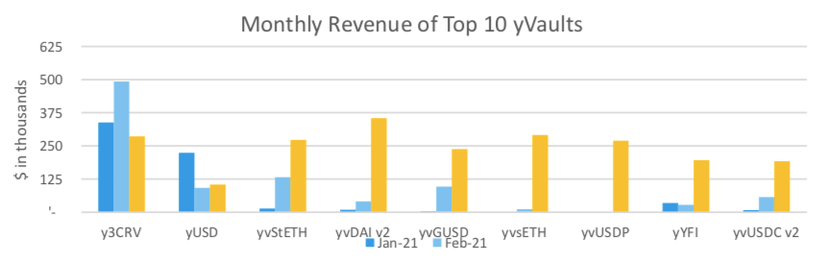
Overall, sales in March were more evenly distributed across yVaults, with eleven of them contributing over $100,000 in sales, as opposed to just three in February.
TVL breaks through
Yearn also reported a skyrocketing TVL, which had surpassed $2 billion by the end of the first quarter and is now over $3 billion, according to the protocol's self-reported statistics. Lead developer Bantg said that the protocol's TVL has been under-reported in the past, prompting Yearn to develop its own chart to monitor the metric.
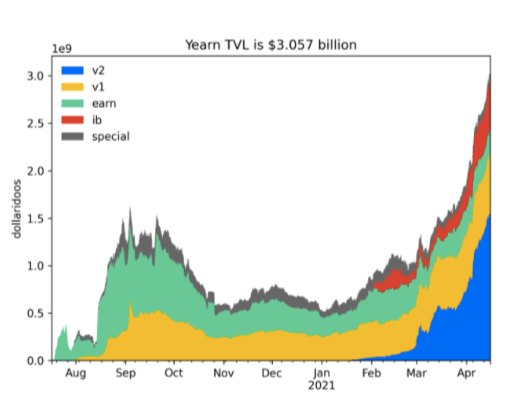
The report emphasizes that these numbers were achieved “without any token subsidies or other incentives typically offered by competing protocols in DeFi.”
Revised governance
Yearn's report highlights its new governance system that shifts decision-making authority from Multisig to yTeams, a group of “organically formed autonomous contributor teams” such as yDev, yBudget and yPeople.
The Multisig will continue to be the entity that executes proposed changes to the protocol and retains its veto power. Nevertheless, the more modular form of governance could enable rapid adaptation of the protocol despite its increasing size.
“Backscratcher” safe and other competitive advantages
Before concluding the report with an overview of its ecosystem, Yearn identifies three competitive advantages: a “backscratcher” vault, its development team, and its community.
The “backscratcher” vault, the yveCRV, leverages its relationship with the Curve protocol to generate additional value for users. In addition, project developer Andre Cronje pioneered the yield bounce concept and has developed numerous other financial primitives.
Finally, Yearn’s community is “fully decentralized,” which, continuing the project’s YFI token fair launch tradition, means no one can own or control the project, although its accounting is similar to that of a traditional store.
Learn Crypto Trading, Yield Farms, Income strategies and more at CrytoAnswers
https://nov.link/cryptoanswers
Comments are closed.