


March, 15 What is the Onomy Protocol (NOM)?
Posted at 10:08 am
in education
Onomy is a sovereign Layer 1 blockchain built on top of Cosmos, whose suite of products aims to act as a comprehensive cross-chain infrastructure to enable on-chain migration for global finance and a portal for retail users to access to deploy on DeFi, crypto assets and Web3 environments.
What is the Onomy protocol?
The Onomy ecosystem consists of a hybrid AMM with order book capability (Onomy Exchange), a cross-chain wallet (Onomy Access) with native non-custodial asset storage, and the “underlying” Onomy Arc Bridge hub. Together, they aim to make on-chain trading fluid and fast to give retail users and institutions alike access to DeFi.
Onomy’s particular focus is on the foreign exchange (Forex) market and aims to provide market makers, individuals and institutions with the tools to trade Forex on-chain and create global access to DeFi and new decentralized banking economies.
How the Onomy protocol works
The Onomy network is based on the Cosmos SDK, which allows it to achieve scalability by leveraging the infrastructure supported by its network of institutional validators.
The protocol leverages Cosmos’ multi-chain network to create diverse liquidity and native asset availability. Onomy’s Arc Bridge Hub includes custom, bi-directional bridges to partner blockchains like Ethereum and multiple EVMs. Onomy Access and the Onomy Exchange leverage these bridges to allow Onomy Assets clients to natively cross-chain directly from the wallet or DEX.
Features of the Onomy Protocol
DAO-driven on-chain treasury
Onomy’s DAO provides votes for token holders and suggestions executed programmatically by on-chain votes. No central team or company holds the keys to the on-chain treasury. NOM holders can decide how the funds are used.
Vertically integrated ecosystem
According to the Onomy Improvement Proposals (OIPs), users can access and swap on Onomy Exchange directly from the Onomy Access wallet. If this exchange relies on a cross-chain transfer, Onomy Arc Bridge Hub handles the bridging of the asset in the background. All wagering and governance for various assets that users hold can be done right in the wallet without the need for multiple browser extensions to manage a portfolio.
Chain Agnostic
The Onomy Exchange is built to operate as a free, open, centralized DeFi hub that requires no token lockups to participate and is actively adding new assets from different chains.
Onomy hopes to provide users with all of their crypto assets in one place, regardless of chain, without having to use a centralized exchange or multiple bridges.
Single Login Onomy Access
Onomy offers a single login with its non-custodial private key management solution, Natural Rights, which enables QR login across multiple blockchains, facilitating the management of multiple private keys and separate wallets for each crypto platform. By logging in to Onomy Access, users can manage DeFi portfolios on-chain.
Hybrid DEX model
Onomy DEX adopts a hybrid structure and implements the order book method and AMM. AMMs are a pain point for retail crypto users, and the Onomy Exchange is built to look and feel like a CEX.
Mark out
By connecting tokens to validators, delegators can earn rewards for securing the network. Staking rewards are adjusted programmatically depending on the staking ratio and inflation rate, which are pre-determined and can only be changed through the DAO vote.
currency
Onomy’s long-term goal is to use its web infrastructure to build on top of a stablecoin framework called Denoms. These are used to operate Forex On-Chain at far greater speed and, importantly, efficiency than is currently possible.
Onomy protocol ecosystem
- Onomy Network (ONET) is an application-specific Layer 1 blockchain that uses Tendermint’s BFT consensus. It supports Onomy’s products and bi-directional bridges to prominent blockchains inside and outside of the Cosmos ecosystem, such as Near, Avalanche, Polygon, Ethereum, etc.
- Onomy Exchange (ONEX) is a unique, hybrid, multi-chain DEX that offers AMM liquidity pools and an order book model for intuitive trading of cryptocurrency and forex pairs. It supports limit, market, conditional and stop-loss orders, cross-chain trading and advanced charting.
- Onomy Access (OACC) is a multi-chain no-custodial mobile wallet app that allows users to manage all assets from integrated blockchains. This includes staking, governance, asset transfers and viewing NFT collections from multiple blockchains, all in one wallet app.
- Onomy Reserve (ORES) governs the minting of decentralized stablecoins called Denoms, which use NOM as part of the minting process. Denoms can be used for forex trading, payment, remittance, lending and settlement.
- Arc Bridge Hub is the bridge infrastructure built into Onomy’s products that enables the seamless transfer of assets to and from large blockchain ecosystems, including the Cosmos ecosystem, via Inter-Blockchain Communication (IBC).
- The binding curve is a non-custodial and decentralized platform designed to enable Ethereum users to acquire, trade and bridge Onomy’s NOM.
What is an Onomy Protocol (NOM) token
NOM is used for transaction fees, bridging fees, and rewards for helping secure the network via PoS staking, governance, and collateral, and has various ties to Onomy products.
The coin is a heart of Onomy’s infrastructure and is used to cover transaction fees on the Onomy network. Also, since Onomy’s L1 leverages Proof-of-Stake consensus, NOM is bound by validators to secure the network. Staking rewards are programmatically adjusted based on staking ratio and inflation rate.
NOM also delegates governance rights to owners who can vote on protocol direction proposals in the Onomy DAO. Possible suggestions include providing new features, funding community initiatives, marketing and development teams, changing blockchain and/or product parameters, and more.
NOM will be further integrated with products like Onomy Exchange via a programmatic buy-and-burn. The Onomy Exchange does not charge static fees to users who trade – instead, the AMM continues to charge by capturing the spread between the bid and ask price, like a regular market maker does. This revenue is then shared with LPs and used to programmatically buy and burn NOM, reducing the total supply over time without any centralized management.
NOM tokenomics
The Onomy Protocol has a total reserve of 100 million NOM. Supporter, Team, and Advisor tokens vest every month for 24-36 months, with a 12-month cliff. DAO Treasury tokens are usable only after successful DAO governance votes, with the system programmatically funding proposals if approved, without central key management by an Onomy contributor. NOM supply will increase through inflationary rewards and bridges out of the retention curve.
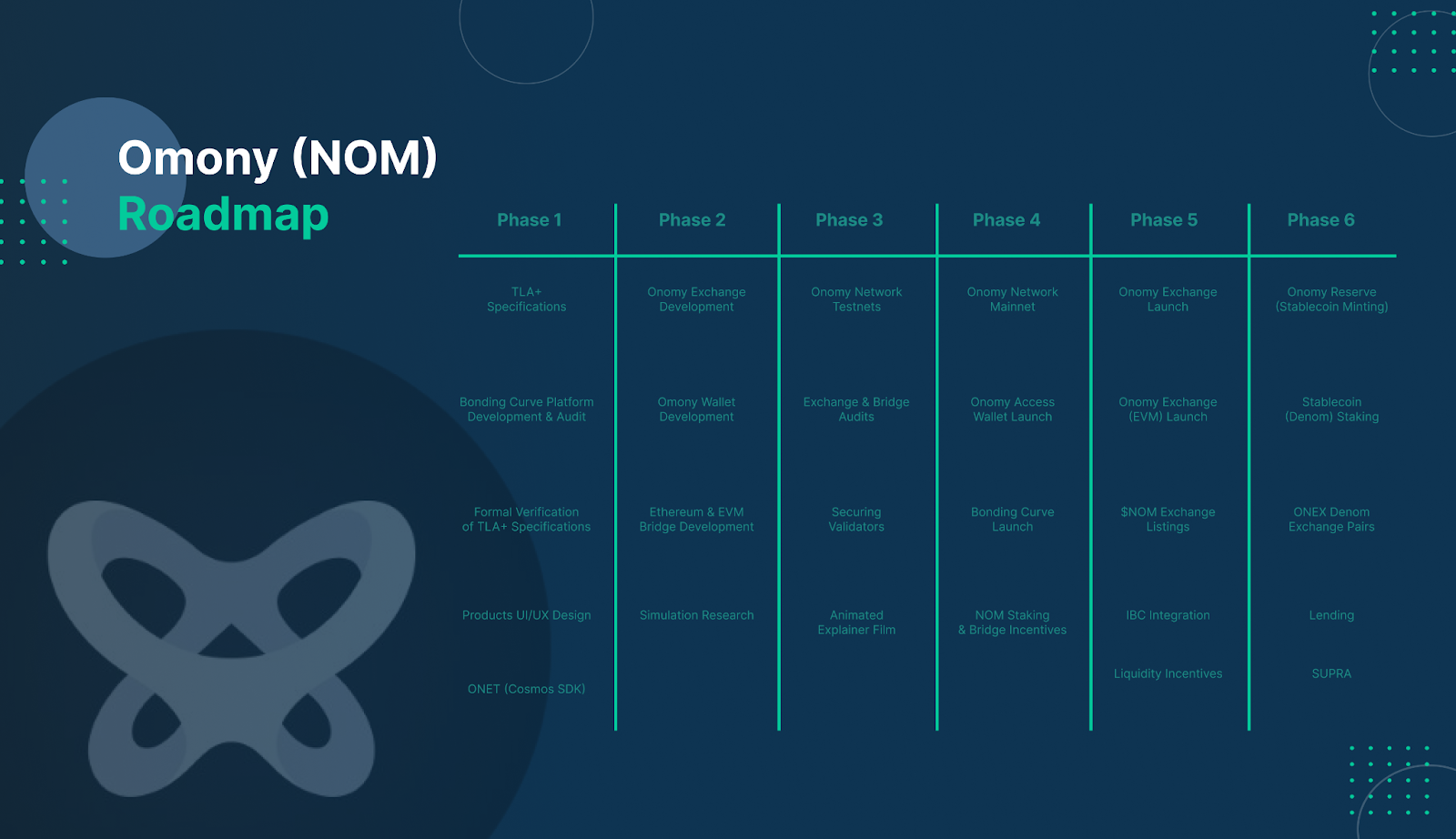
Onomy protocol roadmap
Onomy Protocol Team
The Onomy team is distributed globally across the US, Europe and Asia. Twenty contributors are dedicated to building the protocol every day, with previous experience at the likes of Microsoft, Apple, Fidelity, JPMorgan, ConocoPhillips, and multiple DeFi protocols.
Partner of the Onomy protocol ecosystem
Onomy believes in a multi-chain future. In pursuit of this future, the company has sought and built a wide range of strategic and technical partnerships.
- cosmos
- avalanche
- polygon
- OKX chain
- Neon
- Aurora on NAH
- IOTA
- Other TBA
Onomy’s network spans the entire Web3 space, with future partnerships still in the works. The key to any partnership is creating an interoperable framework between Onomy’s DeFi hub and partnership chains, and expanding the reach of the Arc Bridge Hub to allow more liquidity to benefit from Onomy’s products.
How to buy NOM on Bitfinex
How to buy NOM with crypto
1. Login to your Bitfinex account or register to create one.
2. Go to the deposit page.
3. In the “Cryptocurrencies” section, select the crypto you want to buy NOM with and generate a deposit address in the exchange wallet.
4. Send the crypto to the generated deposit address.
5. Once the funds arrive in your wallet, you can exchange them for NOM. Learn how to trade on Bitfinex here.
How to buy NOM with Fiat
1. Login to your Bitfinex account or register to create one.
2. You must obtain full verification in order to fund your Bitfinex account with fiat. Learn more about the different verification levels here.
3. On the Deposit page, select the fiat currency of your deposit from the Bank Transfer menu. There is a minimum fiat deposit amount on Bitfinex; learn more here.
4. Check your Bitfinex registered email for the transfer details.
5. Send the money.
6. Once the funds arrive in your wallet, you can use them to buy NOM.
Also, we have Bitfinex on mobile so you can easily buy NOM currency on the go.
Onomy Protocol Community Channels
Twitter | Telegram | discord | Medium | GitHub
Learn Crypto Trading, Yield Farms, Income strategies and more at CrytoAnswers
https://nov.link/cryptoanswers
Comments are closed.