


Crypto Farms: What’s Behind the Hype? Photo: Shutterstock
Cryptocurrency farming emerged in 2020 with the advent of decentralized exchanges (DEXs). It is growing in popularity as the decentralized finance (DeFi) space expands.
Farming offers an accessible alternative to mining as a way for users to earn cryptocurrency rewards. It allows investors to maximize returns from their cryptocurrencies by paying a form of interest on the coins they buy and hold, rather than trading.
How does crypto farming work? And how is it different from staking and other forms of mining?
Read on for our introductory guide to cryptocurrency farming.
Crypto farms offer high returns for liquidity
What is a crypto farm? Cryptocurrency farming, also known as yield farming, involves users lending their cryptocurrency to an exchange in farms or pools to provide liquidity for incentivized trading. New DEXs and coins often need this liquidity to have enough coins in circulation to get going.
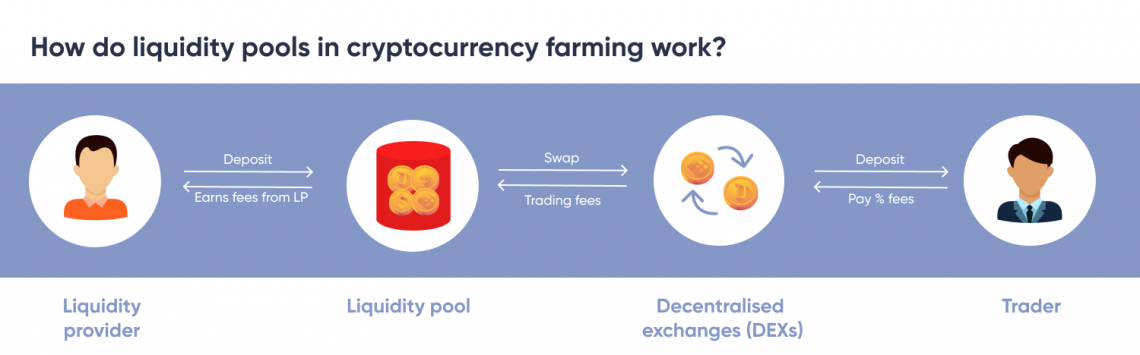
Yield farmers deposit their cryptocurrency coins in a liquidity pool via a decentralized app (dApp). Smart contracts running on the blockchain make it easy to lend the coins to other users for trading and lending.
By locking their coins in this way, investors earn interest in the form of additional coins. As the price of these coins increases, the investor will receive higher returns. Investors receive returns on their funds in the form of an annual percentage return (APY). Apps reward yield farmers with part of their transaction fees or other funds. They can pay out rewards in the form of the same coins that the farmer deposits, their own governance tokens, stablecoins, or other coins.
Yield farmers can deposit individual assets or provide pairs of liquidity. For example, on an automated market maker (AMM) platform such as PancakeSwap, SushiSwap, or UniSwap, yield farmers provide liquidity in a pool by depositing two coins for a swap pair. One of the coins is typically the native blockchain token or a stablecoin like USDC. Running on the Binance blockchain, PancakeSwap mainly pairs coins with Binance token BNB or stablecoin BUSD. (Note that the Binance platform was banned in the UK earlier this year). On Uniswap, which runs on the Ethereum blockchain, coins are mainly paired with ETH or the USDC, USDT, and DAI stablecoins.
As a reward, yield farmers receive a share of the transaction fees users pay to exchange coins. The amount they receive is based on the percentage of the pool they contribute – the more they lend, the higher the return.
Yield farmers can lend their coins to the liquidity pool for a few days or up to a year. You typically pay transaction fees to join or leave the pool.
APYs for different liquidity pools are very competitive and change frequently, so yield farmers looking for the highest yields often switch between pools to maximize their returns.
While the yields can be high, farming is risky – coins that users receive as rewards can lose their value. The highest returns are typically available for newer cryptocurrencies, which can be rug pulls, scams where developers fraudulently inflate a coin price and sell their tokens to withdraw all funds.
Another risk of yield farming is ‘volatile loss’. In liquidity pools where investors deposit pairs, the AMM adjusts the ratio of the two coins to keep the value constant when one of the coins is a stable coin and the other is strongly appreciating. This creates a discrepancy between the value of the coins and the number of coins deposited.
If the investor removes their coins from the pool, the temporary loss becomes a permanent loss that may not be covered by the fees received as a reward. In this case, they would have gotten a higher return if they hadn’t deposited their coins into the pool.
Yield farming vs staking
The term yield farming is sometimes used interchangeably with staking, but there are key differences between crypto farming and staking.
Staking works as part of crypto mining farms and DeFi protocols. With Proof-of-Stake (PoS) blockchain consensus algorithms, users set up a validator node and join a PoS network to become a validator. Validators lock their cryptocurrency coins to verify blockchain transactions. You get rewards for reaching consensus, which allows the network to generate each new block.
Unlike yield farming, staking is a form of cryptocurrency mining used to secure a blockchain network rather than provide liquidity. The more validators stake their coins, the more decentralized and secure a blockchain becomes.
Ethereum, for example, has been working to move from the Proof-of-Work (PoW) mining algorithm to PoS. PoW was the main way to mine cryptocurrencies and earn coins.
The Bitcoin blockchain is based on PoW, which uses computing power to solve complex cryptographic calculations to verify transactions and create new blocks, rewarding miners with cryptocurrency coins. Using staking instead of processing power in a coin mining farm requires far less energy, making it an energy-efficient alternative to PoW. The massive computing power required to mine Bitcoin has made it relatively inaccessible to most investors, as large mining farms using specialized computer processors are now responsible for most new Bitcoin creations.
Protocols like Polkadot use nominee Proof-of-Stake (NPoS) consensus to allow holders of their native coins to stake them and nominate validator nodes in return for APY. Some protocols require users to stake their coins to participate in governance and vote on development decisions to demonstrate their commitment to the project’s success.
Centralized cryptocurrency platforms like Coinbase, FTX, BlockFi, and Nexo allow users to stake their cryptocurrencies and pay them interest in exchange for lending their deposits. This works in a similar way to how traditional banks pay interest to lend customers’ savings. Exchanges perform the validation process on behalf of investors, giving them the ability to stake multiple cryptocurrencies from a single platform, rather than across multiple platforms or DEXs.
Unlike yield farming, when staking, investors commit to locking their coins for a set period of time and are often required to stake a minimum number of coins. Staking rewards are typically fixed APY rates of around 5%, well below typical yield farming APYs.
Depositing liquidity pairs on DEXs for yield farming can be challenging for investors new to cryptocurrencies. It also requires ongoing research to keep an eye on the most competitive rates while avoiding risky new coins that turn out to be scams. Staking offers lower returns but is easier for investors who can lock up their funds for longer periods of time.
Whether you choose yield farming or staking should depend on your experience of using dApps, your tolerance for risk, and the time you want to spend researching farms and APYs.
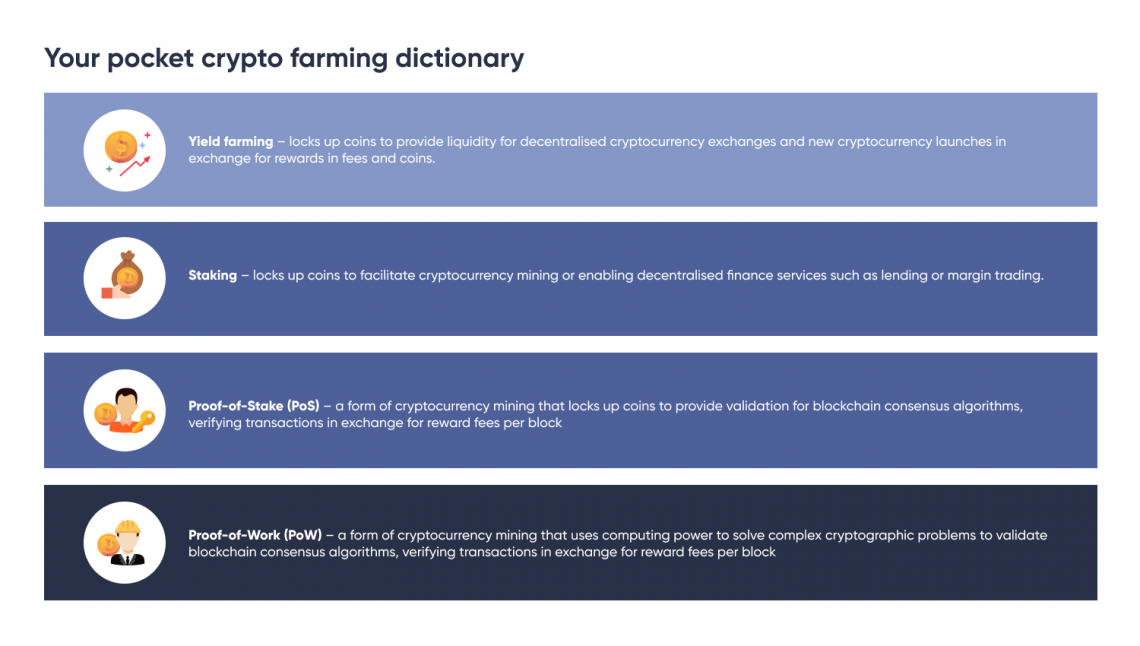
Yield farming – locks coins to provide liquidity for decentralized cryptocurrency exchanges and new cryptocurrency launches in exchange for rewards in the form of fees and coins.
Staking – locks coins to facilitate cryptocurrency mining or enable decentralized financial services like lending or margin trading.
Proof-of-Stake (PoS) – a form of cryptocurrency mining that involves locking coins to validate blockchain consensus algorithms and verify transactions against per-block reward fees
Proof-of-Work (PoW) – a form of cryptocurrency mining that uses computing power to solve complex cryptographic problems to validate blockchain consensus algorithms and verify transactions against per-block reward fees
frequently asked Questions
Is Crypto Farming Illegal?
Cryptocurrency farming is not per se illegal in most countries. A notable exception is China, which has banned cryptocurrency mining and virtual currencies.
However, since proof-of-work (PoW) mining is very energy-intensive, some miners in different parts of the world have set up farms with computers using illegal connections to the power grid. Yield farming provides liquidity rather than using computing power to mine coins, so it doesn’t consume large amounts of electricity.
What is the largest crypto mining farm?
The largest cryptocurrency mining farm was previously located in Dalian, China, where 750 bitcoins were mined per month and accounted for 3% of all bitcoin mining, according to data center company Sunbird. Since China banned cryptocurrency mining, the US has become the largest crypto mining country in the world.
Read more: Crypto Regulation Explained: How It Could Affect Investors
Rate this article

Learn Crypto Trading, Yield Farms, Income strategies and more at CrytoAnswers
https://nov.link/cryptoanswers
Comments are closed.