


In the summer of 2016, an important Ethereum event took place. Marks the formation of two new fission chains. Two blockchains were born, Ethereum Classic (ETC) and Ethereum (ETH).
In this article, you will join me to learn what is Ethereum Classic and ETC coins.
What is Ethereum Classic?
Ethereum Classic is a blockchain platform designed and built on top of Ethereum Blockchain Technologyso anyone can create and use them decentralized applications (dapps). Ethereum Classic is the original chain of Ethereum alongside Ethereum (ETH).
Ethereum Classic Hard Fork Event
To find the answer to this question, we go way back to July 2016.
Before July 2016, Ethereum (ETH) and Ethereum Classic (ETC) were a single blockchain called Ethereum. But because of a mistake in fundraising smart contract With the DAO running on Ethereum (this is the fault of the smart contract author, not the fault of the blockchain), the hacker exploited the vulnerability to withdraw 3.6 million Ether, which was equivalent to $50 million at the time.
However, the DAO smart contract states that the funds in the wallet will be locked for 28 days. Therefore, the hacker has to wait 28 days to have full access to that $50 million. To save investors, the Ethereum Foundation rushed through Carbon Vote’s decision to launch a controversial bailout by manually changing the code on the blockchain to restore the stolen ether with a hardfork copy.
Those who love Bitcoin, support it, respect the blockchain’s immutable history and oppose this hard fork have decided to reject an update, sticking with the old chain (Ethereum Classic) to settle the stolen Ether. Results On July 20, 2016 at block number 1,920,000, two chains of Ethereum and Ethereum Classic were officially split and developed in parallel to this day.
Although the lost funds were reclaimed, the aftermath of this hard fork caused the Ethereum network to split into two chains, Ethereum (ETH) and Ethereum Classic (ETC).
The Ethereum (ETH) blockchain tracks processing speed and plans to move towards it Proof of use.
Ethereum Classic is the Ethereum root chain that maintains the same system as Bitcoin for a secure, decentralized, autonomous blockchain and continues to be the lynchpin for a proof of work based economy.
To properly understand the essence of Ethereum and the birth of Ethereum and Ethereum Classic, learn more: What is Ethereum?
Difference between ETH and ETC
The common purpose of Ethereum and Ethereum Classic is to allow anyone to build and use decentralized applications (dapps). However, the direction of the two is completely different.
- Ethereum Classic focuses more on security and usability.
- Meanwhile, Ethereum is more focused on performance and scalability.
There are also some differences between ETC and ETH:

Detailed information about ETC tokens
Key Metrics ETC
- Tickers: etc.
- Blockchain: Ethereum Classic.
- Consensus: Proof of Work.
- Token Type: Coin Minable
- Block time: 13.1 seconds.
- Block Reward: 3.2 ETC per block.
- Total supply: 210,700,000 ETC.
- Initial Circulation Offer: 116,319,790 ETC.
ETC Token Allocation
Before the hard fork, there were over 82 million ethers in the market. Consists:
- 72 million ether is the pre-mine development team for ICO.
- More than 10 million ethers were successfully mined from 2014 to the hard fork.
After the hard fork event took place on July 20, 2016, there are currently 82 million ETC coins and 82 million ETH coin tokens on the market at the same time.
If the user’s wallet before the hard fork has 100 Ethereum, then after the hard fork the user’s wallet will have 100 ETC and 100 ETH at the same time. Users can sell ETC or ETH on the market.
This is also an event related to a conspiracy involving the ETH Foundation and Vitalik Buterinthe co-founder of Ethereum, sold a large amount of ETC to kill the project “in its infancy”.
After the DAO fork event in March 2017, the Ethereum Classic community adopted a new Bitcoin-like monetary policy. Ethereum Classic capped the number of coins on the market and introduced a reduced mining rewards plan.
Accordingly, Ethereum Classic caps the supply at 210,700,000 ETC coins and uses a Proof of Work (PoW) mechanism.
ETC token release schedule
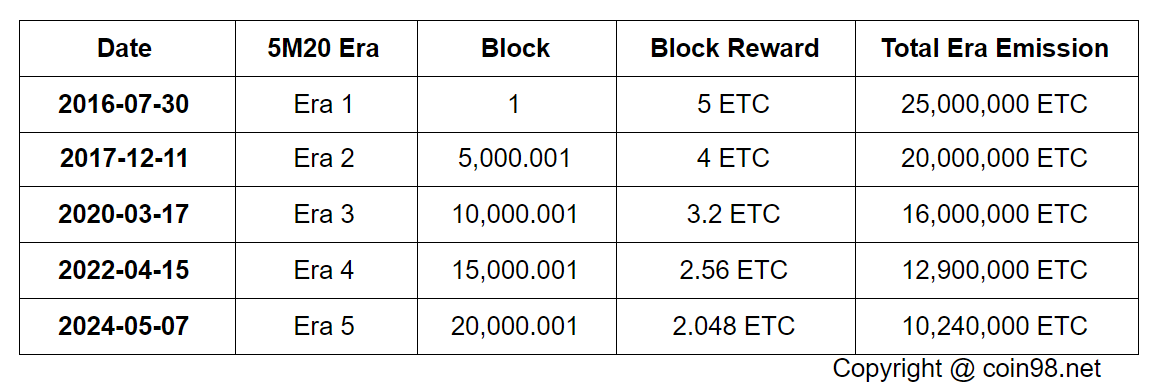
After almost 5 years of mining, more than 55% of the ETC are on the market. The block reward will decrease by 20% every 5 million blocks (roughly 2.4 years). On March 17, 2020, Ethereum Classic reduced the mining reward by 20% from 4 ETC/block to 3.2 ETC/block.
Here is the mining reward reduction schedule:
ETC token use case
Like ETH on Ethereum, ETC uses network transaction processing and smart contracts.
- Gas fee: Payment of gas fees on the Ethereum Classic network. Average about 21,000 gas per transaction. Fees may be higher or lower depending on the speed of the network. The method of calculating the fee for making a transaction or executing a smart contract is as follows:
Transaction fee = gas price * gas limit + miner fees
- Block Reward: Rewards miners who help maintain the security of the Ethereum Classic network. Currently the reward for a mined block is 3.2 ETC. The reward is reduced by 20% for every 5 million blocks mined.
How to mine ETC coins?
As you know, Ethereum Classic uses Proof of Work (PoW) consensus mechanism. So you can earn ETC by mining.
There are currently two popular types of ETC mining: solo mining and mining by reputable mining pools (pool mining).
solo mining
- Download one of these software to your desktop: Antminer E3, Bminer, Claymore Miner, Cruxminer, Easy Miner, Phoenix Miner…
- Install a software.
- Register your ETC wallet address with the software.
- Find IPs to me.
pool mining
- Join 5 largest mining pools to increase profits on ETC mining: Ethermine, Nanopool, MiningPoolHub, 2Miners, Beepool.
- In addition, you can join other mining pools such as B.: 1stPool, 2Miners, AntPool, BTC.com, BoomPool…
A detailed guide to mining Ethereum Classic can be found here.
Ethereum Classic (ETC) wallet
There are many ways to store ETC, you can refer to all ETC wallets here:
- Web wallets: MyCrypto, MyEtherWallet, Portis, Squarelink.
- Extensions/dApps: metamaskOpera, Nifty Wallet, Saturn Wallet, Brave.
- Soft wallets: Coin98 walletExodus, AToken, Coinbase Wallet, trust wallet,…
- Hardware wallets: Ledger, Trezor, SafePal, Ellipal, Bitski, CoolBitX, HTC Exodus, …
- Other wallets: CryptoSteel, ColdTi, Blockplate, BillFold, Hodlinox,…
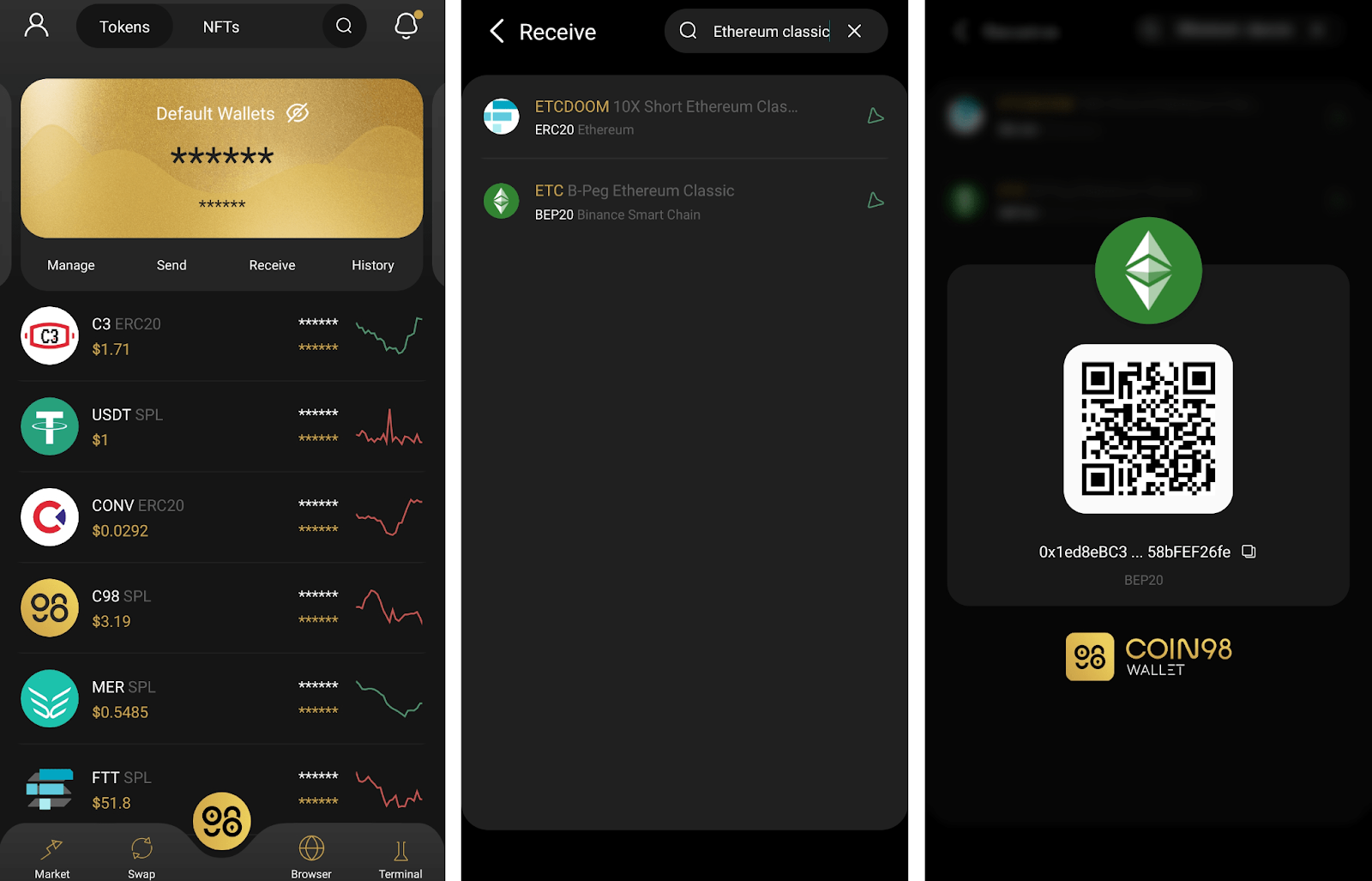
You can store ETC coins in wrapped form on the Binance Smart Chain network with Coin98 Wallet according to the following detailed instructions:
Step 1: Select in the main interface Receive.
Step 2: Enter Ethereum classic in the search field.
Step 3: Copy wallet address and send ETC coins to this address.
How to Buy Ethereum Classic (ETC)
Currently, ETC coins are traded on many different major and minor exchanges where you can buy ETC binanceHuobi, BitMax, VCC exchange, etc.
A more detailed list of ETC supporting exchanges can be found here.
The future of Ethereum Classic (ETC)
Similar to Bitcoin, Ethereum Classic has a fixed and deflationary supply. This will help ETC increase in value in the future.
Currently 64% of the ETC is mined, the chance of winning is still great. This will help ETC to attract a large number of miners to keep the Ethereum Classic network safe, also the chance of making profits is still very high for miners compared to Bitcoin mining.
ETC Labs is the largest active organization in the Ethereum Classic ecosystem. ETC Labs expands the network by sponsoring numerous protocols and projects on the Ethereum Classic network.
Is Ethereum Classic (ETC) a good investment?
I believe that after reading this paragraph, you have also grasped the basic and necessary information about Ethereum Classic (ETC).
I will write down some key ideas so that you can easily make an investment decision.
timetable
As the Ethereum Classic ecosystem continues to grow naturally, independent development teams follow the principles and make Ethereum Classic a single, truly decentralized, immutable and ever-evolving network.
A detailed roadmap as well as what Ethereum Classic has done in the past can be found here.
partnership
The goal of the project is to fulfill the blockchain’s promise of improving users’ lives with Ethereum Classic. The project promotes partnerships with large organizations to address the challenges of implementing this innovative technology.
Some important partners of Ethereum Classic are: aws, IBM, Bubspot, NorthBlock Capital, Gitcoin, Swarm, Unicef, ChainSafe…
Ethereum Classic ecosystem
All projects developed on Ethereum Classic receive support such as: business strategy, network connection, investor recommendation. The Ethereum Classic ecosystem has now expanded to include many different arrays and projects, including some prominent names such as:
- DApp and protocol: ETC Punks, Arena Racing, Aqua Bank, OriginalMy, Stampery, Token Bridge, Gitcoin, Celcius Network, Portal.Network, …
- Exchanges: Binance, BitMax, Bitfinex, Huobi, Upbit,….
- Storage wallets: Metamask, MyEtherWallet, Trezor, Ledger, …
Summary
I hope my last article helped you get a better overview of Ethereum Classic as well as ETC Coins.
What do you think of this Ethereum hard fork? How will ETC grow in the future? Don’t hesitate to comment below the article to discuss with Coin98!
Learn Crypto Trading, Yield Farms, Income strategies and more at CrytoAnswers
https://nov.link/cryptoanswers
Comments are closed.