


Curve Finance is a decentralized exchange (DEX) and liquidity protocol based on the Ethereum network. It is often used to trade stablecoins with low fees and slippage, as well as to deposit cryptocurrencies into liquidity pools to earn trading fees.
Our Curve Finance guide will break down everything about Curve Finance for you; We will go through how Curve works, what liquidity pools and AMMs are, how users make money on Curve, and how the platform compares to other decentralized exchanges.
However, it is important to clarify that cryptocurrency is inherently risky and DeFi products like Curve are novel and experimental in nature. The technology is very interesting and can be disproportionately ruinous or lucrative – recognize the risks in the future.
Explain curve finance
Curve is a decentralized exchange that allows users to trade multiple stablecoins, that much we already know.
While two or more stablecoins should be in the same dollar range (1 USDC = 1 USDT), there is always some degree of divergence when trading between two of them. The larger the amount, the higher the slip.
For example, if you want to trade 100,000 USDT for 100,000 USDC, you may only get 99,900 USDT due to slippage.
The curve uses the curve constant formulasimilar to Uniswap to minimize slippage and trading fees.
The other side of the curve is the liquidity log, and it’s better to understand what automated market makers (AMMs) are and how they work on decentralized exchanges:
- Curve relies on an AMM, a software mechanism that provides prices between two different assets using a mathematical formula. In the case of Curve, prices are quoted between two stablecoins or wrapped versions of cryptocurrencies such as Wrapped Bitcoin (wBTC) and Wrapped Ethereum (wETH).
- AMMs differ from order books, which are typically used by centralized exchanges (CEX) in the sense that they rely on liquidity providers who are the users and other DEXs. Both users and DEXs deposit cryptocurrencies into one or more liquidity pools to reflect a balanced price between one or more assets.
- In contrast, a centralized exchange using the “order book” methodology has a large pool of assets in its custody when needed to provide liquidity for various trading pairs.
Liquidity providers are the backbone of decentralized exchanges; Without them, a DEX would be illiquid and unable to execute trades at reasonable prices. Since a DEX does not hold its users’ assets in custody, it must incentivize them to provide liquidity.
Yield farming is the act of providing liquidity – depositing funds – into a liquidity pool for other users to trade multiple assets. Then the log pays a percentage of trading fees to liquidity providers as an incentive.
As with most liquidity protocols, the level of fees ( the average is 0.04%) Payout to liquidity providers depends on trading volume; The higher the volume, the higher the fees and the higher the APY (Annual Percentage Yield).
Curve’s website looks like a simple Web1 interface from the late ’90s, but is relatively easy to navigate once you get used to it.
To use Curve you need to connect your cryptocurrency wallet like MetaMask, Coinbase Wallet or WalletConnect.
The first section we’ll see is Quick Swap, which allows you to swap over 100 assets, including stablecoins and wrapped coins.
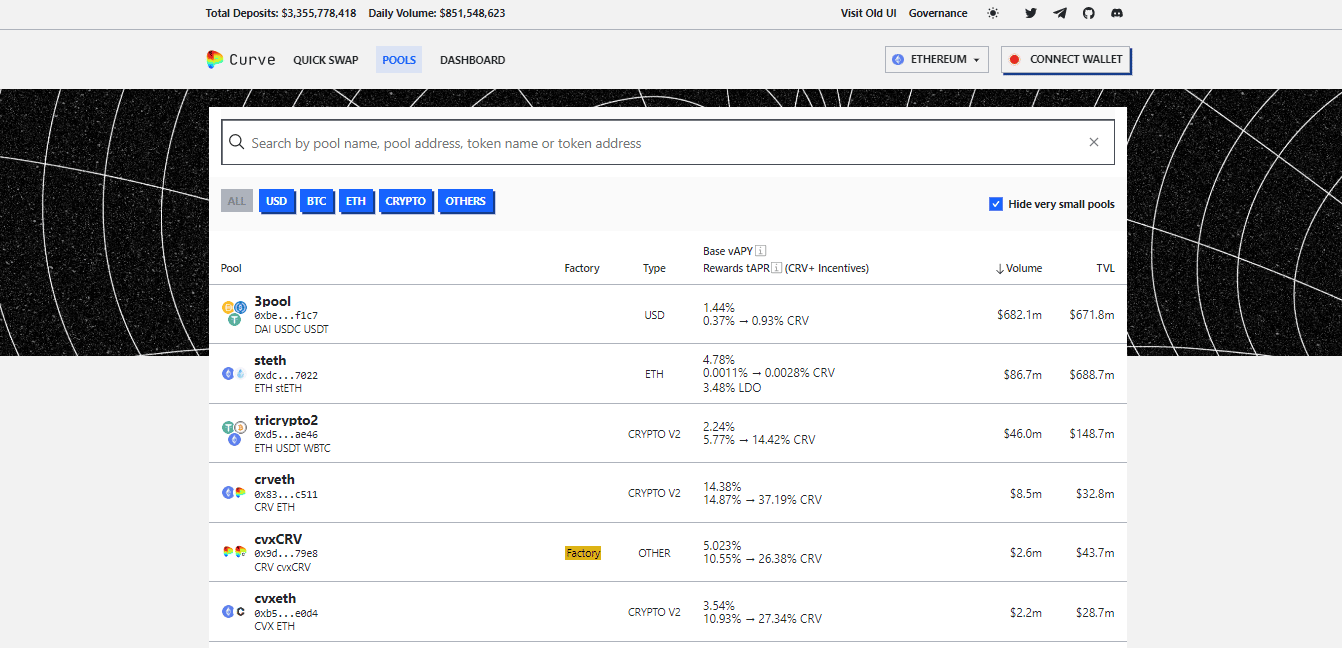
The section shows you the exchange fees and the pool where the exchange takes place. For example, when we exchange USDT to USDC, the protocol routes it to 3pool, which has the largest volume and TVL (Total Value Locked) for DAI, USDC and USDT.
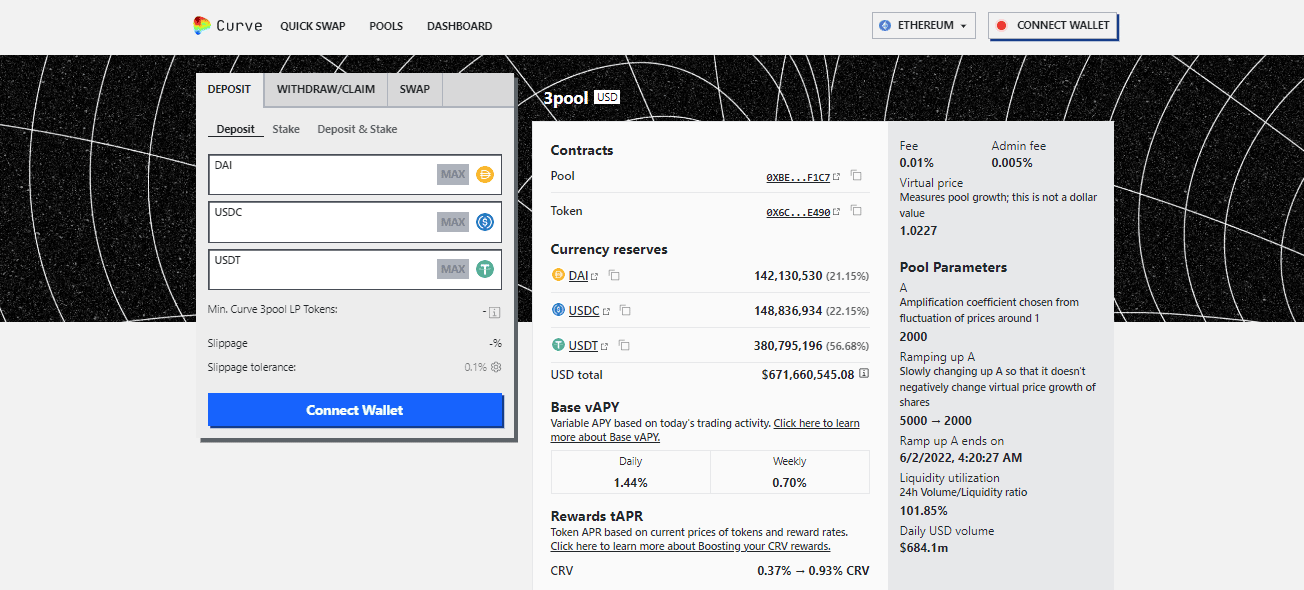
To add liquidity to a pool, simply select a pool from the list and click Deposit. A deposit interface will appear with different coins to be deposited. The protocol rewards you with a deposit bonus if you provide liquidity to the cryptocurrency with the lowest balance. In this example DAI.
There are two types of deposit: regular deposit and Stake & Gauge, which stakes your tokens with no lock-up periods, allowing you to unstake them at any time. This option allows you to earn CRV tokens as a reward but still receive a portion of the trading fees.
Curve vs Balancer
Both curve and equalizer work as decentralized exchanges and AMMs with rebalancing mechanisms. The main difference between the two is that Curve uses stablecoins and packaged versions of Bitcoin and Ethereum.
When a user deposits a DAI into a USDT/DAI pool, the pool becomes imbalanced as the DAI balance is greater than USDT. The protocol then sells DAI at a slight discount relative to USDT to balance the USDT to DAI ratio. In this example, volatility and impermanent loss are minimized as the protocol works with stablecoins.
On the other hand, users deposit two or more cryptocurrencies in a balancer liquidity pool to maximize returns with the inherent risk of volatility. Balancer pools can consist of up to eight cryptocurrencies, while curve pools typically contain three stablecoins.
The CRV token and ways to generate income through staking, vote locking and voting
CRV is a ERC-20 token which has three main uses:
- Mark out: Users lock CRV to earn trading fees from Curve log. The general APY is 4%
- voice lock: Lock CRV for a period of time and receive Voting CRV (veCRV), which are tokens that grant users voting rights and up to a 2.5x increase in the liquidity they contribute to Curve’s liquidity pools provide.
- Choose: In the Curve DAO, users vote on network parameter changes or submit their own suggestions.
The CRV initial supply is 1.3 billion tokens and the total supply is capped at 3.03 billion tokens.
The distribution of CRV is as follows:
- 30% to the development team and investors
- 60% to liquidity providers
- 5% to pre-CRV liquidity provider, 1 year lock-up period
- 5% to the community reserve
Curve’s main competitors
balancers: a self-balancing wealth management platform that operates similarly to a traditional index fund, but with decentralized features. Its pools are divided into public, private and smart categories and can hold up to eight cryptocurrencies.
SushiSwap: a leading decentralized exchange built on the Ethereum network and a fork of a well-known DEX in the DeFi space, Uniswap.
pancake swap: a DEX built on the Binance SmartChain (BSC) and supports other networks like Ethereum and Aptos. It also integrates a marketplace where users can list, buy, sell, and trade non-fungible tokens (NFTs).
osmosis: a popular DEX and development platform built on top of the Cosmos blockchain, allowing users to transact cryptocurrencies across different blockchains and build Web3 applications using SDK and other developer resources.
The founding team of Curve
Michael Egorov founded Curve in January 2020. Prior to Curve, he founded and ran NuCypher and LoanCoin. However, details about the development team are scarce, so nobody really knows exactly who else worked on the development of Curve.
Curve is one of the largest automated market makers (AMM) by market cap, ranking fourth with a market cap of over $510 million, according to data CoinGecko.
Final Thoughts: Ahead of the times
Yield farming is a popular practice in the DeFi space, where liquidity providers seek to leverage their tokens by depositing them into liquidity pools. But in DeFi, with big APY comes big risk like volatility, fickle loss, price crashes, platform meltdown and even hacks.
Because Curve favors stability over volatility, those looking to get into the crazy world of yield farming but have a reduced appetite for risk may find Curve a handy starting point option.
Learn Crypto Trading, Yield Farms, Income strategies and more at CrytoAnswers
https://nov.link/cryptoanswers
Comments are closed.