
What is camelot? Innovative DEX with Customizable Liquidity and Launchpad on Arbitrum – Ratings and Analysis


What is camelot?
Camelot is a DEX based on Arbitrum. It has developed a set of customizable liquidity infrastructures designed to bring more liquidity and composability to the Arbitrum ecosystem. Alongside DEX, Camelot also includes a launchpad that helps projects within the Arbitrum ecosystem conduct public token sales and raise funds.
Camelot was launched on November 22, 2022. The public token sale started on the 29th of the same month. The name Camelot comes from King Arthur’s Camelot Palace and symbolizes the Round Table. All users and projects that use Camelot to build liquidity pools are referred to as Knights, symbolizing the Knight of the Round Table. Since Camelot was built around the Arbitrum network, these people can also be considered “knights” helping to build the Arbitrum ecosystem.
Camelot DEX
Camelot DEX is based on the AMM model and uses a dual liquidity model in its trading. Camelot uses different formulas for volatile pairs (e.g. $GRAIL:$ETH) and stable pairs (e.g. $WETH:$ETH).
- For volatile pairs, Camelot uses the standard constant products formula based on Uniswap v2.
- For stable pairs, Camelot uses the Solidly Curve formula.
Camelot DEX supports customizable dynamic fee settings. Projects can set and customize transaction fees for deploying AMM pools with Camelot by setting different transaction fees for different directions (buy or sell).
The Camelot DEX transaction fees are distributed as follows:
- 60% for liquidity providers in LP tokens
- 22.5% for xGRAIL holders
- 12.5% for GRAIL buyback and incineration
- 5% to the funds of the main contributors
Besides customizable transaction fees, Camelot DEX also supports custom liquidity incentives. Nitro Pools feature developed by Camelot DEX allows AMM pool operators to customize liquidity incentive parameters including incentive method, reward token, incentive start and end time, etc. to meet liquidity incentive needs of projects in different stages.
Camelot launchpad
Camelot Launchpad uses a fair auction and pricing approach. The offer token and $USDC form an AMM pair and all participating users contribute to the $USDC pool and the price of the offer token for all participating users is determined by the ratio of the pair at the end of the auction. Since the number of tokens offered is fixed, the price of tokens offered will gradually increase as the $USDC amounts deposited by users increase. Currently, Camelot Launchpad only accepts $USDC, and during the auction process, users can only deposit into the liquidity pool without withdrawing it.
What is TokenInsight’s rating for Camelot?
TokenInsight has rated Camelot’s current performance with one B and positive outlook. It ranks in the middle of the list of DEXs. Similar projects with a B rating are Bonfida, ApolloX and others.
The breakdown of the evaluation results will be evaluated as follows.
- Underlying Technology & Security 46.5%
- Roadmap & Progress 59.67%
- Token Economy 52.47%
- Token performance 50.67%
- Ecosystem development 49.95%
- Team, Partners & Investors 52%

Underlying Technology & Security (46.5%)
As of February 2023, Camelot has published 2 code audit reports in its documents. Both reports were completed by Paladin, most recently on November 14, 2022. The audits included the smart contract code for $GRAIL and xGRAIL, as well as code related to key infrastructure such as YieldBooster and NitroPool. Based on the findings of the report, most of Camelot’s security issues identified in the audits have been resolved.
Camelot does not have an official code base publicly available on GitHub, nor a bug bounty program.
As of February 2023, Camelot has not experienced any security crises.
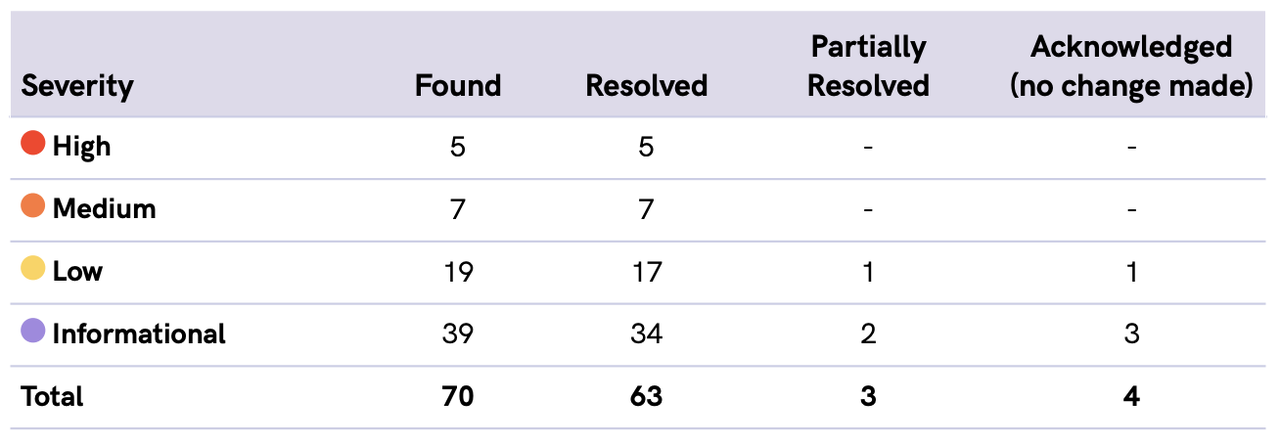 Source: Camelot Audit Reports by Paladin
Token Economy (52.47%)
Camelot has two assets: native token $GRAIL and governance token xGRAIL.
Native token $GRAIL
$GRAIL is Camelot’s native token with a maximum supply of 100,000. $GRAIL has no significant utility in the Camelot ecosystem, and there would be no return from holding $GRAIL alone.
According to the token distribution plan disclosed by Camelot, 15% of the total $GRAIL supply will be distributed for public sale. Of the remaining portion, 22.5% will be allocated to the Liquidity Mining Plan over the next 3 years, 15% to provide liquidity and 32% to key contributors, partners and advisors. The portion of $GRAIL allocated to team/partners/consultants will be fully unlocked over 3 years. The detailed distribution and vesting schedule is set out below.
 $GRAIL distribution plan, source: Camelot detail page on TokenInsight
xGRAIL governance token
xGRAIL is Camelot’s governance token, which can be obtained by converting $GRAIL. The conversion ratio is 1:1. xGRAIL is non-transferrable. The xGRAIL holders can get benefits like dividends, exclusive access or discount on Launchpad events etc. Meanwhile, the number of xGRAILs held by users represents voting rights and can be used to vote on governance proposals.
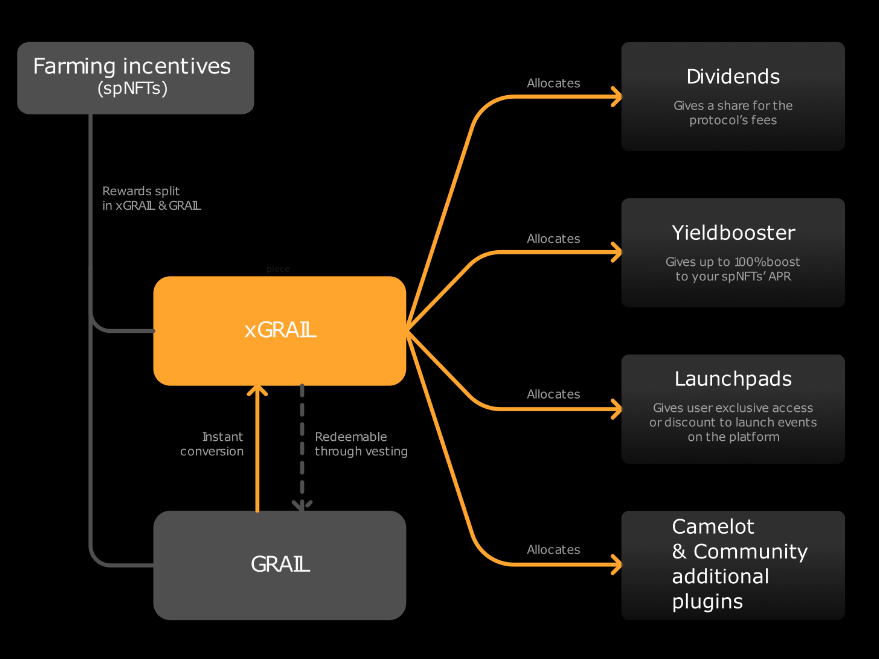 Camelot Token Economic Model, Source: Camelot Doc
$GRAIL can be converted to xGRAIL at any time, but it will take time to repay. When redeeming, holders can choose between a blocking period of 15 days or 6 months. The $GRAIL will roll over daily until it’s fully rolled out. Holders who choose the 6-month vesting period receive 100% of the $GRAIL, while those who choose the 15-day option only receive 50%. The remaining 50% is burned by Camelot.
Token Performance (51.4%)
On December 7th, 2022, $GRAIL officially launched on Camelot with initial liquidity of nearly $4 million. As of February 16, 2023, $GRAIL is also live on multiple exchanges, including MEXC Global, BingX, Uniswap (Arbitrum One), and Bitget, in addition to Camelot DEX. According to TokenInsight, Camelot DEX is currently the top exchange in terms of $GRAIL trading volume, accounting for 80% of the total volume.
Due to the positive impact of recent developments in the Arbitrum ecosystem, $GRAIL has seen its volume and price increase rapidly in a month since its launch. The price of $GRAIL has increased to around $3,400 from an initial $200, almost 15 times higher than 30 days ago. According to the latest data, the price of $GRAIL fell back to around $3,000 on Feb. 16, around 12% below the ATH price.
In terms of trading volume, $GRAIL’s 24-hour spot volume peaked at around $15.6 million on Feb. 15. Compared to 30 days ago, it has increased almost 300 times.
 Source: Camelot detail page on TokenInsight
Ecosystem development (49.95%)
Camelot’s TVL has also exploded due to the rapid growth of the Arbitrum ecosystem. According to DeFiLlama, Camelot’s TVL has been growing rapidly since late January, going from $18M to an ATH of $63M in less than 30 days (2023-02-16). For a new project that has been live for less than 3 months, Camelot did relatively well. It currently ranks 31st among all DEXs.
In terms of trading data, Camelot’s daily trading volume increased from around $100,000 in early 2023 to a peak of $22 million, a nearly 200x increase. Liquidity has also increased from $17 million to nearly $65 million, a nearly four-fold increase.
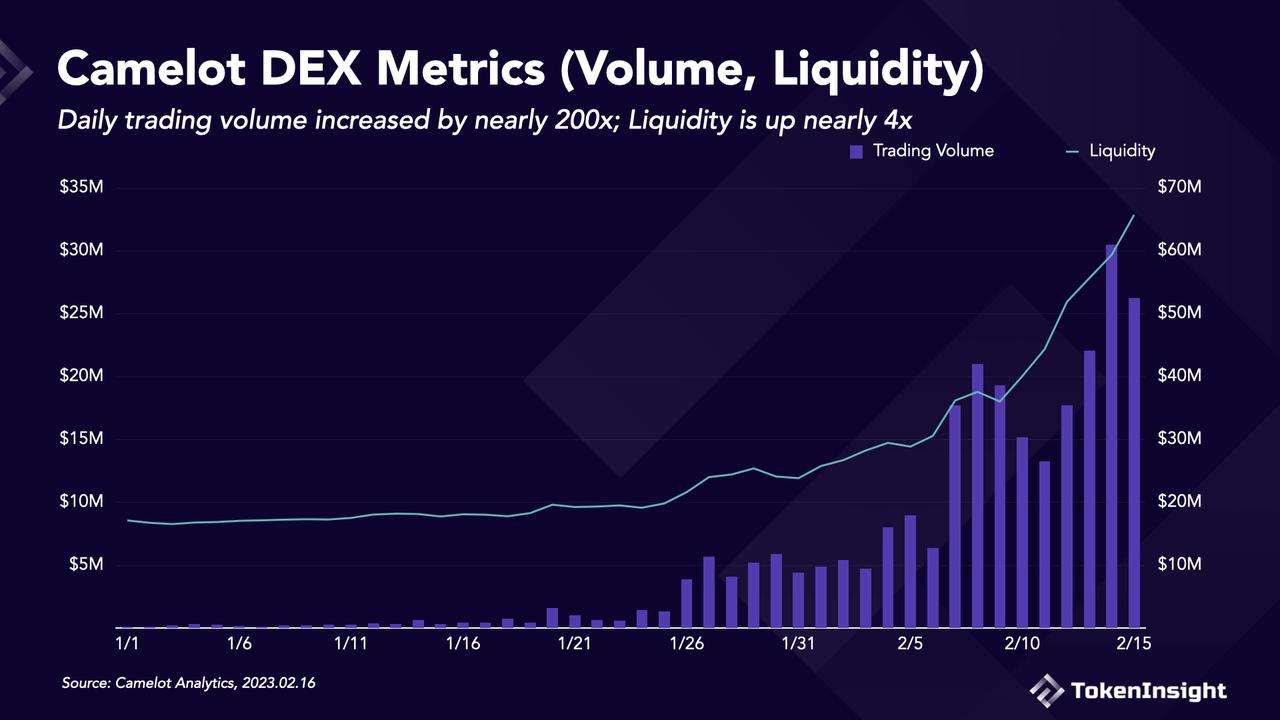 Source: Camelot Analytics
The upcoming projects
Nitro Cartel (Feb 17)
Nitro Cartel launches public sale of its $TROVE governance token on Camelot’s launchpad on February 17, 2023. Nitro Cartel is a high-yield index and strategy vault protocol natively based on the Arbitrum network and designed to generate returns for generate users. Its first index, ALP, is a basket of select blue-chip tokens such as $GMX, $MAGIC, and $GRAIL.
The public sale will comprise 20% of $TROVE’s total supply, with a starting price of $0.0025 per $TROVE and a fully diluted valuation of $12.5 million. The sale will be conducted according to a fair launch price discovery model.
Factor DAO (February 20)
Factor DAO launches public sale of its native token $FCTR on Camelot’s Launchpad on February 20th, 2023. Factor DAO is an on-chain asset management platform that helps users to aggregate multiple DeFi assets and generate revenue through a variety of instruments and strategies. $FCTR holders can earn $veFCTR through $FCTR staking while receiving 50% of the platform’s earnings.
The public sale will comprise 10% of the total $FCTR supply of FCTR and will be conducted using a fair-to-market pricing model with a starting price of $0.1 per $FCTR.
PerpyFinance (March 16)
PerpyFinance will launch the public sale of its native token $PRY on Camelot’s launchpad on March 16, 2023. Perpy is a GMX-based protocol for persistent wealth management with social properties in the Arbitrum ecosystem. Users can create their own portfolios directly on Perpy or copy other traders’ portfolios via smart contracts to generate income. As a reward, the copied trader receives a performance fee. In addition, Perpy offers built-in social features for portfolio sharing or discussions. Detailed information about the public sale has not yet been announced.
Final Thoughts
As the core DEX of the Arbitrum ecosystem, Camelot’s function is not limited to providing swap-related DeFi products. Camelot’s Launchpad can help “incubate” different types of new projects within the Arbitrum ecosystem and provides them with liquidity via its internal infrastructures. So technically, the overall development of the Arbitrum ecosystem is closely tied to Camelot. The liquidity generated by the tokens of these new projects will be pooled to increase Camelot’s overall liquidity and accelerate the growth of its TVL and trading volume to meet the overall growth of the Arbitrum network.
Overall, as a DEX, Camelot has relatively little innovation in its DeFi-related product. But its special role within the Arbitrum network has allowed Camelot to grow rapidly and become one of the hottest projects of recent times. In addition, Camelot’s token economy is relatively well designed. Through the involvement of xGRAIL, Camelot incentivizes users to hold $GRAIL for the long-term and has set up a number of token deflation mechanisms to incentivize the growth of $GRAIL’s long-term value.
Based on the above information, TokenInsight has assigned Camelot a B rating with a positive outlook.
Learn Crypto Trading, Yield Farms, Income strategies and more at CrytoAnswers
https://nov.link/cryptoanswers
Comments are closed.