


The central theses:
-
An automated market maker is a model that provides liquidity in decentralized finance.
-
It facilitates automated cryptocurrency trading through liquidity pools instead of traditional order books.
-
The model incentivizes crypto users to become liquidity providers in exchange for a share of transaction fees.
-
Kyber Network, Uniswap, Balancer, Curve and Bancor are the common AMM protocols.
Decentralized Finance (DeFi) has emerged as one of the most innovative landscapes on the Web3. The advent of decentralized exchanges (DEXs) democratized the mainstream adoption of crypto and contributed to new and revolutionary methods of accessing financial products and services, with automated market makers (AMM) among the numerous possibilities that were initially impossible.
Traditionally, the intermediary has the sovereign power to offer or refuse financial products and services to you, and also acts as the custodian of funds deposited with them. Recently, due to the mismanagement of user funds, there has been a demand for these exchanges to share their proof of reserve.
This leads to DeFi’s greatest appeal: there is no such centralized institution. Instead, the decentralized setup works through peer-to-peer interaction, allowing you to access various financial products and services without an intermediary or custodian, e.g. B. Borrowing, lending, staking, etc.
This article takes an in-depth look at automated market makers, how they work, liquidity pools and liquidity providers, types of automated market makers, and the risk of volatile loss.
What are automated market makers?
Suppose you are a farmer and you want to sell your products. Who are you selling to? A buyer, of course. Now let’s say you are a consumer who wants to buy some vegetables for use. Who are you buying from? A seller who may or may not be a farmer. In this case, let’s imagine a traditional method of buying and selling the agricultural products.
Delivering the vegetables directly to consumers would require complex planning and logistics. Finally, packaging, transporting, storing, shipping and receiving payments from individual consumers requires more labor and time. In addition, these steps can represent an additional financial burden for the farmer. So how do farmers sell their produce without including all the steps above? The answer is mediator. These middlemen buy the products from farmers in bulk, perform the intermediate processes, factor in their profit, and sell them to end users like you and me.
The main goal of an AMM in crypto is to provide much-needed liquidity. Think of a farmer who has harvested a bumper crop but has no one to sell to, or a consumer who wants to buy farm produce but has no direct access to farms! Market makers ensure the smooth buying and selling of cryptocurrencies in DeFi.
An AMM is a crypto trading methodology that operates autonomously to encourage cryptocurrency users to become Liquidity Providers (LPs) in exchange for a portion of transaction fees and/or distribution of the protocol’s native token. The makers eliminate the need for intermediaries and traditional market-making mechanisms such as order-matching systems and other depository methods.
How it works: A cryptocurrency AMM provides liquidity autonomously through smart contracts. LPs provide liquidity by locking assets into these self-managed contracts, while DEX buyers and sellers trade against this liquidity and pay transaction fees. DEXs then share the accumulated transaction fees with the LPs based on the LPs’ token shares in the pools.
How do AMMs work?
The main role of an AMM is to facilitate the smooth trading of crypto in DeFi without the use of order books. Furthermore, although AMMs have trading pairs, there are no counterparties with matching offers. Instead, they use smart contracts to regulate liquidity pools and ensure smooth trading.
Basically, a liquidity pool consists of two cryptocurrencies in the form of a trading pair, for example BNB and BUSD. AMMs use algorithms to control the value of the assets in the pools and adjust to the market prices of the assets. The standard formula used by most DEXs is:
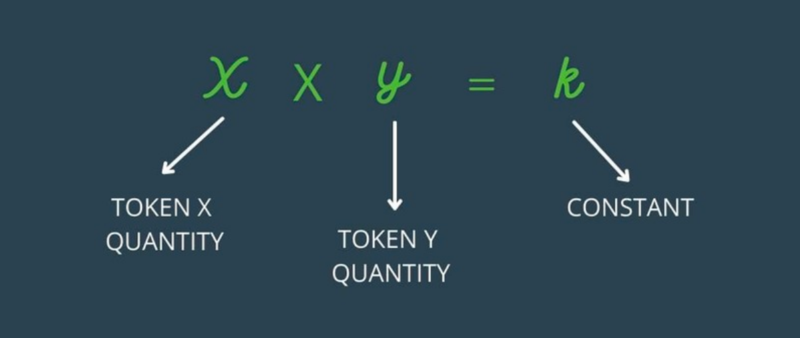
X is the amount of asset A, Y is the amount of asset B, and k is the fixed constant. The formula basically ensures that the total liquidity in a pool stays the same and lets smart contracts regulate the price ratio of the pair. For example, if a trader buys BNB (Pay with BUSD) from a BNB-BUSD liquidity pool, the BNB amount in the pool will decrease while the BUSD amount will increase. The pool’s algorithm adjusts the pair’s price ratio according to the market valuation while maintaining the formula x*y = k. Some DeFi protocols like Curve use more complicated formulas, but the concept remains the same.
liquidity
As mentioned earlier, the main role of AMMs is to provide liquidity in DeFi. So how does an AMM obtain liquidity? The standard method incentivizes crypto investors to deposit assets in a liquidity pool in return for a portion of the transaction fees generated. Any crypto investor from any part of the world can lock them into a specific pool and start generating passive returns.
Recently, DeFi protocols like Olympus have emerged, striving to establish “protocol-based liquidity solutions.” They are part of the emerging trend known as DeFi 2.0. In fact, creating high levels of liquidity is crucial for the mainstream adoption of DeFi as it mitigates price falls caused by large trades.
slip
Slippage is a sudden change in a token’s price caused by a large trade.
Slippage doesn’t just affect AMM logs – it can also affect order book exchanges. However, AMMs are more prone to slippage because their price adjustment algorithms rely on the ratio between the tokens in a pool. Therefore, higher liquidity implies smaller price fluctuations. You can also mitigate slippage through the protocol itself. For example, Curve Finance focuses on similar assets; like pools with stablecoins like USDT and USDC or just wrapped bitcoin tokens. This reduces the risk of a temporary loss as the assets in the pool are all trending at the same price, and the lower volatility also results in a lower fee and lower risk of slipping due to the low price volatility of the tokens in the pool.
Ephemeral Loss
Another problem that plagues the AMM mechanism is the risk of inconsistent loss adversely affecting LPs. A temporary loss occurs when a change in the price of an asset causes your assets in a liquidity pool to be worth less than the value originally deposited. It is fickle as you can recoup the loss if the token pair regains the original market price. The CoinGecko Impermanent Loss Calculator makes it easy for LPs to calculate temporary losses when offering liquidity.
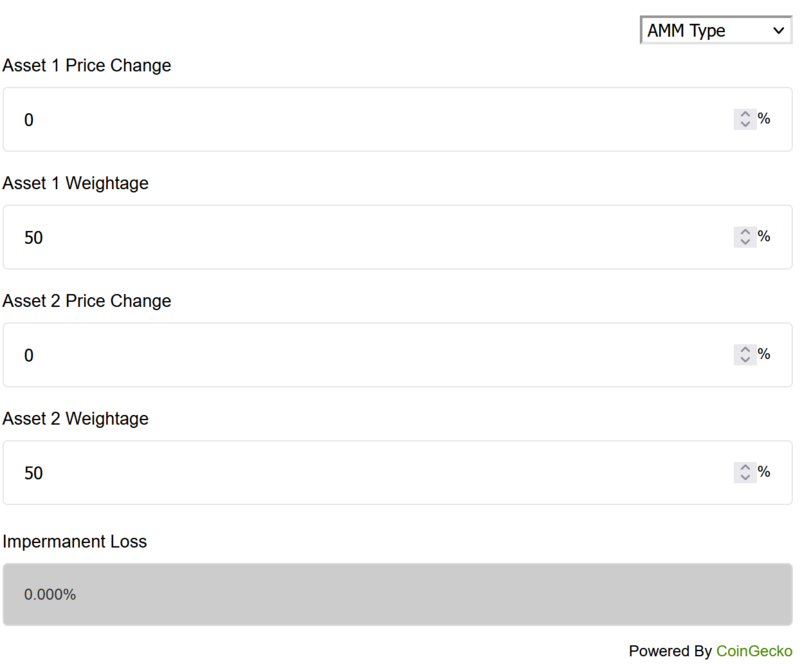
Locking assets in a pool is mainly encouraged by the possibility of yield farming through the transaction fees accumulated by the pool. However, sometimes providing liquidity is less profitable due to the temporary loss. Also, the AMM algorithm only balances the values of token pairs. This means that the same assets can have different market prices; Therefore, withdrawing them from the pool could bring you losses. However, if you refuse to cash out your money – with the intention of waiting for it to regain its original price – you can hamper your ability to explore other lucrative opportunities.
Examples of AMMs
There are two main types of AMMs in crypto. First, there are AMMs that are created and controlled by professional market makers. Second, some AMMs are fully automated through algorithms, allowing any crypto holder to participate by tying assets into smart contracts. With this in mind, we will discuss the five popular AMM protocols.
cyber network
Kyber Network was one of the first AMMs to use automated liquidity pools in 2018. The Kyber team or specialized market makers deploy Kyber’s liquidity pools. Unlike other manufacturers such as Uniswap, the Kyber pools only have limited access. External oracles or smart contract features regulate the prices of the assets in the pools during setup.
Uniswap
Uniswap was the first DEX to introduce decentralized AMMs in 2019. It allows anyone to run a liquidity pool on the protocol and allows any crypto investor to contribute liquidity. Unlike Kyber Network, token prices in Uniswap liquidity pools are not configured or controlled. Instead, token prices are based on the balance ratio between assets.
equalizer
Balancer is a newer protocol with unique features, unlike the two protocols above. It works in a similar way to Uniswap but offers more dynamic features that allow it to have more applications besides functioning as a simple liquidity pool. For example, it supports custom pool ratios, multi-asset pools, and dynamic pool fees. Multi-asset pools act as an index in crypto and act as a distinctive feature of Balancer.
Curve
Curve is among the newest AMM protocols in the DeFi space. Launched in 2020, it features admin-based liquidity pools only. Anyone can contribute to the pools and they only support stablecoins. The protocol views its decision to only support stablecoins as a feature, not an obstacle. Supporting stablecoin-only or wrapped coin pools (e.g. WETH/ETH or WBTC/SBTC) allows Curve to process large trade requests effectively and with minimal slippage.
banking
You can offer liquidity to a bancor pool with a token and maintain 100% exposure to the asset. This is unlike other AMM protocols that require you to be exposed to many tokens. With single token-based liquidity, you can stay long on an asset and qualify for “HODL” returns while earning transaction fees. The fees are automatically compounded in the pools and paid in the deployed assets.
Diploma
As DeFi goes mainstream, you can expect more innovations to further democratize financial products and services. web3’s core goal is to empower people to be their own bank. AMMs will continue to play their role in creating utilities that provide permissionless access to finance without borders. In fact, the future of decentralized finance is pretty exciting!
Tell us how much you like this article!

Josiah Makori
Josiah is a tech evangelist passionate about helping the world understand Blockchain, Crypto, NFT, DeFi, Tokenization, Fintech and Web3 concepts. His hobbies are listening to music and playing football. Follow the author on Twitter @TechWriting001
Read more from Josiah Makori
Learn Crypto Trading, Yield Farms, Income strategies and more at CrytoAnswers
https://nov.link/cryptoanswers
Comments are closed.